Seiberg-Witten Theory and Extended Toda Hierarchy
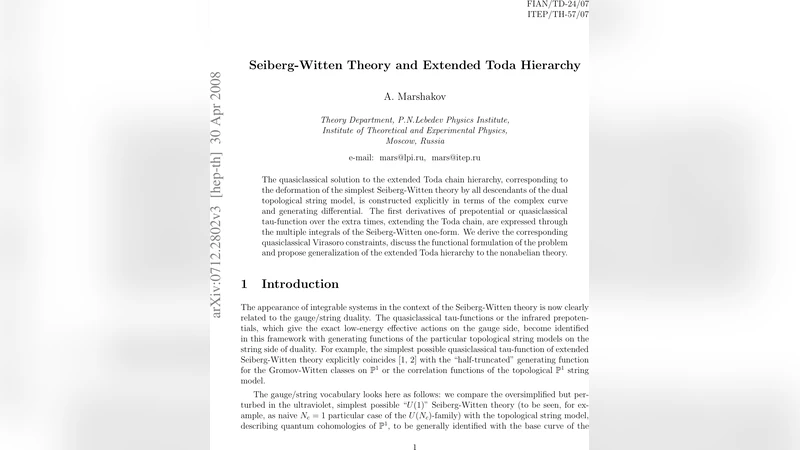
The quasiclassical solution to the extended Toda chain hierarchy, corresponding to the deformation of the simplest Seiberg-Witten theory by all descendants of the dual topological string model, is constructed explicitly in terms of the complex curve and generating differential. The first derivatives of prepotential or quasiclassical tau-function over the extra times, extending the Toda chain, are expressed through the multiple integrals of the Seiberg-Witten one-form. We derive the corresponding quasiclassical Virasoro constraints, discuss the functional formulation of the problem and propose generalization of the extended Toda hierarchy to the nonabelian theory.
💡 Research Summary
The paper tackles the problem of extending the Toda chain hierarchy so that it incorporates all descendants of the dual topological string model, and it does so in the context of the simplest Seiberg‑Witten (SW) theory (the SU(2) N=2 gauge theory). The authors begin by recalling that the ordinary Toda chain involves only two “times” – the spatial variable x (often denoted t₁) and the logarithm of the dynamical scale Λ (t₀). While this limited set reproduces the standard SW curve and prepotential, it cannot accommodate the infinite tower of descendant deformations that naturally appear in the topological‑string description.
To remedy this, an infinite family of extra times tₙ (n ≥ 2) is introduced. Each tₙ corresponds to a descendant operator in the dual topological string theory and can be thought of as a higher‑order flow in the integrable hierarchy. The authors keep the underlying hyperelliptic SW curve,
y² = (z − u)² − Λ⁴,
but promote the generating differential λ (normally λ = z d log w) to a tₙ‑dependent object λ(tₙ). The dependence is polynomial: λ expands as a series whose coefficients are linear in the new times.
The central technical achievement is an explicit expression for the first derivatives of the quasiclassical τ‑function (the prepotential ℱ) with respect to the extra times. They show that
∂ℱ/∂tₙ = (1/n) ∮ₐ λ · λ^{,n‑1}
or equivalently a similar integral over the b‑cycle. In other words, each derivative is a multiple integral of the SW one‑form λ raised to the appropriate power. This formula generalises the usual period integrals (which correspond to n = 1) and demonstrates that the full hierarchy is encoded in the geometry of the same curve, but with a richer set of cycles that involve higher powers of λ.
From these integral representations the authors derive a set of quasiclassical Virasoro constraints. Defining operators Lₖ (k ≥ −1) as specific linear combinations of the tₙ‑derivatives, they prove that
Lₖ ℱ = 0 for all k ≥ −1.
The constraints have the familiar interpretation: L₋₁ generates overall shifts of the times, L₀ implements scaling, and L₁, L₂, … encode higher‑order reparametrisations. Crucially, the Virasoro algebra emerges directly from the geometry of the SW curve and the structure of the extended generating differential, rather than being imposed by hand.
The paper also presents a functional formulation. The prepotential is obtained as the stationary point of an action functional
S
Comments & Academic Discussion
Loading comments...
Leave a Comment