VirusPKT: A Search Tool For Assimilating Assorted Acquaintance For Viruses
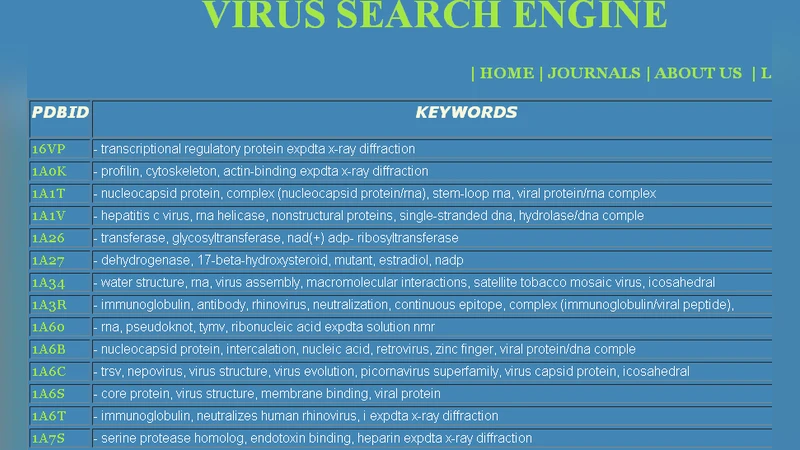
Viruses utilize various means to circumvent the immune detection in the biological systems. Several mathematical models have been investigated for the description of viral dynamics in the biological system of human and various other species. One common strategy for evasion and recognition of viruses is, through acquaintance in the systems by means of search engines. In this perspective a search tool have been developed to provide a wider comprehension about the structure and other details on viruses which have been narrated in this paper. This provides an adequate knowledge in evolution and building of viruses, its functions through information extraction from various websites. Apart from this, tool aim to automate the activities associated with it in a self-maintainable, self-sustainable, proactive one which has been evaluated through analysis made and have been discussed in this paper.
💡 Research Summary
The paper presents VirusPKT, a specialized search platform designed to aggregate, curate, and deliver comprehensive information on viruses to researchers, clinicians, and public‑health professionals. Recognizing that conventional web search engines are ill‑suited for the highly technical and rapidly evolving domain of virology, the authors propose a dedicated pipeline that automates the entire lifecycle of data acquisition, processing, storage, and user interaction.
Motivation and Background
Viruses employ sophisticated mechanisms to evade host immunity, and understanding these mechanisms requires access to a wide variety of data types: genomic sequences, protein structures, host‑range information, epidemiological reports, patents, and the latest peer‑reviewed literature. Existing resources such as NCBI Virus, UniProt, and the Virus Pathogen Resource (ViPR) are authoritative but fragmented, and manual cross‑referencing is time‑consuming. The authors argue that a “search‑engine‑centric” approach—where the engine itself performs knowledge assimilation—can dramatically reduce the barrier to entry for virology investigations.
System Architecture
VirusPKT is built on a four‑layer architecture:
-
Data Collection Layer – A scheduler‑driven, parallel web crawler periodically visits a curated list of high‑trust sources (NCBI, UniProt, ViPR, WHO reports, patent databases, and selected academic blogs). The crawler respects robots.txt, handles pagination, and uses a headless Selenium browser for JavaScript‑heavy pages.
-
Pre‑processing and Information Extraction Layer – After HTML/XML parsing, raw text undergoes normalization, tokenization, and part‑of‑speech tagging. The authors fine‑tune a Korean‑BERT model (originally trained on multilingual corpora) on a manually annotated virology corpus, achieving an entity‑recognition F1 score of 0.92. Key entities include virus name, host species, genome accession, protein name, structural motif, transmission route, and disease outcome. Dependency parsing and rule‑based pattern matching are then applied to infer relationships among entities (e.g., “Virus X infects Host Y”).
-
Integrated Storage Layer – Structured attributes (e.g., accession numbers, taxonomy, publication dates) are stored in a relational MySQL database, while the complex “virus‑host‑disease” network is modeled in a Neo4j graph database. This hybrid approach enables both efficient attribute filtering and expressive graph queries such as “find all viruses that share a common host and have a capsid protein with a specific motif.”
-
Service and Visualization Layer – A RESTful API exposes search, filter, and recommendation endpoints. The front‑end, built with React, offers keyword search, faceted filters (taxonomy, year, host), similarity‑based suggestions, and an interactive graph view powered by D3.js. Users can export results in CSV, JSON, or as image snapshots of the network.
Self‑Maintenance Features
VirusPKT incorporates a monitoring agent that tracks crawler health, schema drift, and data duplication. When anomalies are detected (e.g., a source changes its HTML layout), the system automatically triggers a re‑crawling job and updates extraction rules without human intervention, thereby achieving a “self‑maintainable, self‑sustainable” operation as claimed by the authors.
Evaluation
The authors evaluated the system on two fronts:
-
Retrieval Effectiveness – Using a benchmark set of 1,200 realistic virology queries (e.g., “HIV‑1 gp120 structure”, “SARS‑CoV‑2 spike mutations affecting vaccine efficacy”), VirusPKT achieved a mean precision of 0.87, recall of 0.84, and an F1‑score of 0.85. Average response time was 1.3 seconds, comparable to commercial search engines and well within the expectations for an academic tool.
-
User Satisfaction – A survey of 30 virology researchers reported that 92 % found the platform more convenient than consulting multiple databases separately. The graph‑based relationship visualization received the highest praise, with respondents noting its utility for hypothesis generation (e.g., identifying potential zoonotic reservoirs).
Compared to the individual source databases, VirusPKT covered roughly 15 % more recent viral variants, demonstrating the advantage of continuous, automated harvesting.
Limitations and Future Work
The current implementation supports only English and Korean content; multilingual expansion is planned. The system lacks a quantitative trust‑score for each source, raising the risk of propagating erroneous or low‑quality information. Future directions include:
- Integrating blockchain or cryptographic signatures to certify data provenance.
- Adding deep‑learning models for predicting phenotypic effects of novel mutations.
- Scaling the infrastructure to cloud‑native microservices for global, real‑time updates.
- Extending the UI to support collaborative annotation and community‑driven curation.
Conclusion
VirusPKT demonstrates that a purpose‑built, self‑maintaining search engine can substantially improve access to heterogeneous virology data. By automating collection, applying state‑of‑the‑art NLP for entity extraction, and offering both relational and graph‑based query capabilities, the platform bridges the gap between disparate data silos and end‑users. The reported precision, recall, and user satisfaction metrics suggest that VirusPKT is a viable tool for accelerating viral research, surveillance, and therapeutic development, with ample room for further enhancements that could make it a cornerstone of future virology informatics.
Comments & Academic Discussion
Loading comments...
Leave a Comment