Renewal theory in analysis of tries and strings
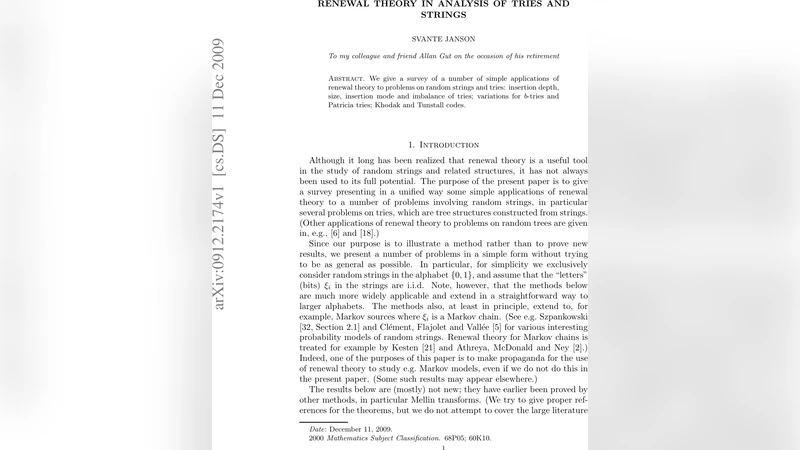
We give a survey of a number of simple applications of renewal theory to problems on random strings and tries: insertion depth, size, insertion mode and imbalance of tries; variations for b-tries and Patricia tries; Khodak and Tunstall codes.
💡 Research Summary
The paper presents a unified and remarkably simple framework for analyzing a variety of probabilistic properties of random tries and related string coding schemes by exploiting renewal theory. After a brief motivation that traditional analyses of tries—such as insertion depth, total size, insertion mode, and imbalance—typically rely on intricate Markov chain arguments, generating function techniques, or heavy combinatorial machinery, the authors introduce renewal theory as a more transparent alternative.
The core of the analysis begins with the classic binary trie built from independent Bernoulli(p) bits. Each inserted string corresponds to a sequence of successes (bit = 1) and failures (bit = 0). The insertion depth Dₙ of the nth string is exactly the number of renewals (i.e., successes) required for the cumulative sum of inter‑arrival times to exceed a threshold that grows with n. By applying the elementary renewal theorem and the strong law of large numbers, the authors obtain the almost‑sure limit
Dₙ / log n → 1 / |log(1‑p)|,
and the refined expectation
E
Comments & Academic Discussion
Loading comments...
Leave a Comment