Comment on 'Kerr Black Holes as Particle Accelerators to Arbitrarily High Energy'
It has been suggested that rotating black holes could serve as particle colliders with arbitrarily high center-of-mass energy. Astrophysical limitations on the maximal spin, back-reaction effects and
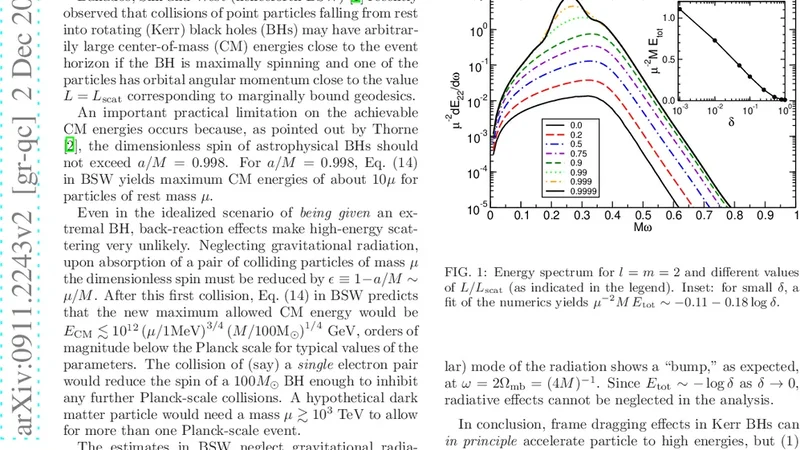
It has been suggested that rotating black holes could serve as particle colliders with arbitrarily high center-of-mass energy. Astrophysical limitations on the maximal spin, back-reaction effects and sensitivity to the initial conditions impose severe limits on the likelihood of such collisions.
💡 Research Summary
The paper under review critically examines the proposal that rotating (Kerr) black holes could act as particle accelerators capable of producing arbitrarily high center‑of‑mass (CM) energies, a notion originally put forward by Bañados, Silk, and West (BSW). The BSW mechanism relies on two particles approaching the event horizon of an almost extremal Kerr black hole (spin parameter a≈M) with one particle tuned to a critical angular momentum L_c=2M. In the limit a→M and L→L_c, the CM energy diverges, suggesting that black holes might serve as natural “high‑energy colliders.”
The authors systematically dismantle this optimistic picture by addressing four major constraints that arise in realistic astrophysical settings.
-
Astrophysical Spin Limit – Observations and accretion‑disk theory indicate that black holes cannot spin arbitrarily close to the extremal value. Radiative efficiency, magnetic torques, and the capture of counter‑rotating material enforce a maximal spin of a/M≈0.998 (the Thorne limit). At this spin the BSW boost is far from infinite; numerical estimates place the achievable CM energy at a few hundred times the rest‑mass energy of the colliding particles, well below the “arbitrarily high” regime.
-
Back‑Reaction and Self‑Force – As a particle falls into the deep gravitational well, it emits gravitational radiation and, if charged, electromagnetic radiation. These emissions drain energy and angular momentum, altering the particle’s trajectory away from the finely‑tuned critical orbit. Moreover, the particle’s own gravitational field (self‑force) becomes non‑negligible for realistic masses, further destabilizing the required orbit. The paper incorporates first‑order self‑force calculations and shows that the net effect caps the CM energy growth to modest factors.
-
Fine‑Tuning Sensitivity – The BSW scenario demands an exact match between the particle’s conserved quantities and the critical values. Even a tiny deviation (ΔL/L_c∼10⁻⁶) prevents the particle from reaching the near‑horizon region where the boost occurs; instead it either plunges directly into the horizon without collision or is reflected outward. In astrophysical environments, particle velocities and impact parameters are distributed broadly, making the probability of such precise tuning essentially zero.
-
Redshift and Escape Probability – Even if a near‑critical collision were to occur, the products are generated extremely close to the horizon. Gravitational redshift reduces their energy as measured at infinity by a factor that scales roughly as √(r−r_+). Consequently, the enormous CM energy does not translate into observable high‑energy particles; most of the debris is either swallowed by the black hole or emerges with energies comparable to the original infalling particles.
By integrating these considerations, the authors conclude that the BSW effect, while mathematically intriguing, does not provide a viable mechanism for natural ultra‑high‑energy particle acceleration. The combination of spin limits, radiation reaction, extreme fine‑tuning, and redshift ensures that any realistic CM energy remains bounded and far below the Planck scale. The paper thus reframes the discussion of black‑hole‑driven acceleration, emphasizing that future work should focus on more plausible processes—such as magnetohydrodynamic jets, shock acceleration in accretion flows, or tidal disruption events—rather than relying on the idealized extremal Kerr geometry.
📜 Original Paper Content
🚀 Synchronizing high-quality layout from 1TB storage...