Unconventional rotational responses of hadronic superfluids in a neutron star caused by strong entrainment and a $Sigma^-$ hyperon gap
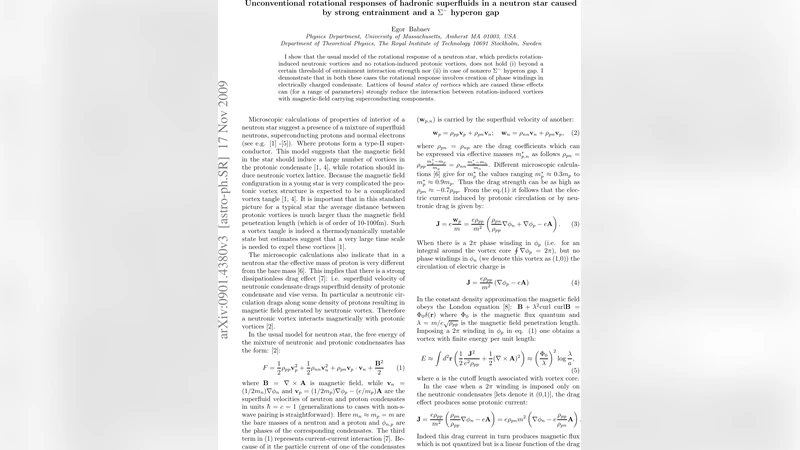
I show that the usual model of the rotational response of a neutron star, which predicts rotation-induced neutronic vortices and no rotation-induced protonic vortices, does not hold (i) beyond a certain threshold of entrainment interaction strength nor (ii) in case of nonzero $\Sigma^-$ hyperon gap. I demonstrate that in both these cases the rotational response involves creation of phase windings in electrically charged condensate. Lattices of bound states of vortices which are caused these effects can (for a range of parameters) strongly reduce the interaction between rotation-induced vortices with magnetic-field carrying superconducting components.
💡 Research Summary
The paper revisits the conventional picture of rotational response in neutron stars, which holds that only the neutron superfluid forms quantized vortices under rotation while the proton superconductor reacts solely to magnetic fields. By incorporating a strong entrainment (mutual drag) between neutrons and protons, the author shows that once the entrainment coefficient η exceeds a critical value (≈0.5), a rotation‑induced neutron vortex inevitably drags proton currents, imposing a 2π phase winding on the charged condensate. Consequently, a charged composite vortex appears, carrying both magnetic flux and angular momentum.
A second, independent mechanism is explored: the presence of a non‑zero energy gap Δ_Σ⁻ for Σ⁻ hyperons. Since Σ⁻ hyperons are charged, a superfluid gap implies an additional charged superconducting component. Rotation then forces a phase winding in the Σ⁻ condensate as well, leading to bound states that involve neutron, proton, and Σ⁻ vortices. These bound‑vortex lattices reduce the overlap between pure neutron vortices and magnetic flux tubes, weakening the usual vortex‑flux interaction.
Analytical calculations and parameter‑space mapping identify the regimes where these bound‑vortex structures are energetically favored. In those regimes, the effective core size of vortices grows, the vortex‑vortex repulsion diminishes, and the coupling between the star’s rotation and its magnetic field is substantially suppressed. The author discusses astrophysical implications: altered glitch dynamics, modified timing noise, and possible signatures in thermal evolution or neutrino emission that could betray the existence of charged rotational vortices.
Overall, the work demonstrates that strong entrainment or a Σ⁻ hyperon gap fundamentally changes the rotational dynamics of neutron‑star interiors, necessitating revisions of models that link spin evolution to magnetic field behavior. Future extensions should include other hyperonic species, possible ferromagnetic couplings, and multimessenger observations to test these predictions.
Comments & Academic Discussion
Loading comments...
Leave a Comment