Adaptive Scheduling of Data Paths using Uppaal Tiga
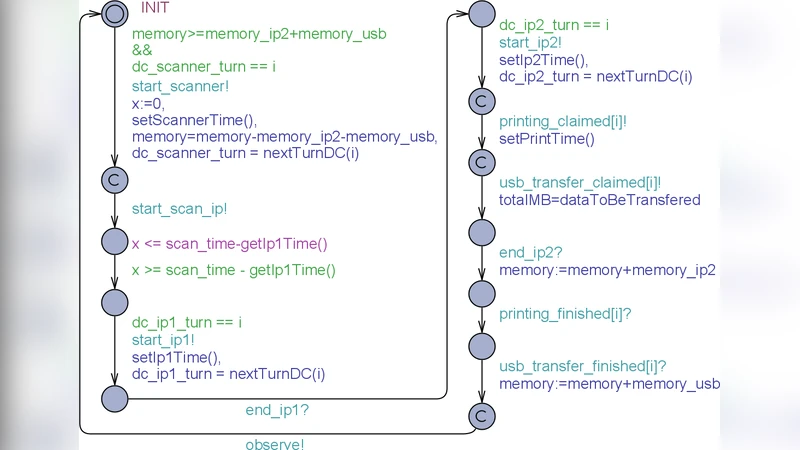
We apply Uppaal Tiga to automatically compute adaptive scheduling strategies for an industrial case study dealing with a state-of-the-art image processing pipeline of a printer. As far as we know, this is the first application of timed automata technology to an industrial scheduling problem with uncertainty in job arrivals.
💡 Research Summary
The paper presents a novel approach to handling uncertainty in job arrivals for a high‑throughput image‑processing pipeline of a modern printer by automatically synthesizing adaptive scheduling strategies with Uppaal Tiga, a tool for timed‑automata games. The authors first model the printer’s internal data path as a set of five processing stages—input buffering, colour conversion, compression, engine transfer, and output buffering—each represented by timed automata that capture processing times, resource constraints (bus bandwidth, memory), and synchronization requirements. Job arrivals are treated as nondeterministic events generated by an “environment” player, with only a minimum inter‑arrival time guaranteed, thereby reflecting real‑world variability in user‑initiated print jobs.
Using Uppaal Tiga, the system (controller) and environment (uncertain arrivals) are cast as a two‑player game. The tool automatically computes a winning strategy that guarantees, for every possible sequence of environment moves, that all jobs meet predefined response‑time deadlines. To keep the state space tractable, the authors apply symmetry reduction, abstract time‑intervals, and a hierarchical decomposition that separates job types (e.g., black‑and‑white, colour, high‑resolution) into independent sub‑models. The resulting strategy is expressed as a set of conditional rules based on the current automaton state and clock values (e.g., “if the bus is free and the clock is within interval
Comments & Academic Discussion
Loading comments...
Leave a Comment