Are astronomical papers with more authors cited more?
Following my previous study of paper length vs. number of citations in astronomy (Stanek 2008), some colleagues expressed an interest in knowing if any correlation exists between citations and the num
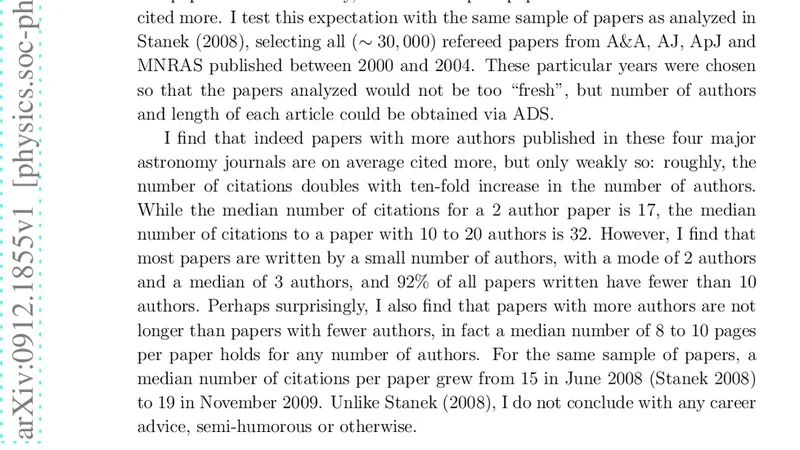
Following my previous study of paper length vs. number of citations in astronomy (Stanek 2008), some colleagues expressed an interest in knowing if any correlation exists between citations and the number of authors on an astronomical paper. At least naively, one would expect papers with more authors to be cited more. I test this expectation with the same sample of papers as analyzed in Stanek (2008), selecting all (~30,000) refereed papers from A&A, AJ, ApJ and MNRAS published between 2000 and 2004. (…) I find that indeed papers with more authors are on average cited more, but only weakly so: roughly, the number of citations doubles with ten-fold increase in the number of authors. While the median number of citations to a 2 author paper is 17, the median number of citations to a paper with 10 to 20 authors is 32. I find that most of the papers are written by a small number of authors, with a mode of 2 authors and a median of 3 authors. I also find that papers with more authors are not longer than papers with fewer authors, in fact a median number of 8 to 10 pages per paper holds for any number of authors. For the same sample of papers, a median number of citations per paper grew from 15 in June 2008 (Stanek 2008) to 19 in November 2009. Unlike Stanek (2008), I do not conclude with any career advice, semi-humorous or otherwise.
💡 Research Summary
The paper investigates whether astronomical articles with more authors receive more citations, extending the author’s earlier work on paper length versus citations (Stanek 2008). Using the NASA Astrophysics Data System, the author compiled a comprehensive dataset of all refereed papers published between 2000 and 2004 in four major journals—Astronomy & Astrophysics, The Astronomical Journal, The Astrophysical Journal, and Monthly Notices of the Royal Astronomical Society—totaling roughly 30,000 records. For each paper the number of authors, the page count, and the cumulative citation count were extracted at two time points: June 2008 (the original dataset for Stanek 2008) and November 2009, allowing a modest assessment of citation growth over a 17‑month interval.
The analysis proceeds by grouping papers according to author count and computing both median and mean citation values for each group. A log‑log transformation of citations versus author number reveals an approximately linear trend, indicating that citations increase with author count but with a shallow slope: a ten‑fold increase in the number of authors corresponds to roughly a two‑fold increase in citations. Concretely, the median citation count for two‑author papers is 17, whereas papers with ten to twenty authors have a median of 32 citations. The distribution of author numbers is heavily skewed toward small teams; the mode is two authors and the overall median is three authors, confirming that most astronomical research is conducted by relatively few collaborators.
Page length was examined to test whether larger author teams produce longer manuscripts. The data show no systematic dependence: regardless of author count, the median paper length stays between eight and ten pages. This suggests that the modest citation advantage of larger teams is not driven by more extensive exposition or additional results.
Citation growth between the two measurement dates was also quantified. The median citation count for the entire sample rose from 15 in June 2008 to 19 in November 2009, reflecting the natural accumulation of citations over time and indicating that the dataset is still evolving.
The author discusses several implications. First, while a statistical correlation exists, its magnitude is small, implying that simply adding co‑authors does not guarantee a substantial citation boost. The modest effect could stem from network effects (broader dissemination among co‑authors) or from self‑citation, but the dominant determinants of citation impact—scientific novelty, relevance, and journal prestige—remain unchanged. Second, the lack of a page‑length correlation suggests that larger collaborations are not necessarily producing more comprehensive papers; instead, they may be dividing labor without expanding the manuscript’s scope.
Limitations are acknowledged. The analysis does not differentiate between review articles, data releases, or original research, each of which has distinct citation behaviours. Author order and individual contribution are ignored, so the metric treats a 30‑author paper the same as a 30‑author paper where many contributors played peripheral roles. The study is confined to four journals and a five‑year publication window, which may not capture trends in other sub‑fields or in more recent, large‑scale surveys (e.g., LSST, Euclid). Moreover, citation counts are taken from a single database and may be subject to coverage biases.
In conclusion, the study finds that astronomical papers with more authors are, on average, cited more often, but the effect is weak: citations roughly double when the author count increases by an order of magnitude. The result cautions against assuming that larger author teams automatically translate into higher scientific impact, and it underscores the importance of research quality, relevance, and visibility over mere collaboration size. Future work could refine the analysis by incorporating field‑specific citation norms, weighting authors by contribution, and extending the dataset to newer publications and additional journals.
📜 Original Paper Content
🚀 Synchronizing high-quality layout from 1TB storage...