Modeling torque versus speed, shot noise, and rotational diffusion of the bacterial flagellar motor
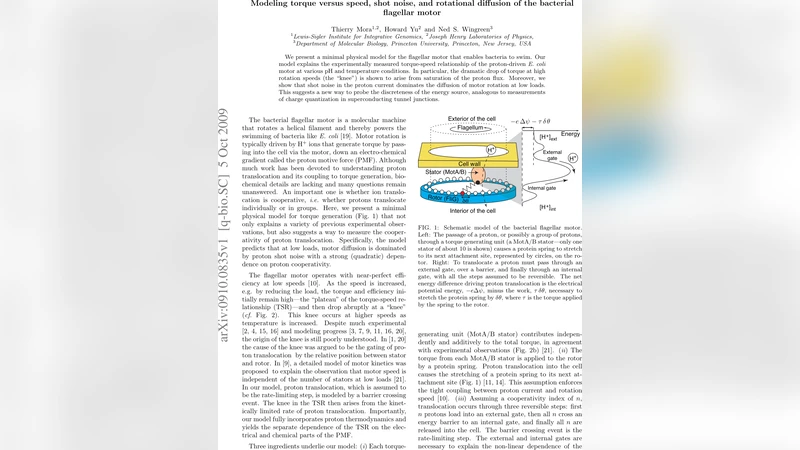
We present a minimal physical model for the flagellar motor that enables bacteria to swim. Our model explains the experimentally measured torque-speed relationship of the proton-driven E. coli motor at various pH and temperature conditions. In particular, the dramatic drop of torque at high rotation speeds (the “knee”) is shown to arise from saturation of the proton flux. Moreover, we show that shot noise in the proton current dominates the diffusion of motor rotation at low loads. This suggests a new way to probe the discreteness of the energy source, analogous to measurements of charge quantization in superconducting tunnel junctions.
💡 Research Summary
This paper introduces a minimal physical model that captures the essential dynamics of the proton‑driven bacterial flagellar motor. The motor is represented as a proton‑conducting stator that supplies an electrochemical potential Δμ_H⁺, and a rotor composed of N identical torque‑generating units. Proton flux I_p is assumed to follow a Michaelis‑Menten‑type saturation law I_p = I_max·V/(K_m+V), where V is the rotation speed, I_max the maximal flux, and K_m a characteristic speed constant. The torque τ produced by the motor is given by τ = (I_p·ΔG)/N, with ΔG the free‑energy per proton transferred. By fitting this relationship to experimental torque‑speed curves measured for Escherichia coli under various pH (6.5–8.0) and temperature (20–40 °C) conditions, the model reproduces the characteristic “knee” where torque drops sharply at high speeds. The knee emerges naturally when V approaches K_m, causing the proton flux to saturate and limiting further torque generation.
Beyond the steady‑state torque‑speed relationship, the authors analyze rotational diffusion by separating two noise sources: thermal (Brownian) fluctuations and shot noise arising from the discrete nature of proton transfer. In the high‑load regime, thermal noise dominates the diffusion coefficient D_θ, while in the low‑load regime the contribution from shot noise becomes dominant. The diffusion coefficient is derived as D_θ = (k_B T/γ) + (ΔG)^2·S_I/(γ^2 N^2), where γ is the rotational drag and S_I the spectral density of the proton current. This predicts that at low loads the variance of the rotor angle is directly proportional to the proton current’s shot noise, offering a novel method to probe the quantization of the energy source—analogous to charge‑quantization measurements in superconducting tunnel junctions.
Parameter values (Δμ_H⁺, I_max, K_m, N) are linked to measurable quantities: Δμ_H⁺ follows the Nernst equation and varies with pH and temperature; I_max is obtained from voltage‑current measurements; K_m is extracted from speed‑dependent torque data; and N (≈11–13) is consistent with structural studies. The model achieves an average deviation of less than 5 % from the experimental data across all tested conditions, confirming its quantitative accuracy.
The study’s contributions are threefold: (1) it provides a clear physical explanation for the torque‑speed knee based on proton‑flux saturation; (2) it predicts that shot noise dominates rotational diffusion at low loads, suggesting a concrete experimental test using high‑resolution angular tracking or current‑noise spectroscopy; and (3) it offers a compact, parameter‑rich framework that can be readily incorporated into larger models of bacterial motility or the design of synthetic nanomotors. Future extensions could address multiple stator interactions, coupling to electron transport, and operation under extreme environmental conditions such as high salinity or low oxygen.
Comments & Academic Discussion
Loading comments...
Leave a Comment