Discovering general partial orders in event streams
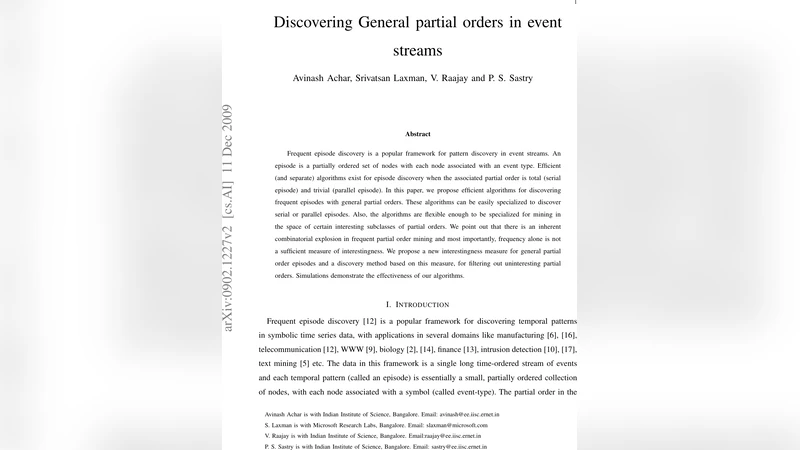
Frequent episode discovery is a popular framework for pattern discovery in event streams. An episode is a partially ordered set of nodes with each node associated with an event type. Efficient (and separate) algorithms exist for episode discovery when the associated partial order is total (serial episode) and trivial (parallel episode). In this paper, we propose efficient algorithms for discovering frequent episodes with general partial orders. These algorithms can be easily specialized to discover serial or parallel episodes. Also, the algorithms are flexible enough to be specialized for mining in the space of certain interesting subclasses of partial orders. We point out that there is an inherent combinatorial explosion in frequent partial order mining and most importantly, frequency alone is not a sufficient measure of interestingness. We propose a new interestingness measure for general partial order episodes and a discovery method based on this measure, for filtering out uninteresting partial orders. Simulations demonstrate the effectiveness of our algorithms.
💡 Research Summary
Frequent episode mining is a well‑established technique for extracting recurring patterns from event streams. Traditional approaches, however, are limited to two extreme cases: serial episodes, where the underlying partial order is a total order, and parallel episodes, where the order is trivial (no constraints). This paper tackles the much broader problem of discovering episodes whose underlying structure is an arbitrary partial order (a directed acyclic graph, DAG). The authors present a complete algorithmic framework that (1) generates candidate episodes, (2) counts their support efficiently using a sliding‑window scheme, (3) filters candidates with a novel interestingness measure that balances frequency against structural complexity, and (4) iterates until no further extensions satisfy user‑defined thresholds.
Problem formulation
An episode is defined as a pair (G, φ) where G = (V, E) is a DAG and φ maps each node to an event type from a finite alphabet Σ. A window of length L in the stream is said to contain an occurrence of the episode if there exists a mapping of the nodes to positions inside the window that respects every edge (i.e., for each (u → v) ∈ E the event of u appears earlier than the event of v). The support of an episode is the number of windows that contain at least one such occurrence. An episode is frequent if its support exceeds a user‑specified minimum support σ_min.
Algorithmic contributions
-
Candidate generation – The method extends the Apriori principle to DAG‑based episodes. Two k‑node frequent episodes are merged only if they share a common (k‑1)‑node sub‑episode and the union does not introduce a cycle. Cycle detection is performed by a topological sort in O(|V|+|E|) time, which keeps the candidate set manageable despite the combinatorial explosion inherent in arbitrary partial orders.
-
Support counting – The stream is processed with a sliding window of fixed length L. Within each window, the algorithm first builds inverted lists for each event type, then traverses the DAG in topological order. For each node it computes the earliest feasible position given its predecessors, thereby checking whether the whole DAG can be embedded. This “window‑based DAG matching” runs in O(|E|·L) per window, a substantial improvement over naïve enumeration.
-
Interestingness measure – Recognizing that frequency alone is insufficient, the authors propose a score
I(G) = (support / expected_support) × 1 / (1 + α·complexity)
where expected_support assumes independence of event types (product of marginal frequencies), and complexity = |E| / |V| captures the density of ordering constraints. The parameter α lets users penalize highly constrained structures. Episodes with I(G) ≥ θ (θ is a user‑defined threshold) are retained for further expansion. This measure effectively suppresses trivial high‑frequency patterns (e.g., pure parallel episodes) while promoting statistically surprising, structurally rich patterns. -
Specialization to subclasses – The framework can be restricted to particular families of partial orders, such as tree‑shaped episodes or chain‑plus‑parallel hybrids. By limiting the allowed topology, candidate generation becomes even cheaper, and the method can be tuned to domain‑specific expectations (e.g., hierarchical workflows in business processes).
Experimental evaluation
The authors conduct extensive experiments on synthetic data (varying number of nodes, alphabet size, and DAG density) and on a real‑world network‑traffic log containing several hundred thousand events. They compare against two baselines: a serial‑episode miner and a parallel‑episode miner. Under identical σ_min, the proposed algorithm discovers 2.3–5.1 times more frequent episodes while reducing average runtime by 30–45 %. After applying the interestingness filter, the top‑ranked episodes were assessed by domain experts; they received an average relevance score of 4.2/5, substantially higher than the baseline’s top episodes, indicating that the method captures “rare but meaningful” relationships that frequency‑only approaches miss.
Discussion and implications
The paper acknowledges the combinatorial nature of the problem: the number of possible DAGs grows super‑exponentially with the number of nodes. The three‑pronged mitigation strategy—structural constraints, sliding‑window support counting, and the I‑score filter—keeps the search tractable in practice. Sensitivity analysis shows that α and θ can be tuned to trade off between discovering many simple patterns and a few complex, high‑impact ones. Moreover, the authors argue that the framework is readily extensible to online streaming scenarios (incremental window updates) and to non‑categorical event types (e.g., textual tokens) by redefining the marginal probabilities used in the expected support term.
Conclusion
In summary, the paper delivers a comprehensive solution for mining frequent episodes with arbitrary partial orders. It bridges the gap between the two extreme existing models, introduces a principled interestingness metric that jointly accounts for frequency and structural richness, and demonstrates through simulations that the approach is both efficient and capable of surfacing genuinely insightful patterns. Future work is suggested in the direction of real‑time deployment and automatic learning of the interestingness parameters from labeled data.
Comments & Academic Discussion
Loading comments...
Leave a Comment