Solar System planetary tests of dot c/c
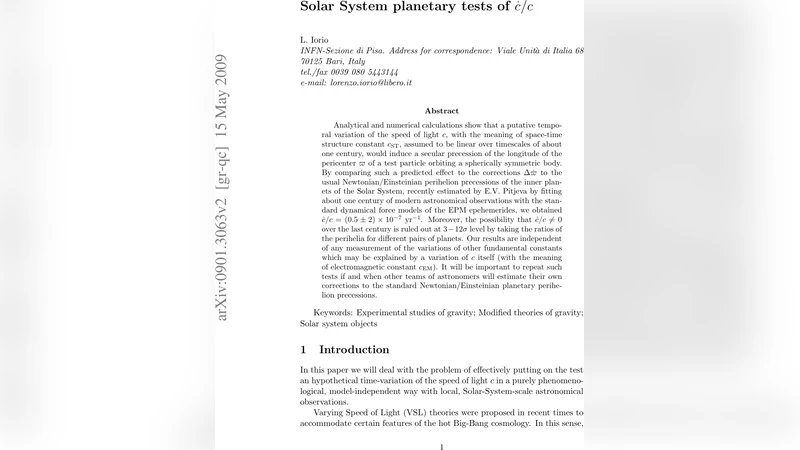
Analytical and numerical calculations show that a putative temporal variation of the speed of light c, with the meaning of space-time structure constant c_ST, assumed to be linear over timescales of about one century, would induce a secular precession of the longitude of the pericenter \varpi of a test particle orbiting a spherically symmetric body. By comparing such a predicted effect to the corrections \Delta\dot\varpi to the usual Newtonian/Einsteinian perihelion precessions of the inner planets of the Solar System, recently estimated by E.V. Pitjeva by fitting about one century of modern astronomical observations with the standard dynamical force models of the EPM epehemerides, we obtained \dot c/c =(0.5 +/- 2)\times 10^-7 yr^-1. Moreover, the possibility that \dot c/c\neq 0 over the last century is ruled out at 3-12\sigma level by taking the ratios of the perihelia for different pairs of planets. Our results are independent of any measurement of the variations of other fundamental constants which may be explained by a variation of $c$ itself (with the meaning of electromagnetic constant c_EM). It will be important to repeat such tests if and when other teams of astronomers will estimate their own corrections to the standard Newtonian/Einsteinian planetary perihelion precessions.
💡 Research Summary
The paper investigates whether a secular variation of the speed of light, interpreted as the space‑time structure constant (c_{\mathrm{ST}}), can be detected through its dynamical imprint on planetary orbits. Under the hypothesis that (c_{\mathrm{ST}}) changes linearly over a timescale of about a century, the authors derive an additional perturbative acceleration (\mathbf{a}{c}=-(\dot c/c),\mathbf{v}) for a test particle orbiting a spherically symmetric mass. This acceleration produces a constant extra precession of the longitude of perihelion (\varpi) given by (\dot\varpi{c}= -\dot c/c). Because this effect is additive to the well‑known Newtonian and Einsteinian perihelion advances (e.g., the 43″ century(^{-1}) relativistic precession of Mercury), it can be isolated by comparing the observed residual precessions (\Delta\dot\varpi) with the theoretical prediction.
The observational input consists of the corrections (\Delta\dot\varpi) to the standard Newtonian/Einsteinian perihelion precessions for the inner planets (Mercury, Venus, Earth, Mars) as estimated by E.V. Pitjeva in the EPM ephemerides. These corrections were obtained by fitting roughly a century of modern astrometric data (radar ranging, laser ranging, optical observations) with the standard dynamical models. By performing a weighted least‑squares fit of the theoretical (\dot\varpi_{c}) to the four measured (\Delta\dot\varpi) values, the authors find
\
Comments & Academic Discussion
Loading comments...
Leave a Comment