A New Approach to Cold Start in Peer to Peer File Sharing Networks
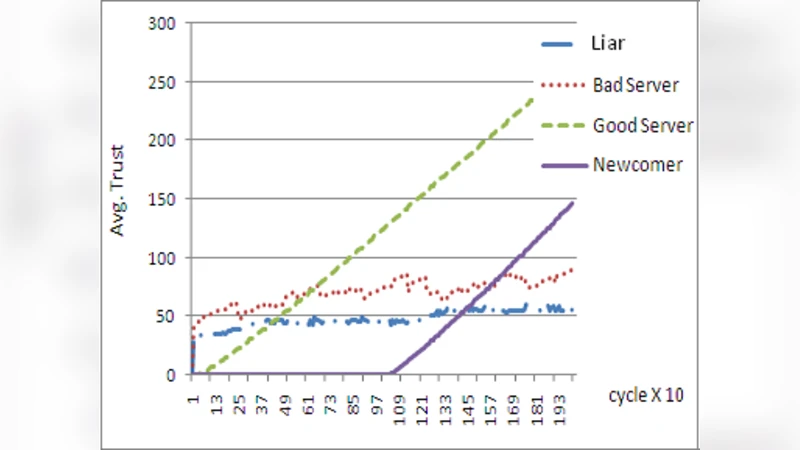
Solving free riding and selecting a reliable service provider in P2P networks has been separately investigated in last few years. Using trust has shown to be one of the best ways of solving these problems. But using this approach to simultaneously deal with both problems makes it impossible for newcomers to join the network and the expansion of network is prevented. In this paper we used the game theory to model the behavior of peers and developed a mechanism in which free riding and providing bad service are dominated strategies for peers. At the same time newcomers can participate and are encouraged to be active in the network. The proposed model has been simulated and the results showed that the trust value of free riders and bad service providers converge to a finite value and trust of peers who provide good service is monotonically increased despite the time they join the network.
💡 Research Summary
The paper tackles two long‑standing challenges in peer‑to‑peer (P2P) file‑sharing systems—free riding and the provision of low‑quality service—while simultaneously addressing the “cold‑start” problem that hampers the entry of new peers. Existing literature typically treats trust‑based reputation mechanisms as a solution to either free riding or service quality, but when both are combined the initial trust score of a newcomer is too low to obtain any meaningful transactions, effectively blocking network growth.
To overcome this, the authors model peer interactions as a repeated game. In each round a peer can choose one of three strategies: (1) cooperate by providing good service, (2) defect by providing bad service, or (3) abstain (free ride). The payoff for a chosen strategy consists of a direct transaction gain plus a trust‑weighted component. Trust is a continuous value in the interval