Neutrino Emission from Cooper Pairs and Minimal Cooling of Neutron Stars
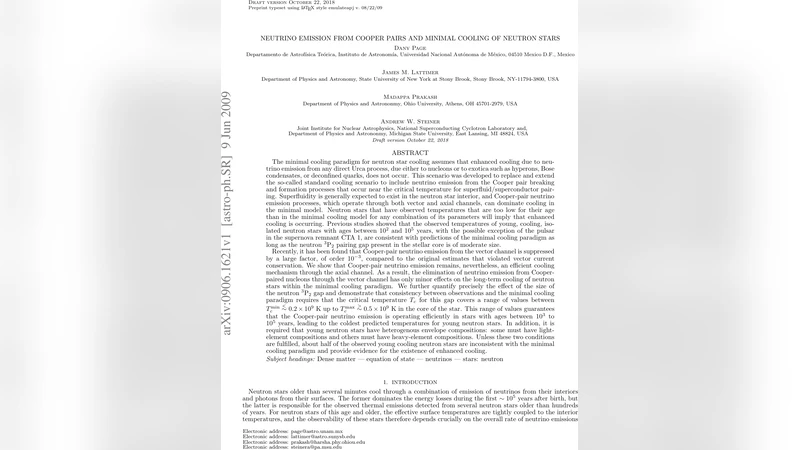
The minimal cooling paradigm for neutron star cooling assumes that enhanced cooling due to neutrino emission from any direct Urca process, due either to nucleons or to exotica such as hyperons, Bose condensates, or deconfined quarks, does not occur. This scenario was developed to replace and extend the so-called standard cooling scenario to include neutrino emission from the Cooper pair breaking and formation processes that occur near the critical temperature for superfluid/superconductor pairing. Recently, it has been found that Cooper-pair neutrino emission from the vector channel is suppressed by a large factor compared to the original estimates that violated vector current conservation. We show that Cooper-pair neutrino emission remains, nevertheless, an efficient cooling mechanism through the axial channel. As a result, the elimination of neutrino emission from Cooper-paired nucleons through the vector channel has only minor effects on the long-term cooling of neutron stars within the minimal cooling paradigm. We further quantify precisely the effect of the size of the neutron 3P2 gap and demonstrate that consistency between observations and the minimal cooling paradigm requires that the critical temperature T_c for this gap covers a range of values between T_c^min < 0.2 x 10^9 K up to T_c^max > 0.5 \times 10^9 K in the core of the star. In addition, it is required that young neutron stars have heterogenous envelope compositions: some must have light-element compositions and others must have heavy-element compositions. Unless these two conditions are fulfilled, about half of the observed young cooling neutron stars are inconsistent with the minimal cooling paradigm and provide evidence for the existence of enhanced cooling.
💡 Research Summary
The paper revisits the “minimal cooling” paradigm for neutron‑star thermal evolution, which assumes that enhanced cooling via direct Urca processes (nucleonic, hyperonic, meson‑condensate or quark‑matter) does not occur. Instead, the dominant neutrino source is the Cooper‑pair breaking and formation (CPBF) that takes place when nucleons become superfluid or superconducting near their critical temperature. Recent work has shown that earlier estimates of the CPBF neutrino emissivity from the vector current channel violated vector‑current conservation and over‑estimated the rate by roughly three orders of magnitude. The authors demonstrate that, despite this suppression, the axial (spin‑1) channel remains an efficient emitter; its emissivity stays at the level required to affect the long‑term cooling curves. Consequently, the removal of the vector contribution has only a minor impact on the overall cooling history within the minimal‑cooling framework.
A central focus of the study is the neutron ³P₂ superfluid gap. By varying the critical temperature T_c of this gap, the authors map out the range of T_c values that can reproduce the observed temperatures of young neutron stars. They find that consistency demands a broad distribution: the minimum T_c must be below ≈2 × 10⁸ K, while the maximum must exceed ≈5 × 10⁸ K. If the gap were narrower, the CPBF neutrino emission would either switch off too early or remain too strong, leading to a mismatch with data.
The paper also emphasizes the role of the stellar envelope composition. Light‑element (H/He) envelopes have higher thermal conductivity than heavy‑element (Fe‑rich) ones, producing higher surface temperatures for the same interior temperature. The authors show that the observed sample of young cooling neutron stars can only be reproduced if the population is heterogeneous: some stars must possess light‑element envelopes, others heavy‑element envelopes.
Putting these pieces together, the authors conclude that the minimal‑cooling paradigm remains viable provided (1) the ³P₂ neutron gap spans the required T_c range and (2) the envelope composition is heterogeneous across the observed population. If either condition fails, roughly half of the observed young neutron stars cannot be explained without invoking enhanced cooling mechanisms such as direct Urca processes. This result therefore strengthens the case that, while minimal cooling can account for many objects, a subset of neutron stars likely experiences additional rapid cooling channels.
Comments & Academic Discussion
Loading comments...
Leave a Comment