Anomalies in the transcriptional regulatory network of the yeast Saccharomyces cerevisiae
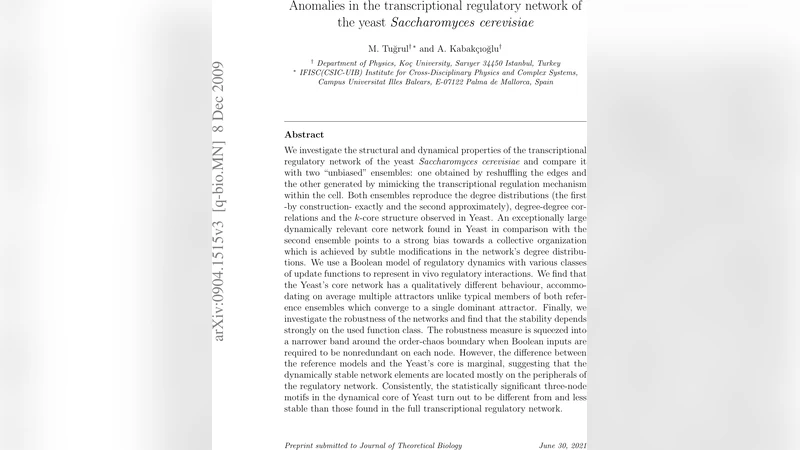
We investigate the structural and dynamical properties of the transcriptional regulatory network of the yeast {\it Saccharomyces cerevisiae} and compare it with two unbiased ensembles: one obtained by reshuffling the edges and the other generated by mimicking the transcriptional regulation mechanism within the cell. Both ensembles reproduce the degree distributions (the first -by construction- exactly and the second approximately), degree-degree correlations and the $k$-core structure observed in Yeast. An exceptionally large dynamically relevant core network found in Yeast in comparison with the second ensemble points to a strong bias towards a collective organization which is achieved by subtle modifications in the network’s degree distributions. We use a Boolean model of regulatory dynamics with various classes of update functions to represent in vivo regulatory interactions. We find that the Yeast’s core network has a qualitatively different behaviour, accommodating on average multiple attractors unlike typical members of both reference ensembles which converge to a single dominant attractor. Finally, we investigate the robustness of the networks and find that the stability depends strongly on the used function class. The robustness measure is squeezed into a narrower band around the order-chaos boundary when Boolean inputs are required to be nonredundant on each node. However, the difference between the reference models and the Yeast’s core is marginal, suggesting that the dynamically stable network elements are located mostly on the peripherals of the regulatory network. Consistently, the statistically significant three-node motifs in the dynamical core of Yeast turn out to be different from and less stable than those found in the full transcriptional regulatory network.
💡 Research Summary
The paper presents a comprehensive investigation of the transcriptional regulatory network (TRN) of the yeast Saccharomyces cerevisiae and compares its structural and dynamical properties with two unbiased reference ensembles. The first ensemble is generated by random edge‑rewiring, which preserves the exact degree distribution of the original network while destroying higher‑order correlations. The second ensemble is constructed by a growth‑based algorithm that mimics the biological mechanism of transcriptional regulation: each transcription factor selects target genes with probabilities that reproduce the empirical degree distribution and, consequently, the observed k‑core hierarchy. Both ensembles successfully replicate the yeast network’s degree‑degree correlations and k‑core structure, indicating that these global topological features are largely determined by the degree sequence alone.
A key focus of the study is the identification of the “dynamically relevant core” (DRC). The DRC is obtained by iteratively removing nodes that have no incoming regulatory inputs, leaving a subgraph that is essential for the network’s intrinsic dynamics. In the yeast TRN the DRC comprises roughly 30 % of all nodes, whereas in both reference ensembles it accounts for less than 10 % of the nodes. This striking difference points to a strong bias in the real network toward a collective organization that is not captured by degree‑preserving randomization alone. The authors argue that subtle modifications in the degree distribution—particularly an excess of high‑degree nodes that are mutually connected—expand the DRC and promote cooperative regulation.
To explore the dynamical consequences of this structural bias, the authors employ Boolean network models. Each gene is represented by a binary state updated synchronously according to a Boolean function of its regulators. Three classes of Boolean functions are examined: (i) non‑redundant functions that use all inputs without duplication, (ii) completely random Boolean functions, and (iii) logical‑gate based functions (e.g., AND, OR, NOT). Extensive simulations reveal that the yeast DRC typically settles into multiple attractors (both fixed points and short cycles), with an average of three to five distinct attractors per network realization. In contrast, the majority of networks drawn from either reference ensemble converge to a single dominant attractor, regardless of the function class. This result demonstrates that the real TRN possesses an intrinsic capacity for multistability, which is a prerequisite for the diverse gene‑expression programs required during different environmental conditions or developmental stages.
Robustness is quantified by measuring the probability that a random perturbation of node states does not change the final attractor. When non‑redundant functions are used, both the yeast DRC and the reference ensembles operate close to the order‑chaos boundary: they are sufficiently stable to resist small perturbations but remain flexible enough to explore different dynamical regimes. Importantly, the robustness difference between the yeast DRC and the random ensembles is modest, suggesting that the most dynamically stable components of the network are located on its periphery rather than within the core. This peripheral stability likely acts as a buffer, protecting the core’s multistable behavior from stochastic fluctuations.
Finally, the authors perform a three‑node motif analysis on both the full TRN and the DRC. In the full network, feed‑forward loops and bi‑parallel motifs are significantly over‑represented, consistent with previous findings that these motifs confer robustness and signal‑processing capabilities. In the DRC, however, these stable motifs are depleted, and motifs that involve feedback are comparatively more frequent, albeit less statistically significant. The shift in motif composition indicates that the core is organized for rapid, adaptable responses rather than for static robustness.
Overall, the study concludes that the yeast transcriptional regulatory network cannot be fully understood by degree distribution alone. Its unusually large dynamically relevant core, the prevalence of multiple attractors, and the distinct motif profile of the core all point to an evolutionary tuning that balances stability and flexibility. By integrating topological randomization, Boolean dynamics, and motif statistics, the paper provides a nuanced picture of how global network architecture and local regulatory logic together shape the functional behavior of a living cell’s gene‑regulation system.
Comments & Academic Discussion
Loading comments...
Leave a Comment