On the Advancements of Conformal Transformations and their Associated Symmetries in Geometry and Theoretical Physics
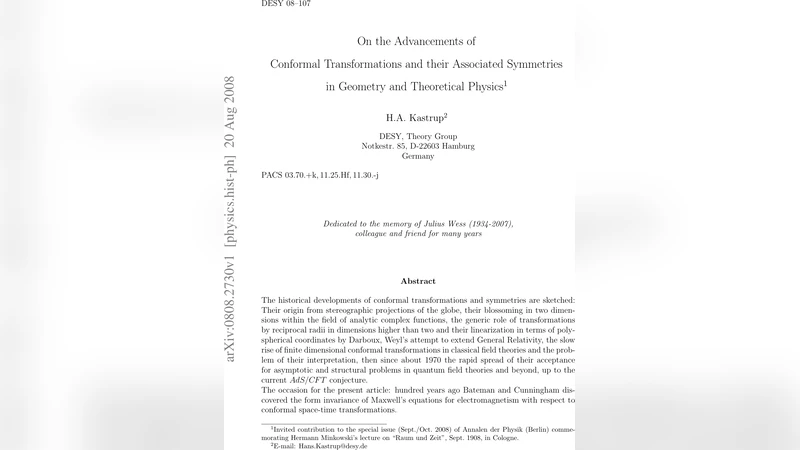
The historical developments of conformal transformations and symmetries are sketched: Their origin from stereographic projections of the globe, their blossoming in two dimensions within the field of analytic complex functions, the generic role of transformations by reciprocal radii in dimensions higher than two and their linearization in terms of polyspherical coordinates by Darboux, Weyl’s attempt to extend General Relativity, the slow rise of finite dimensional conformal transformations in classical field theories and the problem of their interpretation, then since about 1970 the rapid spread of their acceptance for asymptotic and structural problems in quantum field theories and beyond, up to the current AdS/CFT conjecture. The occasion for the present article: hundred years ago Bateman and Cunningham discovered the form invariance of Maxwell’s equations for electromagnetism with respect to conformal space-time transformations.
💡 Research Summary
The paper provides a chronological survey of the development of conformal transformations and their associated symmetries, tracing their evolution from geometric origins to contemporary theoretical physics. It begins with the stereographic projection of the sphere, which preserves circles and thus motivated the study of angle‑preserving maps in two dimensions. This geometric insight dovetailed with the theory of analytic functions, where the Riemann sphere became the prototypical conformal manifold and gave rise to an infinite‑dimensional group of local conformal maps.
In higher dimensions the key operation is the reciprocal‑radius (or inversion) transformation, (\mathbf{x}\mapsto\mathbf{x}/|\mathbf{x}|^{2}), which preserves the ratio of distances and therefore the conformal class of the metric. Darboux’s introduction of polyspherical coordinates linearized these inversions, allowing a matrix representation of the full conformal group. Weyl later generalized this idea by promoting the scale factor to a gauge field, laying the groundwork for a geometric unification of scale invariance with general relativity.
A pivotal historical moment occurred in 1909 when Bateman and Cunningham demonstrated that Maxwell’s equations are invariant under the full 15‑parameter conformal group (SO(4,2)) of four‑dimensional spacetime. Their result showed that classical field equations admit a larger symmetry than the Lorentz group alone, opening a line of inquiry into finite‑dimensional conformal symmetries for scalar, spinor, and gauge fields. The interpretation of these symmetries—particularly their relation to conserved currents and physical observables—remained controversial throughout the first half of the twentieth century.
The resurgence of conformal symmetry began in the 1960s with Wilson’s renormalization‑group ideas and Kadanoff’s block‑spin transformations. These concepts revealed that at critical points many statistical systems become scale‑invariant, and, under additional mild assumptions, fully conformally invariant. In two dimensions this led to the discovery of the Virasoro algebra and modular invariance, providing a complete classification of 2‑D conformal field theories (CFTs) and establishing a deep connection with string world‑sheet dynamics.
From the 1970s onward, conformal invariance entered quantum field theory more broadly. Asymptotic freedom in non‑abelian gauge theories and the operator‑product expansion (OPE) highlighted the role of conformal symmetry in the short‑distance structure of four‑dimensional theories. The modern climax of this trajectory is the AdS/CFT correspondence, which posits an exact duality between a gravitational theory on a five‑dimensional anti‑de Sitter space and a four‑dimensional conformal field theory on its boundary. This duality demonstrates that the conformal group of the boundary theory is precisely the isometry group of the bulk spacetime, thereby extending the relevance of conformal symmetry from pure geometry to quantum gravity.
Overall, the article uses the centennial anniversary of the Bateman‑Cunningham discovery as a narrative anchor to weave together the mathematical foundations, historical milestones, and physical applications of conformal transformations. It emphasizes how a concept that originated in cartography and complex analysis has become a cornerstone of modern high‑energy physics, statistical mechanics, and even quantum gravity.
Comments & Academic Discussion
Loading comments...
Leave a Comment