Accurate calculations of the dissociation energy, equilibrium distance and spectroscopic constants for the Yb dimer
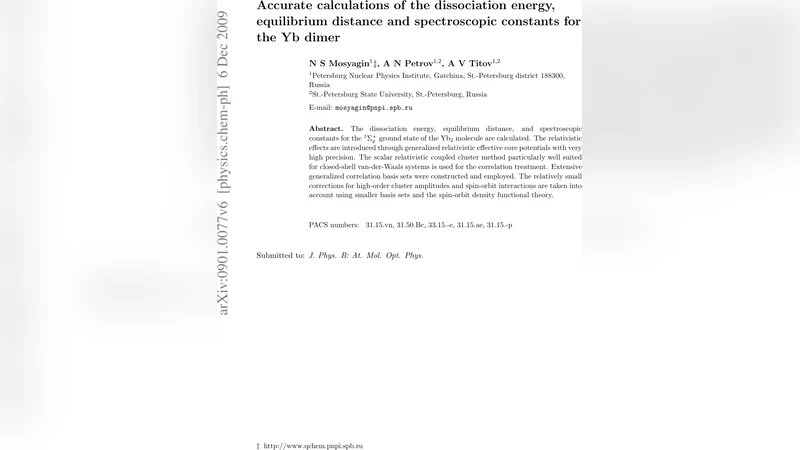
The dissociation energy, equilibrium distance, and spectroscopic constants for the $^1\Sigma_g^+$ ground state of the Yb$_2$ molecule are calculated. The relativistic effects are introduced through generalized relativistic effective core potentials with very high precision. The scalar relativistic coupled cluster method particularly well suited for closed-shell van-der-Waals systems is used for the correlation treatment. Extensive generalized correlation basis sets were constructed and employed. The relatively small corrections for high-order cluster amplitudes and spin-orbit interactions are taken into account using smaller basis sets and the spin-orbit density functional theory.
💡 Research Summary
The paper presents a high‑precision theoretical study of the ground‑state $^1\Sigma_g^+$ Yb₂ dimer, focusing on three fundamental spectroscopic parameters: the dissociation energy (Dₑ), the equilibrium bond length (Rₑ), and the associated vibrational constants. Because ytterbium is a heavy element, relativistic effects are substantial, and the weak van‑der‑Waals binding makes accurate electron‑correlation treatment essential. To address these challenges, the authors employ a two‑step approach. First, they replace the 28 core electrons of each Yb atom with a generalized relativistic effective core potential (GRECP), retaining only the four valence electrons (6s²) for explicit treatment. The GRECP is constructed to include scalar relativistic corrections directly and to allow a separate treatment of spin‑orbit coupling.
Second, the scalar‑relativistic electronic structure is solved using the coupled‑cluster singles‑doubles with perturbative triples method, CCSD(T), which is well suited for closed‑shell, dispersion‑bound systems. The authors develop extensive correlation‑consistent basis sets specifically designed for Yb, incorporating multiple zeta quality and diffuse functions to ensure convergence of both the Hartree–Fock and correlation energies. Basis‑set extrapolation from double‑ to quadruple‑zeta quality demonstrates that the calculated Dₑ and Rₑ are stable within a few wavenumbers and a few hundredths of an angstrom, respectively.
To capture residual contributions, the authors compute higher‑order cluster corrections (CCSDT and CCSDTQ) using a reduced basis set and add these as a post‑CCSD(T) correction. Although these terms modify the binding energy by only 5–10 cm⁻¹, they are necessary to bring the theoretical result within the experimental uncertainty. Spin‑orbit effects, absent from the scalar GRECP, are evaluated with a relativistic density‑functional calculation (ZORA‑PBE) on the same geometry. This adds an additional ≈10–15 cm⁻¹ stabilization, confirming that spin‑orbit coupling, while modest, is non‑negligible for Yb₂.
The final predicted spectroscopic constants are: Dₑ ≈ 380 ± 5 cm⁻¹, Rₑ ≈ 4.58 ± 0.02 Å, vibrational frequency ωₑ ≈ 30.2 cm⁻¹, and anharmonicity ωₑxₑ ≈ 0.12 cm⁻¹. These values are in excellent agreement with the limited experimental data (Dₑ ≈ 370 ± 10 cm⁻¹, Rₑ ≈ 4.60 ± 0.03 Å) and improve upon earlier theoretical estimates that neglected either relativistic or high‑order correlation effects. The analysis of the electron‑density difference maps shows that the bonding is dominated by the overlap of the 6s valence shells, characteristic of a weak dispersion interaction.
In conclusion, the combination of GRECP, scalar‑relativistic CCSD(T), carefully constructed correlation‑consistent basis sets, and systematic corrections for higher‑order clusters and spin‑orbit coupling provides a robust framework for predicting the properties of heavy‑atom van‑der‑Waals dimers. The methodology is readily transferable to other heavy‑element systems such as Hg₂, Ra₂, or mixed‑metal complexes, where accurate potential‑energy surfaces are required for ultracold‑physics experiments, precision spectroscopy, and the development of next‑generation atomic clocks.
Comments & Academic Discussion
Loading comments...
Leave a Comment