Combinatorial Characterization of the Assur Graphs from Engineering
We introduce the idea of Assur graphs, a concept originally developed and exclusively employed in the literature of the kinematics community. The paper translates the terminology, questions, methods and conjectures from the kinematics terminology for…
Authors: Brigitte Servatius, Offer Shai, Walter Whiteley
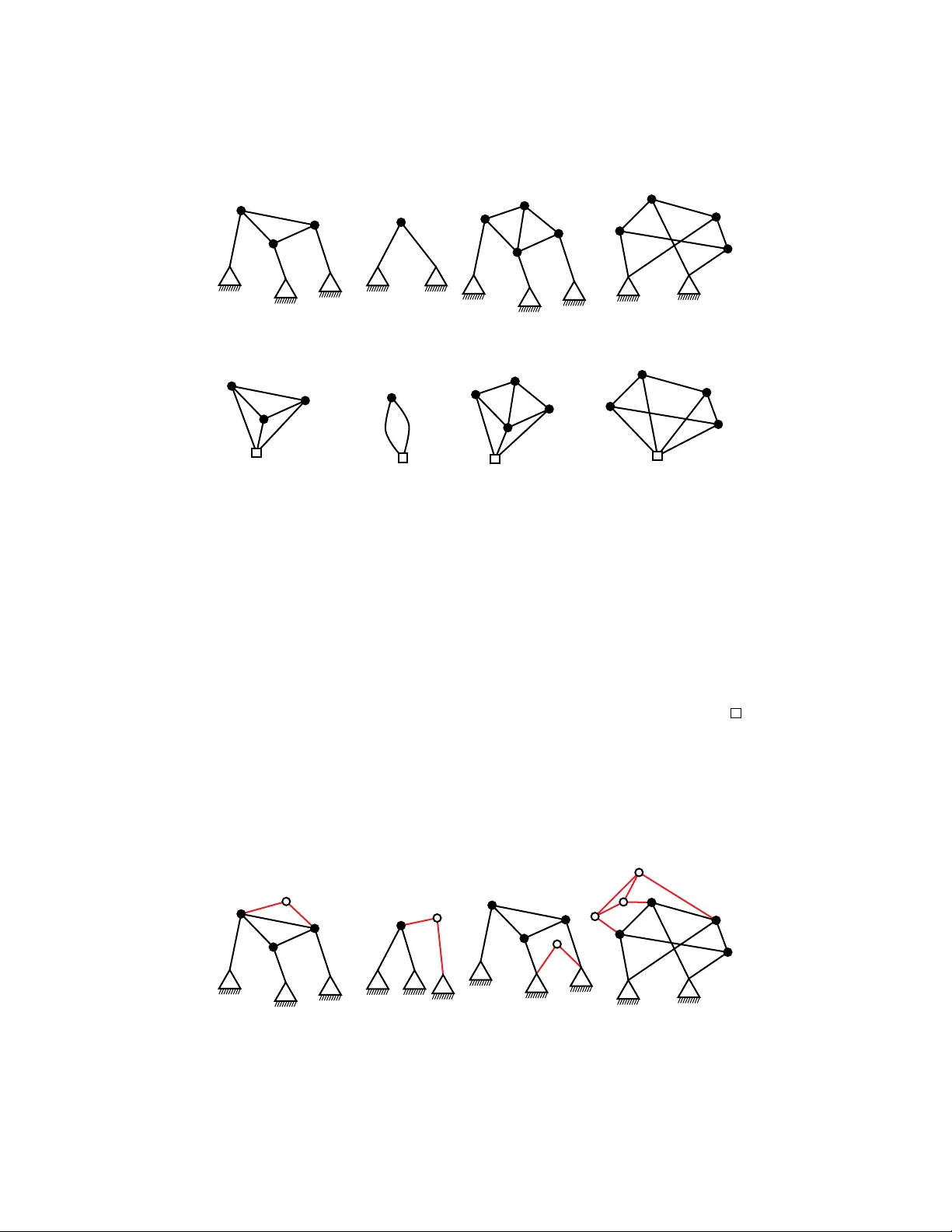
Com binatorial Characterization of the Assur Graphs from Engineering Brigitte Serv atius ∗ Offer Shai † W alter Whiteley ‡ July 17, 2021 Abstract W e in tro duce the idea of Assur graphs, a concept originally dev elop ed and exclusiv ely employ ed in the literature of the kinematics communit y . The pap er translates the terminology , questions, methods and conjec- tures from the kinematics terminology for one degree of freedom link ages to the terminology of Assur graphs as graphs with sp ecial prop erties in rigidit y theory . Exploiting recen t works in com binatorial rigidity theory w e pro vide mathematical c haracterizations of these graphs derived from ‘minimal’ link ages. With these characterizations, w e confirm a series of conjectures p osed by Offer Shai, and offer tec hniques and algorithms to b e exploited further in future work. 1 In tro duction W orking in the theory of mechanical link ages, the concept of ‘Assur groups’ was dev elop ed by Leonid Assur (1878-1920), a professor at the Saint-P etersburg P olytechnical Institute. In 1914 he published a treatise (reprin ted in [2]) en ti- tled Investigation of plane b ar me chanisms with lower p airs fr om the viewp oint of their structur e and classific ation . In the kinematics literature it is common to in tro duce ‘Assur groups’ (selected groups of links) as special minimal struc- tures of links and joints with zero mobilit y , from whic h it is not p ossible to obtain a simpler substructure of the same mobility [15]. Initially Assur’s pa- p er did not receiv e muc h attention, but in 1930 the well kno wn kinematician I.I. Artobolevski ˘ i, a mem b er of the Russian academy of scie nces, adopted As- sur’s approach and employ ed it in his widely used b o ok [1]. F rom that time on Assur groups are widely emplo yed in Russia and other eastern Europ ean coun tries, while their use in the west is not as common. How ever, from time to time Assur groups are rep orted in researc h pap ers for div erse applications such ∗ Mathematics Departmen t, W orcester P olytechnic Institute. bserv atius@math.wpi.edu † F aculty of Engineering, T el-Aviv Univ ersity . shai@eng.tau.ac.Il ‡ Department of Mathematics and Statistics, Y ork Universit y T oronto, ON, Canada. white- ley@mathstat.yorku.ca. W ork supported in part by a gran t from NSERC Canada 1 as: p osition analysis of mechanisms [12]; finding dead-center positions of planar link ages [15] and others. The mec hanical engineering terminology for link ages (kinematics) and their standard coun ting tec hniques are introduced via an example in the next section. Cen tral to Assur’s metho d is the decomp osition of complex link ages in to funda- men tal, minimal pieces whose analyses could then b e merged to giv e an ov erall analysis. Many of these approac hes for Assur groups w ere dev elop ed from a range of examples, analyzed geometrically and combinatorially , but never de- fined with mathematical rigor. In parallel, rigidit y of bar and joint structures as well as motions of related mec hanisms ha ve b een studied for sev eral centuries by structural engineers and mathematicians. Recently (since 1970) a focused dev elopmen t of a mathemat- ical theory using combinatorial to ols w as successful in man y applications. F or example for planar graphs there is a simple geometric duality theory , which, if applied to mechanisms and framew orks yields a relation b et ween statics and kinematics: any lock ed planar mechanism is dual to an unstable planar isostatic framew ork (determinate truss) [16, 6]. The purpose of this paper is t w ofold. First, w e wan t to dra w together the v o cabulary and questions of mechanical engineering with the rigidity theory terminologies of engineering and mathematics. Second, we w ant to apply the mathematical to ols of rigidity theory , including the connections b et ween statics and kinematics, to giv e precision and new insights in to the decomposition and analysis of mechanical link ages. The mathematical tools w e need are briefly sk etched with references pro- vided in § 2.3-2.7. Our main result is the description of Assur graphs (our term for Assur groups) in Engineering terms ( § 2.1,2.2) and its reform ulation in math- ematical terms. W e show that our mathematical reformulation allo ws us in a natural w ay to embed Assur’s tec hniques in the theory of frameworks ( § 3) and bring the results bac k to link ages. In the process w e v eriy sev eral conjectured c haracterizations presented b y Offer Shai in his talk concerning the generation of Assur graphs and the decomposition of link ages in to Assur graphs, at the 2006 Vienna W orkshop on Rigidity and Flexibility § 3.1. W e also giv e algorith- mic pro cesses for decomp osing general link ages into Assur graphs, as well as for generating all Assur graphs ( § 3.2-3.3). In a second pap er [17], we will apply the geometric theory of bar-and-joint framew ork rigidit y in the plane to explore additional properties and characteri- zations of Assur graphs. This exploration includes singular (stressed) p ositions of the framew orks, explored using reciprocal diagrams, and the in tro duction of ‘driv ers’, which app ear in passing in the initial example in the next section. 2 Preliminaries In the first t wo sub-sections w e presen t the mechanical engineering v o cabulary , problems and approaches through an example. These offer the background and the motiv ation for the concepts of the pap er, but do not yet give the formal 2 mathematical definitions. In the remaining five sub-sections w e giv e the frame- w ork basics needed to mathematically describ e these approaches. 2.1 Link ages and Assur graphs A link age is a mec hanism consisting of rigid b odies, the links , held together b y joints. Since we only consider link ages in the plane, all our joints are pin join ts, or pins. A complex link age may b e efficiently studied b y decomposing it in to simple pieces, the Assur groups. (Engineers use the term group to mean a sp ecified set of links. In mathematics the word group is used for an algebraic structure, but most of the tools we will use come from graph theory , so the w ord graph seems more natural and we will use it as soon as w e start our mathematical section). W e in tro duce these ideas via an example. Figure 1 depicts an excav ator attached with a link age system. In the follow- ing, we illustrate ho w the sc hematic drawing of this system is constructed and ho w it is decomposed into Assur groups. 0 1 2 3 0 1 0 3 4 5 6 7 8 A B C D E F G H Figure 1: The excav ator with its kinematic system. In order to get a uniform scheme, termed structur al scheme , it is common to represen t all the connections betw een the links by revolute joints as appears in Figure 2. Here join ts 0 1 and 0 3 attac h the excav ator to the vehicle (fixed ground) and these sp ecial joints are marked with a small hatched triangle, and are called pinne d joints . All other joints are called inner joints. A link which can b e altered (e.g. b y c hanging its length) is called a driving link . A driving link can b e thought of as driving or changing the distance b et ween its endp oin ts like the pistons in our exca v ator example, whic h may be modeled in the structural sc heme by a rotation of an inserted link 1. Once the engineering system is represented in the structural scheme, to start the analysis, all the driving links are deleted and replaced by pinned join ts 3 0 1 2 3 0 1 0 3 4 5 6 7 8 A B C D E F G H 0 1 2 3 0 1 0 3 4 5 6 7 8 A B C D E F G H Figure 2: The unified structural sc heme of the kinematic system of the exca v a- tor. (mathematically sp eaking the driving links are con tracted and their endp oin ts iden tified). In the current example, links 1 and 4 are deleted and join ts A and D are pinned. Then, the system is decomposed into three Assur groups, each consisting of tw o links, one inner join t and tw o pinned joints. In the literature the Assur groups of this type are referred to as dyads [13]. The order of the decomp osition is imp ortan t. If an inner join t of a group, G 1 , b ecomes a pinned join t in group G 2 , then G 1 should precede G 2 . In our example (see Figure 3), the unique order of decomp osition is: Dyad 1 = { 2 , 3 } ; Dy ad 2 = { 5 , 6 } ; Dy ad 3 = { 7 , 8 } . 0 2 3 0 3 5 6 7 8 A B C D E E F G G H H Figure 3: Assur group decomposition of the structural scheme of the kinematic system of the excav ator. 4 2.2 Degree of freedom of a mechanism: Gr ¨ ubler’s equa- tion The degree of freedom (DOF) of a link age is the num b er of independent co or- dinates or measurements required to define its position. In mechanical engineering [13], Gr ¨ ubler’s equation relates the (least num b er of in ternal) degrees of freedom F of a link age mechanism to the n umber L of links and the num b er J of joints in the mec hanism. In the plane, if J i is the n umber of join ts from whic h i links emanate, i ≥ 2 then F = 3( L − 1) − 2 X ( i − 1) J i (1) In the example abov e L = 9 b ecause the fixed ground is considered a link, and P ( i − 1) J i = 11, b ecause the revolute joint E is coun ted t wice as it pins links 5, 6, and 7. By Gr ¨ ubler’s equation we get F = 3(9 − 1) − 2 · 11 = 2, whic h is correct as there are tw o driving links (tw o distances b eing controled). If these t wo driving links are remov ed and their ends pinned (iden tified) as in the example analysis, we hav e only 7 links left and the n um b er of revolute joints is no w 9, so F = 0. This is another indication that the drivers work indep enden tly . Note that Gr ¨ ubler’s equation only gives a lo wer b ound on the degree of freedom and there are man y cases where the actual DOF is larger than the predicted one [13]. If a link age con tains a sub-collection of links pinned in such a w ay among themselv es that the Gr ¨ ubler coun t is negative for the sub-collection, then the predicted DOF for the link age might b e smaller than the actual DOF (see Figure 4(a)). This situation can be detected and corrected by combinatorial means as we will describ e in Laman’s Theorem, see § 2.5 Theorem 1. Coun ting techniques, ho wev er, cannot detect sp ecial geometries, e.g. par- allelism or symmetry of links, which also might lead to a false Gr ¨ ubler DOF prediction. W e will examine this type of geometric singularit y of a com binato- rially correct graph in [17]. b d c a p q b d c a p q Figure 4: In some cases Gr ¨ ubler’s equation provides a false answ er (a), due to an ov ercoun ted subgraph. In others (b) it correctly predicts a pinned isostatic framew ork (determinate truss). 5 2.3 F ramew orks F or a link age in whic h all the links are bars, with revolute joints at the t wo endp oin ts of the bar, w e can rewrite Gr ¨ ubler’s equation in terms of graph theory , b y introducing a graph whose vertices, V , are the join ts and whose edges, E , are the bars. With V i denoting the set of v ertices of v alence i , Gr ¨ ubler’s equation b ecomes F = 3( | E | − 1) − 2 X ( i − 1) J i = 3( | E | − 1) − 2 X i | V i | + 2 X | V i | = 3 | E | − 3 − 4 | E | + 2 | V | = 2 | V | − 3 − | E | . So if the edges of a graph embedded in the plane are in terpreted as rigid bars and the v ertices as revolute join ts, the graph needs to ha ve at least 2 | V | − 3 edges in order to hav e no in ternal degrees of freedom, an observ ation made already b y Maxwell. The coun t 2 | V | − 3 will be central to the rest of the pap er. By a fr amework w e mean a graph G = ( V , E ) together with a configuration p of V into Euclidean space, for our purp ose the Euclidean plane. W e will alwa ys assume that the tw o ends of an edge (a bar) are distinct points). A motion of the framework is a displacemen t of the vertices which preserv es the distance b et w een adjacent vertices, and a framework is rigid if the only motions whic h it admits arise from congruences. Let us assume that the lo cation p i of a vertex is a contin uous function of time, so that w e can differentiate with resp ect to time. If we consider the initial v elo cities, p 0 i , of the endp oin ts p i of a single edge ( i, j ) under a contin uous motion of a framework, then, to av oid compressing or extending the edge, it m ust b e true that the comp onents of those v elo cities in the direction parallel to the edge are equal, i.e. ( p i − p j ) · ( p 0 i − p 0 j ) = 0 . (2) A function assigning vectors to eac h vertex of the framew ork such that equa- tion 2 is satisfied at eac h edge is called an first-or der motion. If the only first- order motions are trivial , that is, they arise from first-order translations or first-order rotations of R 2 , then we say that the framework is first-order rigid in the plane. First-order rigidity implies rigidit y , see for example [5]. In our excav ator example not all links are bars. In the structural scheme link 8 is mo deled b y a bar b ecause it contains only tw o pins, while link 3, which con tains 5 pins app ears as a “b ody”. W e can replace such a b ody by a rigid subframew ork on these 5 vertices (or more). In general, an y link age consisting of rigid bo dies held together b y pin join ts can b e modeled as a framew ork by replacing the b o dies with rigid framew orks. 2.4 The rigidit y matrix An y graph G can be considered a subgraph of the complete graph K n on the v ertex set V = { 1 , . . . , n } , where n is large enough. Let p b e a fixed c onfigur ation (em b edding) of V into R 2 . 6 Equation 2 defines a system of linear equations, indexed b y the edges ( i, j ), in the v ariables for the unkno wn v elo cities p 0 i . The matrix R ( p ) of this system is a real n ( n − 1) / 2 by 2 n matrix and is called the rigidity matrix . As an example, w e write out co ordinates of p and of the rigidity matrix R ( p ), in the case n = 4. p = ( p 1 , p 2 , p 3 , p 4 ) = ( p 11 , p 12 , p 21 , p 22 , p 31 , p 32 , p 41 , p 42 ); p 11 − p 21 p 12 − p 22 p 21 − p 11 p 22 − p 12 0 0 0 0 p 11 − p 31 p 12 − p 32 0 0 p 31 − p 11 p 32 − p 12 0 0 p 11 − p 41 p 12 − p 42 0 0 0 0 p 41 − p 11 p 42 − p 12 0 0 p 21 − p 31 p 22 − p 32 p 31 − p 21 p 32 − p 22 0 0 0 0 p 21 − p 41 p 22 − p 42 0 0 p 41 − p 21 p 42 − p 22 0 0 0 0 p 31 − p 41 p 32 − p 42 p 41 − p 31 p 42 − p 32 A framew ork ( V , E , p ) is infinitesimally rigid (in dimension 2) if and only if the submatrix of R ( p ) consisting of the ro ws corresponding to E has rank 2 n − 3. W e sa y that the vertex set V is in generic p osition if the determinan t of any submatrix of R ( p ) is zero only if it is identically equal to zero in the v ariables p 0 i . F or a generically embedded v ertex set, linear dependence of the rows of R ( p ) is determined by the graph induced by the edge set under consideration. The rigidit y properties of a graph are the same for any generic embedding. A graph G on n v ertices is generic al ly rigid if the rank ρ of its rigidit y matrix R G ( p ) is 2 n − 3, where R G ( p ) is the submatrix of R ( p ) containing all ro ws corresp onding to the edges of G , for a generic embedding of V . The (generic) DOF of G is defined to b e 2 n − 3 − ρ . 2.5 Results for the plane Linear dependence of the rows of the rigidit y matrix defines a matroid on the set of rows and for generic configurations we sp eak ab out indep endent e dge sets rather than independent rows of R ( p ). F or a generic embedding of n v ertices in to R 2 w e call the matroid on the complete graph obtained from R ( p ) the generic rigidit y matroid in dimension 2 on n vertices, R 2 ( n ). The follo wing theorem c haracterizes R 2 ( n ). Theorem 1. (Laman [10]) The indep endent sets of R 2 ( n ) ar e those sets of e dges which satisfy L aman ’s c ondition: | F | ≤ 2 | V ( F ) | − 3 for al l F ⊆ E , F 6 = ∅ ; (3) Laman’s Theorem w as pro ved in 1970 and it was this theorem that promoted the use of matroids to attac k rigidity questions. There are man y equiv alen t axiom systems kno wn for matroids. These can be used to reveal structural prop erties of v arious t yp es and their relationships. The fact that matroids are exactly those structures for which indep endent sets can b e constructed greedily has important algorithmic conseqences. F rom the count condition in the inequalities (3) for indep enden t edge sets it is straight forward to deduce coun t conditions for b ases of R 2 ( n ) (edge sets 7 inducing minimally rigid or isostatic graphs), as w ell as for minimally dependent sets, or cir cuits , which will pla y a fundamental role in our analysis and will b e treated in the next section. Indep enden t sets of R 2 ( n ) may b e constructed inductively [20]. Giv en an indep enden t edge set E in R 2 ( n ), we can extend E b y new edges provided that the inequalities 3 are not violated. Starting with an indep enden t set (e.g. a single edge): (a) W e can attach a new v ertex v b y t wo new edges x = ( v , u ) and y = ( v , w ) to the subgraph of G induced by E and E ∪ { x, y } is independent, see Figure 5a. This is also called 2 -valent vertex addition . (b) Similarly , w e can attach a new vertex v by three new edges to the endpoints of an edge e ∈ E plus any other vertex in the subgraph of G induced by E , and E \ e ∪ { x, y , z } is indep endent, see Figure 5b. This operation is called e dge-split , b ecause the new v ertex v is thought of as splitting the edge e . x y z e v x y v a) b) Figure 5: Building up an indep enden t set of edges b y: 2-v alent vertex (a) and edge-split (b) These Henneb er g te chniques dev elop ed in [20] hav e b ecome standard in rigidit y theory , see also [7], and when w e resort to “the usual arguments” within some of the pro ofs to come, we ha v e these standard pro of tec hniques in mind. F or further reference we state the following well known result. Theorem 2 (Henneb erg [20]) . Any indep endent set in R 2 ( n ) c an b e obtaine d fr om a single e dge by a se quenc e of 2 -valent vertex additions and e dge-splits. Figure 6 illustrates a sequence described in Theorem 2. 2.6 Rigidit y circuits Minimally dep endent sets, or circuits, in R 2 ( n ) are edge sets C satisfying | C | = 2 | V ( C ) | − 2 and every prop er non-empty subset of C satisfies inequality (3). 8 a b a b c d a b c e d a b c f e d a b c Figure 6: A Henneb erg sequence constructing an isostatic graph. Note that these circuits, called rigidity cir cuits , alwa ys ha ve an ev en n umber of edges. W e will, as is commonly done, not distinguish b et ween edge sets and the graphs they induce. Similarly to the inductiv e constructions of indep enden t sets (see Figure 5), all circuits in R 2 ( n ) can b e constructed from a tetrahedron (the complete graph on four vertices) b y tw o simple operations, see [3], namely e dge-split as in Figure 5b, and 2-sum , where the 2-sum of tw o (disjoint) graphs is obtained by “gluing” the graphs along an edge and removing the glued edge, see Figure 7. Figure 7: 2-sums taken along the lined up edge pairs combine circuits into a larger circuit. Theorem 3 (Berg and Jordan [3]) . A ny cir cuit in R 2 ( n ) c an b e obtaine d fr om K 4 by a se quenc e e dge-splits and 2-sums. 2.7 Isostatic Pinned F ramew ork Giv en a framework associated with a link age, we are interested in its in ternal motions, not the trivial ones, so following the mec hanical engineers we pin the framew ork b y prescribing, for example, the co ordinates of the endpoints of an edge, or in general by fixing the p osition of the vertices of some rigid subgraph, see Figure 8. W e call these v ertices with fixed positions pinne d , the others inner . (Inner v ertices are sometimes called fr e e or unpinne d in the literature.) Edges among pinned vertices are irrelev ant to the analysis of a pinned framework. W e will denote a pinned graph by G ( I , P ; E ), where I is the set of inner v ertices, P is the set of pinned v ertices, and E is the set of edges, where eac h edge has at least one endp oin t in I . 9 A pinned graph G ( I , P ; E ) is said to satisfy the Pinne d F r amework Condi- tions if | E | = 2 | I | and for all subgraphs G 0 ( I 0 , P 0 ; E 0 ) the following conditions hold: 1. | E 0 | ≤ 2 | I 0 | if | P 0 | ≥ 2, 2. | E 0 | ≤ 2 | I 0 | − 1 if | P 0 | = 1 , and 3. | E 0 | ≤ 2 | I 0 | − 3 if P 0 = ∅ . W e call a pinned graph G ( I , P ; E ) pinne d isostatic if E = 2 | I | and e G = G ∪ K P is rigid as an unpinned graph, where K P is a complete graph on a v ertex set containing all pins (but no inner v ertices). In other w ords, we “replace” the pinned vertex set by a complete graph containing the pins and call G ( I , P ; E ) isostatic, if choosing any basis in that replacement produces an (unpinned) isostatic graph. A pinned graph G ( I , P ; E ) realized in the plane, with P for the pins, and p for all the vertices, is a pinne d fr amework . A pinned framework is rigid if the matrix R e G has rank 2 | I | , where R e G is the rigidity matrix of e G with the columns corresp onding to the vertex set of K p remo ved, indep endent if the ro ws of R e G corresp onding to E are indep enden t, and isostatic , if it is rigid and independent. The v ertices I of a pinned framework are in generic p osition if an y submatrix of the rigidity matrix is zero only if it is iden tically equal to zero with the co ordinates of the inner v ertices as v ariables. The co ordinates of the pins are prescrib ed constants. Figure 8 sho ws an example of a pinned isostatic G and a corresponding basis b G of e G . b) a) G G Figure 8: F ramework (a) is pinned isostatic b ecause F ramew ork (b) is isostatic. It is common in engineering to choose pins in adv ance and their placemen t P might not b e generic, in fact not even in gener al p osition (no three p oin ts collinear), as it is sometimes necessary to hav e all pins on a line. The follo wing result sho ws that this is not a problem. Theorem 4. Given a pinne d gr aph G ( I , P ; E ) , the fol lowing ar e e quivalent: (i) Ther e exists an isostatic r e alization of G . (ii) The Pinne d F r amework Conditions ar e satisfie d. 10 (iii) F or al l plac ements P of P with at le ast two distinct lo c ations and al l generic p ositions of I the r esulting pinne d fr amework is isostatic. Pr o of. Let e G = G ∪ K P 0 P 0 k P , and F a maximal indep enden t edge set of K P 0 . Then by Theorem 1 w e deduce that E ∪ F is isostatic if and only if the Pinned F ramework Conditions are satisfied, so ( i ) ⇔ ( ii ) In order to sho w ( ii ) ⇒ ( iii ) we first show that we can extend F to F ∪ E by a Henneberg sequence of 2-v alent v ertex additions and edge-splits (see Figure 5). T o this end we de-construct e G first by removing inner vertices as follo ws. Assume that | I | > 1. Since | E | = 2 | I | and I spans at most 2 | I | − 3 edges, we m ust ha ve at least three edges joining the set of inner v ertices I to the pinned vertices P . Therefore, if we sum o v er the v alence of inner v ertices, and denote the the set of edges with b oth endp oints in I b y E i , the ones with one endp oin t in I b y E p , we obtain P v al ( i ) = 2 | E i | + | E p | = 2 | I | + | E i | ≤ 4 | I | − 3. So there will be some inner vertices of v alence 2 or 3. If at this stage there is some vertex of degree 2, w e can just remov e it, to create a smaller graph with the same isostatic coun t. If there is some v ertex of degree 3, then b y the usual argumen ts [7, 20], it can be remov ed, and replaced b y a new edge joining t wo of its neigh b ors, which w ere not y et joined in a remaining rigid subgraph (e.g. not both pinned), to create a smaller subgraph with the isostatic coun t. This pro duces a rev erse sequence of smaller and smaller isostatic graphs until we hav e no inner vertices. T o obtain a realization, place P in an arbitrary position P with at least t wo distinct vertices. Create an isostatic graph whose vertex set contains P , b y , for example, ordering the vertices in P with distinct p ositions arbitrarily , P = { p 1 , p 2 , . . . } , adding edges b et ween consecutiv e vertices and attac hing an extra v ertex, p 0 b y edges ( p 0 , p i ). This graph is clearly isostatic, pro vided the p oin t p 0 is not placed on the line through p i and p i +1 for any i , b ecause it has the correct edge count and is rigid since it consists of a string of non-collinear triangles. T o complete the pro of, we w ork back up the sequence of subgraphs w e cre- ated in the de- construction pro cess. W e assume the current graph is realized as isostatic. When the next graph is created by adding a 2-v alent v ertex, then adding such a v ertex in an y position except on the line joining its tw o attac h- men ts gives a new isostatic realization. When the next graph is created b y an edge-split, note that at least one of the neigh b ors of the new vertex is inner, so this added inner v ertex can b e placed in a generic position ensuring that the three new attac hmen ts are not collinear. Therefore, b y the usual arguments [7, 20], this insertion is also isostatic when placed along the line of the bar b eing remov ed, and therefore also when placed in an y generic position. Since (iii) trivially implies (i), the pro of is complete. A pinned graph G ( I , P ; E ) satisfying the Pinned F ramework Conditions m ust ha ve at least tw o pins and in every isostatic realization of G there must be at least t wo distinct pin lo cations. Placing all pins in the same lo cation nev er yields an isostatic framework, but w e can make an imp ortan t observ ation ab out 11 the DOF of such a “pin collapsed” framew ork. Theorem 5. L et G ( I , P ; E ) b e a pinne d gr aph satisfying the Pinne d F r ame- work Conditions. Identifying the pinne d vertic es to one vertex p ∗ yields a gr aph G ∗ ( V , E ) , V = I S { p ∗ } and the DOF of G ∗ is one less than the numb er of rigidity cir cuits c ontaine d in G ∗ . Pr o of. Since | E | = 2 | I | = 2 | V | − 2, G ∗ con tains to o many edges to b e isostatic. If G ∗ is rigid, it is o verbraced by exactly one edge, hence con tains exactly one rigidit y circuit. If G p is not rigid, each of the rigidit y circuits in G ∗ m ust con tain p ∗ . If t wo rigidit y circuits intersected in a vertex other than p ∗ , the union of their edge sets, together with the pinned subgraph w ould violate the Pinned Subgraph Conditions. Therefore all circuits in G ∗ ha ve exactly the v ertex p in common. Removing exactly one edge from each circuit yields a basis for G ∗ in R ( G ∗ ), establishing the desired connection b et ween the DOF and the n um b er of circuits. 3 Characterizations of Assur graphs W e start with t w o citations from the mechanical engineering literature as moti- v ation for our com binatorial conditions. The follo wing definition app ears in [23]: “An Assur group is obtained from a kinematic c hain of zero mobility b y sup- pressing one or more links, at the condition that there is no simpler group inside”. In [18] w e find: “An eleme n t of an Assur group is a kinematic chain with free or unpaired join ts on the links whic h when connected to a stationary link will ha v e zero DOF. A basic rigid chain is a c hain of zero DOF and whose sub c hains all ha ve DOF greater than zero. In other w ords an elemen t of an Assur group is a basic rigid chain with one of its links deleted”. These descriptions from the engineering literature are not definitions in the mathematical sense, but rather use ‘minimality’ informally , as in the original w ork of Assur. W e are now ready to giv e a formal definition by confirming a series of equiv alent combinatorial characterizations of Assur graphs. These statemen ts are new, and (iii) and (iv) come from the conjectures offered b y Offer Shai at the w orkshop. 3.1 Basic Characterization of Assur graphs Theorem 6. Assume G = ( I , P ; E ) is a pinne d isostatic gr aph. Then the fol lowing ar e e quivalent: (i) G = ( I , P ; E ) is minimal as a pinne d isostatic gr aph: that is for al l pr op er subsets of vertic es I 0 ∪ P 0 , I 0 ∪ P 0 induc es a pinne d sub gr aph G 0 = ( I 0 ∪ P 0 , E 0 ) with | E 0 | ≤ 2 | I 0 | − 1 . (ii) If the set P is c ontr acte d to a single vertex p ∗ , inducing the unpinne d gr aph G ∗ with e dge set E , then G ∗ is a rigidity cir cuit. (iii) Either the gr aph has a single inner vertex of de gr e e 2 or e ach time we delete a vertex, the r esulting pinne d gr aph has a motion of al l inner vertic es (in generic p osition). 12 (iv) Deletion of any e dge fr om G r esults in a pinne d gr aph that has a motion of al l inner vertic es (in generic p osition). Pr o of. (i) implies (iv) If w e delete an edge, there must b e a motion b y the coun t. If there is a set of inner vertices that are not moving, in generic p osition, then these v ertices, and their edges to the pinned v ertices, mu st form a prop er isostatic pinned subgraph contradicting condition (i). (iv) implies (iii) Remo ving an edge with an endp oin t of v alence 2 produces a graph with a p endant edge. This must b e the only inner vertex, since any other inner v ertices are not moving, contradicting (iv). Since removing a single edge results in a motion of all inner v ertices, removing all edges incident with one particular vertex results in a framework with a motion on all the remaining v ertices. Con versely , (iii) implies (i) If the graph con tains a minimal prop er pinned subgraph, then removing any vertex outside of this subgraph will pro duce a motion at most in the v ertices outside of the subgraph. This con tradicts (iii). (i) is equiv alent to (ii) If G = ( V , P ; E ) is a pinned isostatic graph, then iden tifying the vertices in P to a single v ertex p ∗ yields a graph G ∗ = ( V ∗ , E ∗ ) with | E ∗ | = 2( | V | + 1) = | V ∗ | − 2, so G ∗ is dep enden t and if the minimalit y condition in (i) is satisfied, it must b e a rigidity circuit. Conv ersely , if G ∗ is a rigidit y circuit, we can pic k an arbitrary v ertex of G ∗ and call it p ∗ . Splitting p ∗ in to a vertex set P , | P | ≥ 2, (where P may hav e as many vertices as the v alence of p ∗ in G ∗ allo ws) and sp ecifying for each edge with endp oin t p ∗ a new endp oin t from P so that no isolated vertices are left, yields an isostatic pinned framew ork satisfying the minimalit y condition. This theorem provides a rigorous mathematical definition: an Assur gr aph is a pinned graph satisfying one of the four equiv alent conditions in Theorem 6. Condition (i) is a refinement of the Gr ¨ ubler count (1), in a form whic h is no w necessary and sufficien t. Condition (ii) translates the minimality condition to minimal dep endence in R 2 ( n ) and thus serv es as a purely combinatorial description of Assur graphs and ma y be chec ked by fast algorithms [8, 11]. Conditions (iii) and (iv) are similar in nature. Condition (iii) provides the engineer with a quick er chec k for the Assur prop erty for smaller graphs than (iv), since there are fewer vertices than edges to delete. Ho wev er, condition (iv) tells the engineer that a driver inserted for an arbitrary edge will (generically) mo ve all inner v ertices. W e will expand on this prop ert y in [17] Some examples of Assur graphs are drawn in Figure 9 and their corresp ond- ing rigidit y circuits in Figure 10. 3.2 Decomp osition of general isostatic framew orks W e no w show that a general isostatic framework can be decomposed in to a partially ordered set of Assur graphs. The given framew ork can b e re-assem bled from these pieces by a basic link age comp osition. Figure 11 sho ws isostatic pinned framew orks and Figure 13 indicates their decomposition. 13 Figure 9: Assur graphs Figure 10: Corresp onding circuits for Assur graphs Giv en t wo link ages as pinned framew orks H = ( W, Q ; F ) and G = ( V , P ; E ) and an injective map C : Q → V ∪ P , the linkage c omp osition C ( H, G ) is the link age obtained from H and W by identifying the pins Q of H with their images C ( Q ). Lemma 1. Given two pinne d isostatic gr aphs H = ( W , Q, F ) , G = ( V , P ; E ) , the c omp osition C ( H , G ) cr e ates the new c omp osite pinne d gr aph: C = ( V ∪ W , P , E ∪ F ) which is also isostatic. Pr o of. By the counts, we hav e | F | = 2 | W | , and | E | = 2 | V | , so | E ∪ F | = 2 | W ∪ V | . A similar analysis of the subgraphs confirms the isostatic status. Under this op eration, the Assur graphs will b e the minimal, indecomp os- able graphs. W e can sho w that ev ery pinned isostatic graph G is a unique comp osition of Assur graphs, whic h w e will call the Assur c omp onents of G . Theorem 7. A pinne d gr aph is isostatic if and only if it de c omp oses into A ssur c omp onents. The de c omp osition into Assur c omp onents is unique. Figure 11: Decomp osable - not Assur graphs 14 Figure 12: The first step of a decomposition for isostatic frameworks in 11 - with iden tified subcircuit(s). Figure 13: Recomp osing the pinned isostatic graphs in Figure 11 from their Assur components. Pr o of. T ake the isostatic pinned framework, and identify the ground pins. This is no w a dependent graph. Using properties of R 2 ( n ), see [4], w e can iden tify minimal dep enden t subgraphs - which, by Theorems 5 and 6, are Assur comp o- nen ts after the pins are separated. These are the initial components. When all of these initial comp onen ts are contracted in step tw o, we seek additional Assur comp onen ts. W e iterate the pro cess un til only the ground is left. The decomp osition pro cess describ ed in the pro of of Theorem 7 naturally induces a partial order on the Assur comp onen ts of an isostatic graph: comp o- nen t A ≤ B if B o ccurs at a higher level, and B has at least one v ertex of A as a pinned v ertex. The algorithm for decomposing the graph guarantees that A ≤ B means that B occurs at a later stage than A . This partial order can b e represen ted in an Assur scheme as in Figure 14. This partial order, with the iden tifications needed for link age comp osition, can be used to re-assemble the graph from its Assur comp onen ts. Replacing any edge in an isostatic framework pro duces a 1 DOF link age. The decomposition describ ed in Theorem 7 p ermits the analysis of this link age in lay ers. In fact, we can place driv ers in each Assur comp onen t to obtain link ages with several degrees of freedom and their complex b eha vior can b e simply described b y analyzing the individual Assur comp onen ts. This pro cess 15 III IV a) b) I IV V c) II III II I V Figure 14: An isostatics pinned framework a) has a unique decomp osition in to Assur graphs b) which is represented by a partial order or Assur scheme c). of adding drivers is studied in more detail in [17]. 3.3 Generating Assur graphs W e summarize inductive techniques to generate all Assur graphs. Engineers find suc h tec hniques of interest to generate basic building blocks for syn thesizing new link ages. Figure 15: An Edge-Split takes an Assur graph with at least four vertices to an Assur graph Figure 16: 2-sum of Assur graphs gives a new Assur graph with a remov ed pin. The dyad is the only Assur graph on three vertices. There is no Assur graph on four v ertices. An Assur graph, whose corresponding rigidity circuit is K 4 is called a b asic Assur graph. 16 T o generate all Assur graphs (on five or more vertices) w e use Theorem 6(ii) together with Theorem 3 to generate all rigidity circuits. T o get from a rigidit y circuit C to an Assur graph, w e c ho ose a v ertex p ∗ of C and split it in to tw o or more pins (as in the pro of of Theorem 6). The choice of p ∗ , the splitting of p ∗ in to a set P of pins (2 ≤ | P | ≤ v al ( p ∗ )), and choosing for each edge incident to p ∗ an endp oin t from P allo ws us to construct sev eral Assur graphs from one rigidit y circuit, see Figure 17. W e say that G ( I , P ; E ) and G 0 ( I , P 0 , E ) are related b y pin r e arr angement if G ∗ = G 0∗ (see Figure 17). Figure 17: Pin rearrangement (maintaining fact of at least tw o pins) The op erations of edge-split and 2-sum, whic h were used to generate rigidit y circuits inductiv ely , can also b e used directly on Assur graphs to generate new Assur graphs from old, see Figures 15 and 16. In particular, the op eration of 2-sum may b e of practical v alue if, for space reasons for example, a pinned v ertex is to be eliminated, see Figure 16. Theorem 8. Al l Assur gr aphs on 5 or mor e vertic es c an b e obtaine d fr om b asic Assur gr aphs by a se quenc e of e dge-splits, pin-r e arr angements and 2 -sums of smal ler Assur gr aphs. Since mec hanical engineers might w ant to hav e additional to ols readily av ail- able for generating Assur graphs, one can seek additional op erations under which the class of Assur graphs is closed. V ertex-split (creating tw o v ertices of degree at least three) is another operation which tak es a rigidity circuit to a rigidit y circuit, and therefore tak es an Assur graph with at least three vertices to a larger Assur graph (Figure 18). This is, in a sp ecific sense, the dual op eration to edge-split [4]. More generally , [4] explores a n umber of additional op erations for generating larger circuits from smaller circuits. Each of these processes will tak e an Assur graph to a larger Assur graph. The inductiv e constructions for Assur graphs can be used to pro vide a visual c ertific ate se quenc e for an Assur graph. If we are given a sequence of edge-splits and 2-sums starting from a dyad and ending with G , see Figure 19, it is trivial to verify that G is an Assur graph. W e constructed such a sequence in the pro of of Theorem 4. It is well known, see [20], that there are exp onen tial algorithms to pro duce such a certificate. How ever, there are other fast algorithms, for example the so called p ebble games, see [8, 11] to detect all the rigidity prop erties of graphs that can b e adapted to verify the Assur property . 17 Figure 18: V ertex split taking an Assur graph to an Assur graph. Figure 19: Certificate sequence for the final Assur graph. 4 Concluding commen ts The pap er introduces, for the first time, the concept of Assur graphs, in the rigorous mathematical terminology of rigidit y theory . This work pa ves a new c hannel for co operation b et ween the communities in kinematics and in rigidity theory . An example for suc h channel is the material appearing in § 2.7 showing ho w to transform determinate trusses used b y the kinematicians into isostatic framew orks, widely employ ed by the rigidity theory and structural engineering comm unities. A t this point, it is hard to predict all the practical applications that are to b enefit from this new relation betw een the disciplines. Nevertheless, w e antici- pate practical results from the use of rigidit y theory in mechanisms as in tro duced in the pap er. Examples of such results, include using rigid circuits from rigidity theory to find the prop er decomp osition sequence of pinned isostatic framework in to Assur comp onen ts (Section 3.2) and generation of Assur graphs by applying t wo known operations to their corresp onding rigidit y circuits (Section 3.3). It is exp ected that new opp ortunities will b e op ened up, for example, for mec hanical engineers to comprehend topics in rigidit y theory that are used to day in man y disciplines, including biology , comm unications and more. Mechanical engineers in the west may b e motiv ated to use the Assur graphs (Assur groups) concept as it is widely applied in eastern Europ e and Russia. Decomp osing a larger link age into Assur graphs and analyzing these pieces one at a time is an effectiv e wa y to analyze the ov erall motion, w orking in lay ers. This pap er has given a precise mathematical foundation for the Assur metho d as w ell as a pro of of its correctness and completeness. W e hav e follow ed standard engineering practice and developed the theory in the language of bar-and-join t framew orks, but of course there is no need to 18 replace a larger link (rigid bo dy) with an isostatic bar-and-join t sub-framework to apply the counting techniques. It is simply conv enient to do so in order to streamline notation and graphics. All of our results may b e rew orded in terms of b ody and bar structures or b o dy and pin frameworks. This presentation would b e muc h closer to the original example in Figures 1 and 2 and the counts of § 2.2. T o extend this type of analysis to 3D link ages, the lack of go od characteriza- tion of isostatic bar-and-join t frameworks in 3D is an initial obstacle. Ho wev er, if w e fo cus on b ody-and-bar or bo dy-and-hinge structures (the analog of bo dy- and-bar and b ody-and-pin frameworks in the plane) then the generic DOF of these structures is computable by analogous counting techniques [21, 22], and all our combinatorial methods will carry ov er sucessfully . References [1] I. I. Artobolevski ˘ ı. T e oriya mehanizmov i ma ˇ sin . Gosudarstv. Izdat. T ehn.- T eor., Moscow-Leningrad, 1951. 2d ed. [2] L. V. Assur. Issle dovanie ploskih ster ˇ znevyh mehanizmov s niz ˇ simi p ar ami s to ˇ cki zr eniya ih struktury i klassifikacii . Izdat. Ak ad. Nauk SSSR, 1952. Edited b y I. I. Artob olevski ˘ ı. [3] Alex R. Berg and Tib or Jord´ an. A pro of of Connelly’s conjecture on 3-connected circuits of the rigidit y matroid. J. Combin. The ory Ser. B , 88(1):77–97, 2003. [4] Laura Chav ez, Lily Moshe, and W alter Whiteley . Extending basis and circuits for 2-rigidity via tree cov erings. pr eprint , 2005. [5] Rob ert Connelly . The rigidity of certain cabled frameworks and the second- order rigidity of arbitrarily triangulated conv ex surfaces. A dv. in Math. , 37(3):272–299, 1980. [6] Henry Crapo and W alter Whiteley . Spaces of stresses, pro jections, and par- allel drawings for spherical p olyhedra. Beitr ae ge zur Algebr a und Ge ometrie / Contributions to A lgebr a and Ge ometry , (35): 259–281, 1994. [7] Jack Grav er, Brigitte Serv atius, and Herman Serv atius. Combinatorial rigidity , volume 2 of Gr aduate Studies in Mathematics . American Mathe- matical Society , Pro vidence, RI, 1993. [8] Donald Jacobs, and Bruce Hendrickson An algorithm for t wo-dimensional rigidit y p ercolation: the p ebble game, J. Comput. Phys. (137): 346–365, 1997, [9] Bruce Hendric kson. Conditions for unique graph realizations. SIAM J. Comput. , 21(1):65–84, 1992. 19 [10] G. Laman. On graphs and rigidit y of plane sk eletal structures. J. Engr g. Math. , 4:331–340, 1970. [11] Audrey Lee and Ileana Strein u. Pebble Game Algorihms and ( k , l )-sparse graphs, 2005 Eur op e an Confer enc e on Combinatorics, Gr aph The ory and Applic ations (Eur oComb ’05) , DMTCS Pro ceedings: 181–186, 2005 [12] S. Mitsi, K.-D. Bouzakis, G. Mansour, and I. P op escu. P osition analysis in polynomial form of planar mechanisms with Assur groups of class 3 including revolute and prismatic joints. Me ch. Mach. The ory , 38(12):1325– 1344, 2003. [13] Rob ert L. Norton. Design of Machinery: An Intr o duction T o The Synthesis and Analysis of Me chanisms and Machines . McGraw Hill, New Y ork, 2004. [14] R. P enne. Relative Cen ters of Motion, Implicit Bars and Dead-Center P ositions for Planar Mechanisms. Preprin t Department of Industrial Sciences and T echnology , Karel de Grote-Hogeschool, An tw erp, Belgium, Rudi.P enne@kdg.b e, 2007. [15] G. R. P enno c k and G. M. Kamthe. A study of dead-center p ositions of single-degree-of-freedom planar link ages using assur kinematic chains,. IMe chE J. Me ch. Eng. Sci. , Sp ecial Issue on Kinematics, Kinematic Ge- ometry , and their Applications, An Invited Paper, in press., 2006. [16] O. Shai. Deriving structural theorems and metho ds using T ellegen’s the- orem and combinatorial representations. Internat. J. Solids Structur es , 38(44-45):8037–8052, 2001. [17] Brigitte Serv atius, Offer Shai, and W alter Whiteley . The combinatorial c haracterization of Assur graphs. Preprint, 2008. [18] Ra jesh P . Sunk ari and Linda C. Schmidt. Structural synthesis of planar kinematic chains by adapting a mck ay-t yp e algorithm. Me chanism and Machine The ory , 41(9):1021–1030, 2006. [19] Tiong-Seng T ay . A new pro of of Laman’s theorem. Gr aphs Combin. , 9(4):365–370, 1993. [20] Tiong-Seng T ay and W alter Whiteley . Generating isostatic frameworks. Structur al T op olo gy , (11):21–69, 1985. [21] Neil White and W alter Whiteley . The algebraic geometry of motions of bar-and-b ody frameworks. SIAM J. Algebr aic Discr ete Metho ds , 8(1):1– 32, 1987. [22] W alter Whiteley . Rigidity and Scene Analysis. in Handb ook of Dis- crete and Computational Geometry , 2nd Edition J. O’Rourke and J. Goo dman (eds): 1327-1354, 2004. 20 [23] Bernard Y annou and Adrian V asiliu. Design platform for planar mecha- nisms based on a qualitativ e kinematics. 21
Original Paper
Loading high-quality paper...
Comments & Academic Discussion
Loading comments...
Leave a Comment