Methods for analytically estimating the resolution and intensity of neutron time-of-flight spectrometers. The case of the TOFTOF spectrometer
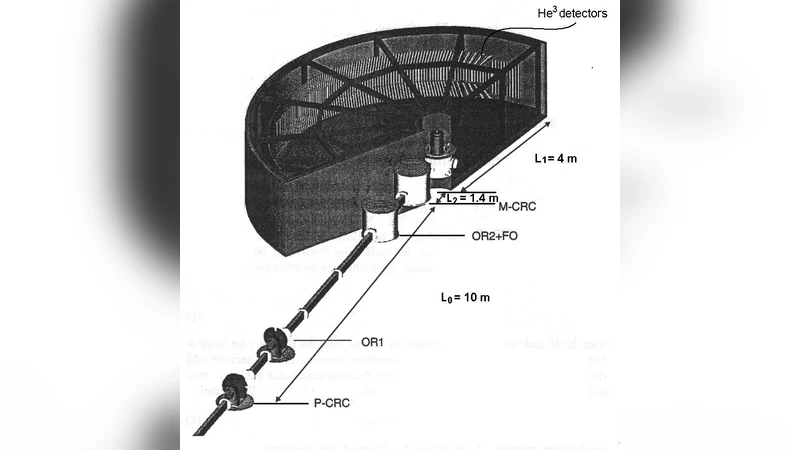
An analytical method is presented with allows to estimate the energy resolution of time-of-flight neutron spectrometers, as well as its partial contributions, over a dynamical range that extends from the elastic line to the accessible inelastic regions. Such a method, already successfully applied in the past to the TOSCA and HET neutron inelastic scattering spectrometers installed at the ISIS neutron spallation source [A M Gaspar, PhD Thesis, Universidade Tecnica de Lisboa, 2004], is here applied to the high resolution time-of-flight spectrometer TOFTOF, mainly dedicated to quasi-elastic neutron scattering studies and installed at the new neutron reactor FRM II. To make such calculations easily understandable, the principle of work of the TOFTOF instrument and of each of its components is explained in detail. A simply method that can be used to estimate the instrument intensity, i.e. of the number of neutrons arriving at the sample position per unit time, is also briefly outlined. To the benefit of the TOFTOF users, graphs displaying the dependencies of the instrument resolution at the elastic line and of the instrument intensity on the relevant instrument parameters, i.e the wavelength of the incident neutrons, the choppers speed of rotation and the frame overlap ratio, are presented, in the form of iso-resolution or iso-intensity lines. The method of estimation of the frame overlap ratio that is commonly used at time-of-flight instruments such as TOFTOF is also explained and alternative options concerning this parameter, depending on the dynamical range of interest, are briefly addressed.
💡 Research Summary
The paper presents a fully analytical framework for estimating both the energy resolution and the neutron intensity of the TOFTOF time‑of‑flight (TOF) spectrometer, a high‑resolution instrument primarily used for quasi‑elastic neutron scattering at the FRM II reactor. Building on a method previously applied to the ISIS TOSCA and HET spectrometers, the authors adapt the approach to the specific geometry and components of TOFTOF, providing explicit formulas that relate the resolution to the instrument’s key operating parameters: incident neutron wavelength (λ), chopper rotation speed (f), and the frame‑overlap ratio (R).
The instrument is described in detail: neutrons from the source are pulsed, pass through a frame chopper and a high‑speed chopper (both defined by slit opening angle θ and rotation frequency f), travel a variable‑length guide to the sample, scatter, and are finally detected by an array of fast detectors. Each element contributes a timing uncertainty (Δt) that propagates into the final energy resolution ΔE/E. The authors decompose Δt into four independent contributions: (1) source pulse width τ₀, (2) chopper opening time τ_c = θ/(2πf) (combined for the two choppers), (3) detector timing jitter τ_d, and (4) sample‑related uncertainties (geometrical spread and intrinsic dynamical broadening). Assuming Gaussian statistics, the total timing spread is the root‑sum‑square of these terms. By converting the timing spread into an energy spread using the standard TOF relation (ΔE/E ≈ (m_n v³/h L_total) · Δt), the authors obtain a compact analytical expression for the resolution that explicitly contains λ, f, and R.
For intensity, a simple multiplicative model is proposed: the neutron flux at the sample I = Φ₀ · η_c · η_g · σ_s · η_d, where Φ₀ is the source flux per Å, η_c is the chopper transmission (a function of slit opening and rotation speed), η_g is the guide transmission, σ_s is the sample scattering cross‑section, and η_d is the detector efficiency. The frame‑overlap ratio R directly influences η_c: a lower R (longer frames) allows more neutrons through the choppers, increasing intensity, but at the cost of overlapping successive frames, which limits the usable dynamical range. The authors therefore define a maximum permissible TOF separation Δt_max = R·T_frame and discuss how to choose R based on the desired energy window.
The analytical results are visualized through iso‑resolution and iso‑intensity contour plots in the λ–f plane for several representative values of R (0.5, 0.75, 1.0). For example, at λ = 4 Å, f = 400 Hz and R = 0.75 the calculated resolution is ΔE/E ≈ 1.2 % with an intensity of roughly 1.5 × 10⁶ neutrons · s⁻¹ · sr⁻¹. Pushing the resolution below 0.5 % requires increasing f to 600 Hz and reducing R to 0.5, which simultaneously reduces intensity by about 30 %. These trade‑offs are clearly illustrated, enabling users to select operating conditions that best match their scientific goals—whether they need the highest possible energy resolution for narrow quasielastic features or maximal flux for weak inelastic signals.
The paper also revisits the conventional method for setting the frame‑overlap ratio (based on the ratio of frame length to the longest TOF of interest) and contrasts it with a modern “dynamic frame selection” approach made possible by digital timing electronics. The latter allows the experimenter to deliberately narrow the frame for a specific energy region, thereby boosting flux without sacrificing resolution elsewhere.
In conclusion, the authors provide a practical, fast, and transparent tool for TOFTOF users that eliminates the need for extensive Monte‑Carlo simulations or time‑consuming calibration measurements. The analytical model captures the essential physics of each instrument component, offers clear guidance on how to balance resolution, intensity, and dynamical range, and can be readily extended to other high‑resolution TOF spectrometers. Future work will focus on validating the model against measured data, incorporating non‑Gaussian chopper opening effects, and accounting for multiple‑scattering corrections to further refine the predictive capability.
Comments & Academic Discussion
Loading comments...
Leave a Comment