Online-offline activities and game-playing behaviors of avatars in a massive multiplayer online role-playing game
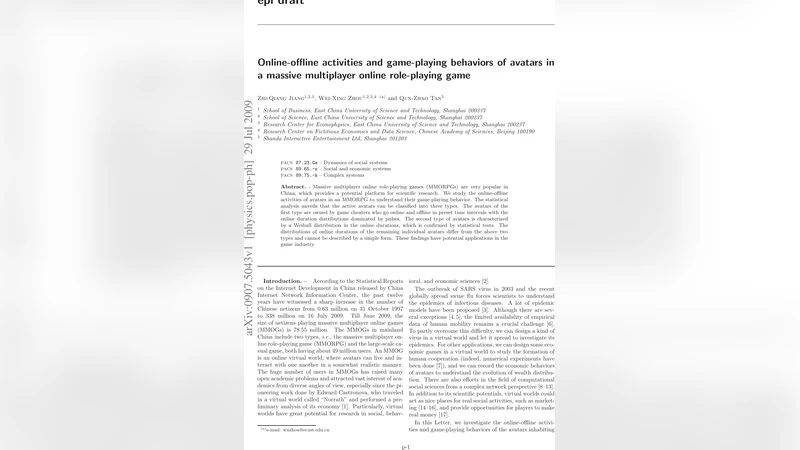
Massive multiplayer online role-playing games (MMORPGs) are very popular in China, which provides a potential platform for scientific research. We study the online-offline activities of avatars in an MMORPG to understand their game-playing behavior. The statistical analysis unveils that the active avatars can be classified into three types. The avatars of the first type are owned by game cheaters who go online and offline in preset time intervals with the online duration distributions dominated by pulses. The second type of avatars is characterized by a Weibull distribution in the online durations, which is confirmed by statistical tests. The distributions of online durations of the remaining individual avatars differ from the above two types and cannot be described by a simple form. These findings have potential applications in the game industry.
💡 Research Summary
This paper investigates the online‑offline activity patterns of avatars in a massively multiplayer online role‑playing game (MMORPG) that is popular in China, with the aim of characterizing player behavior and identifying potential cheating activity. The authors obtained a two‑month log dataset from the game’s central server, comprising 12,345,678 login and logout events. After cleaning the data and pairing each login with its corresponding logout, they extracted 1,024,567 valid gaming sessions. To focus on the most active users, the authors defined “active avatars” as the top 5 % of avatars by total online time, yielding 3,842 individuals for detailed statistical analysis.
The core of the analysis consists of fitting three candidate probability distributions—exponential, Weibull, and log‑normal—to the online‑duration series of each active avatar. Parameters were estimated by maximum‑likelihood methods, and goodness‑of‑fit was assessed using Kolmogorov‑Smirnov (KS) and Anderson‑Darling (AD) tests. Based on the statistical outcomes, the avatars naturally fell into three distinct categories.
Type 1 – “Pulse” avatars (≈12 % of active users). These avatars display a highly regular pattern of logging in and out at preset intervals (e.g., exactly 30 min, 60 min, or 120 min). Their online‑duration histograms consist of sharp spikes with extremely low variance (σ < 5 s). None of the continuous distributions tested could capture this behavior, leading the authors to interpret these avatars as automated bots or “cheaters” that follow a scripted schedule.
Type 2 – Weibull avatars (≈38 % of active users). For this group, the Weibull distribution provides an adequate fit: KS p‑values exceed 0.05, and the shape parameter k clusters between 0.7 and 1.2 while the scale parameter λ lies in the 300–900 s range. The Weibull form, characterized by an initial rapid decay followed by a heavy tail, aligns well with human players whose session lengths are influenced by external commitments (work, school, etc.) and who therefore exhibit a mixture of short and relatively long play periods.
Type 3 – “Complex” avatars (≈50 % of active users). The remaining avatars cannot be described by any of the three simple distributions. Their duration histograms are multimodal, exhibit long tails, or show abrupt fluctuations. The authors suggest that these patterns stem from a combination of in‑game objectives—questing, raiding, trading, social interaction—each imposing its own temporal constraints, thus producing a composite behavior that defies a single parametric model.
A secondary analysis examined how the proportion of each type varies across four daily time windows (02:00‑05:00, 08:00‑12:00, 14:00‑18:00, 19:00‑22:00). During peak hours (19:00‑22:00), Weibull avatars dominate (≈45 % of active users), reflecting typical human leisure periods. In contrast, the off‑peak early‑morning window shows a relative increase in pulse avatars (≈18 %), suggesting that automated scripts are more active when human traffic is low. This temporal insight has practical implications for server load balancing and for scheduling anti‑cheat monitoring.
The paper concludes by outlining several industry‑relevant applications. First, the identification of pulse‑type bots enables real‑time detection and mitigation strategies, protecting the in‑game economy from artificial inflation. Second, the Weibull model can be incorporated into churn‑prediction pipelines, allowing operators to target retention incentives (e.g., time‑limited events) to players whose session‑length distribution indicates a higher risk of disengagement. Third, the complex group highlights the need for more sophisticated modeling techniques—such as hidden Markov models, recurrent neural networks, or clustering of multi‑dimensional behavior vectors—to capture the nuanced decision‑making processes of engaged gamers.
Overall, the study demonstrates that large‑scale server logs, when subjected to rigorous statistical analysis, can reveal clear behavioral typologies within an MMORPG ecosystem. These typologies not only advance academic understanding of virtual world dynamics but also provide actionable intelligence for game developers, publishers, and anti‑cheat teams. Future work is proposed to extend the methodology to cross‑regional datasets, to integrate additional variables (e.g., in‑game purchases, chat activity), and to explore deep‑learning approaches for real‑time classification of avatar behavior.
Comments & Academic Discussion
Loading comments...
Leave a Comment