Homotopical interpretation of globular complex by multipointed d-space
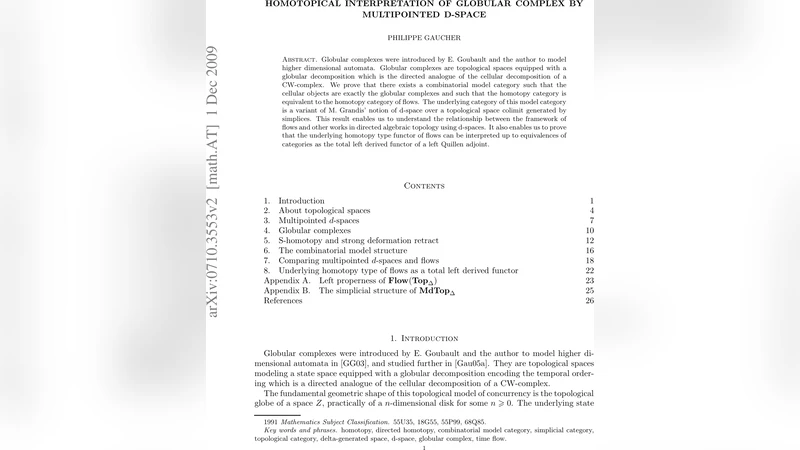
Globular complexes were introduced by E. Goubault and the author in arXiv:math/0107060 to model higher dimensional automata. Globular complexes are topological spaces equipped with a globular decomposition which is the directed analogue of the cellular decomposition of a CW-complex. We prove that there exists a combinatorial model category such that the cellular objects are exactly the globular complexes and such that the homotopy category is equivalent to the homotopy category of flows introduced in arXiv:math/0308054. The underlying category of this model category is a variant of M. Grandis’ notion of d-space over a topological space colimit generated by simplices. This result enables us to understand the relationship between the framework of flows and other works in directed algebraic topology using d-spaces. It also enables us to prove that the underlying homotopy type functor of flows constructed in arXiv:math/0308063 can be interpreted up to equivalences of categories as the total left derived functor of a left Quillen adjoint.
💡 Research Summary
The paper provides a homotopical framework for globular complexes, a topological model introduced by Goubault and the author to represent higher‑dimensional automata. A globular complex is a space equipped with a “globular decomposition,” the directed analogue of the cellular decomposition of a CW‑complex. The main achievement of the work is the construction of a combinatorial model category whose cellular objects are precisely the globular complexes, and whose homotopy category is equivalent to the homotopy category of flows (as defined in arXiv:math/0308054).
The construction begins by adapting Grandis’s notion of d‑space. The author introduces multipointed d‑spaces, i.e., topological spaces together with a distinguished set of points (the “multipoints”) and a directed structure on paths that respects these points. This category is generated as a colimit of simplices, which makes it amenable to cellular constructions. Within this setting a model structure is defined: weak equivalences are those maps that become homotopy equivalences after passing to the associated flow, cofibrations are generated by attaching globes (the directed cells), and fibrations are characterized by a right lifting property with respect to trivial cofibrations. The model category is shown to be cofibrantly generated, proper, and combinatorial.
A crucial theorem establishes a Quillen equivalence between this model category of multipointed d‑spaces and the model category of flows. The functor from multipointed d‑spaces to flows forgets the underlying topological data and retains only the directed execution paths, while its right adjoint builds a multipointed d‑space from a flow by freely adding the necessary topological structure. The equivalence proves that the homotopical information carried by globular complexes (via the cellular model) is exactly the same as that carried by flows.
The paper also revisits the underlying homotopy type functor for flows, originally defined in arXiv:math/0308063. By viewing this functor as the left adjoint of the Quillen pair, the author shows that its total left derived functor coincides (up to natural isomorphism) with the previously defined homotopy type. Consequently, the passage from a flow to its underlying topological space is a homotopically meaningful operation, fully compatible with the model‑categorical framework.
Beyond the technical results, the work clarifies the relationship between the flow approach to directed algebraic topology and other frameworks that use d‑spaces. It demonstrates that globular complexes, flows, and multipointed d‑spaces are not disparate tools but rather different presentations of the same homotopical content. This unification opens the door to transferring techniques such as localization, Bousfield‑type constructions, and homotopy‑coherent diagrams between the various settings.
In summary, the paper achieves three major goals: (1) it builds a combinatorial model category whose cellular objects are exactly the globular complexes; (2) it proves a Quillen equivalence with the established model category of flows, thereby identifying their homotopy categories; and (3) it interprets the underlying homotopy type functor of flows as a total left derived functor of a left Quillen adjoint. These contributions significantly advance the homotopical understanding of directed spaces and provide a robust categorical platform for future research in concurrency, higher‑dimensional automata, and directed homotopy theory.
Comments & Academic Discussion
Loading comments...
Leave a Comment