The strange algebra of combinatorial games
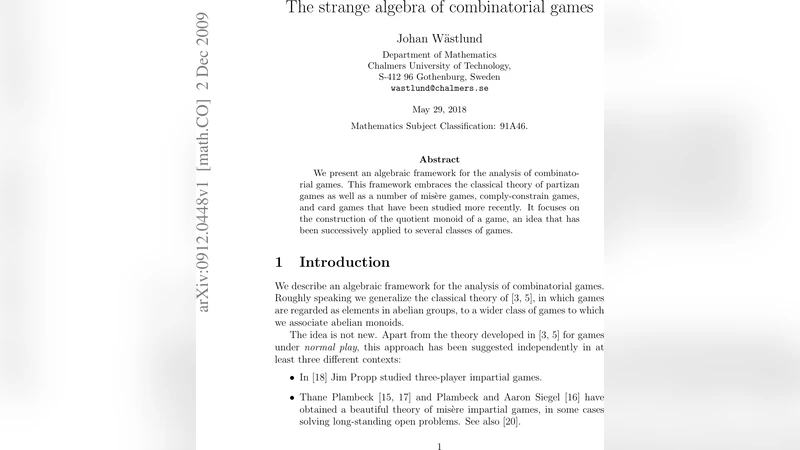
We present an algebraic framework for the analysis of combinatorial games. This framework embraces the classical theory of partizan games as well as a number of misere games, comply-constrain games, and card games that have been studied more recently. It focuses on the construction of the quotient monoid of a game, an idea that has been successively applied to several classes of games.
💡 Research Summary
The paper “The Strange Algebra of Combinatorial Games” proposes a unified algebraic framework for analyzing a broad spectrum of combinatorial games. It begins by observing that classical partizan game theory, misère game analysis, comply‑constrain variants, and many modern card‑game models have traditionally been treated with disparate mathematical tools. This fragmentation hampers the discovery of common structural principles, especially when dealing with hybrid or newly invented games.
To address this, the authors introduce the notion of a game monoid. For a set G of finite, deterministic games, they define an equivalence relation ∼: two games G₁ and G₂ are equivalent if, when added to any third game X, the outcome (win/lose for the first player) is identical. The quotient set G/∼, equipped with the natural disjunctive sum operation ⊕, satisfies associativity, has an identity element (the zero game with no moves), and thus forms a monoid. Each equivalence class captures the full strategic essence of its members, allowing the reduction of any game to a canonical representative.
The paper then applies this construction to four representative families:
-
Classical Partizan Games – By mapping each game to its left and right option sets, the authors recover Conway’s surreal number field. The monoid of partizan games is isomorphic to the additive group of surreal numbers; the ordering of games coincides with the usual surreal order, and the zero element corresponds to the neutral game.
-
Misère Games – Since the Sprague‑Grundy theorem does not extend directly to misère play, the authors introduce a new invariant called the core value. The core value is an integer that records the parity of the terminal losing condition. Two misère games are equivalent precisely when they share the same core value, and the monoid operation reduces to XOR of core values, mirroring the Nim‑heap structure but adapted to misère termination.
-
Comply‑Constrain Games – These games feature a two‑stage move: a player first complies by selecting a set of allowed moves, then the opponent constrains by eliminating some of those options. The authors model this as a pair of non‑commuting binary operations (⊕₁, ⊕₂). The resulting monoid is non‑abelian, and each equivalence class is described by a pair (A, C) where A is the comply set and C the constraint set. An explicit multiplication table is provided, demonstrating how strategic interactions compose.
-
Card Games (e.g., draw‑and‑discard variants) – Here the state consists of a multiset of cards and a remaining deck. The disjunctive sum corresponds to the multiset union of decks, leading to a commutative monoid of multisets. The authors identify canonical representatives for common hand configurations and give a concise algebraic description of draw‑and‑discard dynamics.
For each family, the paper supplies concrete representatives, explicit operation tables, and proofs that the quotient structures satisfy the monoid axioms. Moreover, the authors explore how familiar game‑theoretic concepts (ordering of partizan games, Grundy numbers, misère quotients) appear naturally within the monoid framework, establishing a dictionary between classical results and their algebraic counterparts.
The latter sections discuss extensions. By redefining equivalence to respect not only win/lose outcomes but also scoring functions, resource consumption, or probabilistic payoffs, one can generate richer monoids that capture additional dimensions of gameplay. The authors sketch algorithmic considerations: a hash‑based storage of equivalence classes, incremental construction of the operation table, and potential compression techniques for large monoids. They also outline future research directions, including infinite or loopy games, stochastic variants, multi‑player extensions, and connections to category theory (e.g., viewing games as objects and the sum as a coproduct).
In conclusion, the paper demonstrates that viewing combinatorial games through the lens of quotient monoids yields a powerful, unifying algebraic language. This language not only reproduces known results for well‑studied game families but also provides a systematic method for analyzing new or hybrid games, opening avenues for both theoretical exploration and practical algorithm design.
Comments & Academic Discussion
Loading comments...
Leave a Comment