Testing the No-Hair Theorem with Observations of Astrophysical Black Holes in the Electromagnetic Spectrum
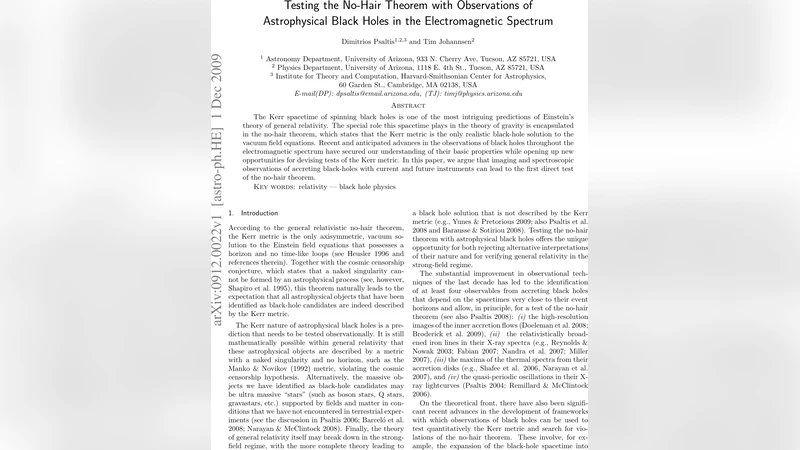
The Kerr spacetime of spinning black holes is one of the most intriguing predictions of Einstein’s theory of general relativity. The special role this spacetime plays in the theory of gravity is encapsulated in the no-hair theorem, which states that the Kerr metric is the only realistic black-hole solution of the vacuum field equations. Recent and anticipated advances in the observations of black holes throughout the electromagnetic spectrum have secured our understanding of their basic properties while opening up new opportunities for devising tests of the Kerr metric. In this paper, we argue that imaging and spectroscopic observations of accreting black-holes with current and future instruments can lead to the first direct test of the no-hair theorem.
💡 Research Summary
The paper presents a comprehensive strategy for testing the no‑hair theorem—specifically the uniqueness of the Kerr metric—as a direct probe of general relativity using electromagnetic observations of astrophysical black holes. It begins by outlining the theoretical foundation of the no‑hair theorem, emphasizing that in vacuum general relativity the only stationary, asymptotically flat black‑hole solution is described by two parameters: mass and spin. Any deviation from the Kerr geometry would imply the existence of additional “hair” and would therefore signal new physics beyond Einstein’s theory.
Two complementary observational avenues are explored. The first is high‑resolution imaging of the black‑hole shadow with current and next‑generation very‑long‑baseline interferometers such as the Event Horizon Telescope (EHT) and its planned successor, the ngEHT. The shadow’s boundary shape, size, and brightness asymmetry are highly sensitive to the underlying spacetime metric. By performing ray‑tracing simulations in parametrically deformed Kerr spacetimes (e.g., the Johannsen‑Psaltis metric) the authors quantify how non‑Kerr parameters alter the shadow morphology. They propose a Bayesian image‑reconstruction framework that can extract metric deviations while accounting for instrumental noise and model uncertainties.
The second avenue is X‑ray and optical/UV spectroscopy of the innermost accretion flow. The iron Kα fluorescence line, together with the continuum spectrum, encodes the location of the innermost stable circular orbit (ISCO), which in the Kerr solution is a deterministic function of spin. In deformed metrics the ISCO radius shifts, producing measurable changes in line width, skewness, and peak energy. The authors combine general‑relativistic magnetohydrodynamic (GR‑MHD) simulations with relativistic ray‑tracing to generate synthetic spectra for a range of deformation parameters. Using Bayesian inference they demonstrate how existing data from XMM‑Newton, NuSTAR, and NICER already place meaningful constraints, and they forecast the dramatic improvement expected from upcoming missions such as Athena and Lynx, whose superior energy resolution will resolve subtle line‑profile features at the percent level.
The paper also evaluates the synergy of multi‑wavelength, multi‑method observations. Consistency between spin estimates derived from shadow imaging and from spectral fitting would reinforce the Kerr hypothesis, whereas a statistically significant discrepancy would point to new gravitational physics. By integrating constraints from both domains within a unified statistical framework, systematic errors and model dependencies can be minimized.
In conclusion, the authors argue that while current observations are broadly compatible with the Kerr metric, the imminent arrival of higher‑sensitivity instruments will enable the first direct, model‑independent test of the no‑hair theorem. Their roadmap outlines specific observational campaigns, data‑analysis pipelines, and theoretical modeling efforts needed to either confirm the uniqueness of Kerr black holes or uncover deviations that could herald a breakthrough in our understanding of gravity.
Comments & Academic Discussion
Loading comments...
Leave a Comment