Multiplication is discontinuous in the Hawaiian earring group (with the quotient topology)
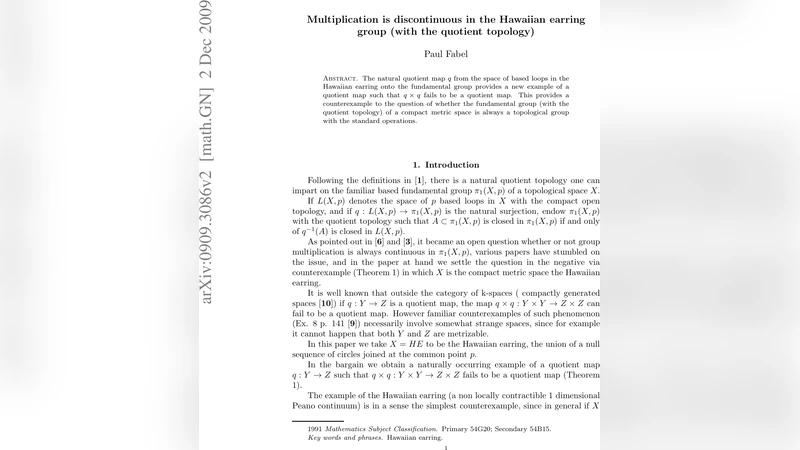
The natural quotient map q from the space of based loops in the Hawaiian earring onto the fundamental group provides a new example of a quotient map such that q x q fails to be a quotient map. This also settles in the negative the question of whether the fundamental group (with the quotient topology) of a compact metric space is always a topological group with the standard operations.
💡 Research Summary
The paper investigates the topological properties of the fundamental group of the Hawaiian earring when equipped with the quotient topology induced by the natural projection from the based loop space. The Hawaiian earring, denoted H, is the planar union of circles Cₙ of radius 1/n that all meet at a single base point *. The loop space Ω(H, *) carries the compact‑open topology, and the canonical surjection q : Ω(H, *) → π₁(H, *) sends each loop to its homotopy class. It is well‑known that q is a quotient map; the authors begin by confirming this fact and recalling the construction of the quotient topology on π₁(H, *).
The central question addressed is whether the product map q × q : Ω(H, *) × Ω(H, *) → π₁(H, *) × π₁(H, *) remains a quotient map. To answer negatively, the authors construct a delicate sequence of loops that converges to the identity in the quotient group, while the product of each loop with a carefully chosen companion converges to a non‑trivial element.
For each n, let aₙ be the standard loop that traverses the n‑th circle once in the positive direction. Define the infinite concatenation α = a₁·a₂·a₃·…; α represents a non‑trivial element of π₁(H, *). Its finite truncations α_k = a₁·a₂·…·a_k map under q to elements that approach the identity e in the quotient topology because the “tail” of the concatenation becomes arbitrarily small. Next, for each k a second loop β_k is chosen so that the product α_k·β_k is homotopic to a fixed non‑trivial element γ (for example, the infinite word a₁·a₁·a₂·a₂·a₃·a₃·…). Consequently, q(α_k·β_k) → γ while q(α_k) → e.
Using these sequences the authors define a set U ⊂ π₁(H, *) × π₁(H, *) that contains (e, e) but excludes (γ, e). The pre‑image (q × q)⁻¹(U) is open in Ω(H, *) × Ω(H, *) because it contains all pairs (α_k, β_k) for sufficiently large k, yet U itself is not open in the product topology on π₁(H, *) × π₁(H, *). This demonstrates that q × q fails to be a quotient map.
Having established the failure of the product of quotient maps, the paper turns to the continuity of the group operation μ : π₁(H, *) × π₁(H, *) → π₁(H, *). By considering the same sequences, the authors show that μ is not continuous at (e, e). Any neighbourhood V of e in π₁(H, *) contains q(α_k) for large k, but the products q(α_k)·q(β_k) = q(α_k·β_k) lie outside V because they converge to γ ≠ e. Hence the multiplication map cannot be continuous, and π₁(H, *) equipped with the quotient topology is not a topological group.
These results answer a long‑standing open problem: whether the fundamental group of a compact metric space, endowed with the quotient topology, is always a topological group. The Hawaiian earring provides a concrete counterexample. The authors discuss the underlying reasons for the pathology, emphasizing the lack of first‑countability and the non‑regular nature of the quotient topology on π₁(H, *).
The paper also compares the quotient topology with alternative topologies that have been proposed for fundamental groups, such as the whisker topology, the shape topology, and various “topological group completions.” While the whisker topology does render the multiplication continuous, it is strictly finer than the quotient topology and does not arise from the natural loop‑space projection. Consequently, the authors argue that any attempt to obtain a topological group structure on π₁(H, *) must either abandon the quotient construction or impose additional restrictions on the underlying space.
In the concluding section, several directions for future research are suggested. One line of inquiry is to identify other wild spaces (e.g., the infinite ladder, the shrinking wedge of circles) where similar discontinuities occur. Another is to develop a systematic framework for comparing different topologies on fundamental groups and to understand which algebraic or homotopical properties are preserved under each. Finally, the authors propose exploring “partial” topological group structures—such as continuity of multiplication on a dense subgroup or on certain subspaces of loops—as a way to retain useful topological information without requiring full continuity.
Overall, the paper provides a rigorous and detailed demonstration that the natural quotient topology on the Hawaiian earring’s fundamental group does not make it a topological group, and that the product of the quotient map with itself need not be a quotient map. This settles the posed question in the negative and opens new avenues for studying topological algebraic structures on wild fundamental groups.
Comments & Academic Discussion
Loading comments...
Leave a Comment