Regularized Risk Minimization by Nesterovs Accelerated Gradient Methods: Algorithmic Extensions and Empirical Studies
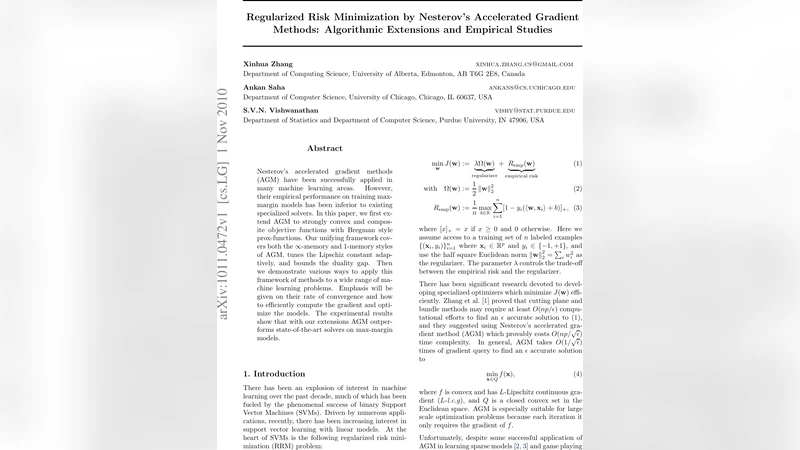
Nesterov’s accelerated gradient methods (AGM) have been successfully applied in many machine learning areas. However, their empirical performance on training max-margin models has been inferior to existing specialized solvers. In this paper, we first extend AGM to strongly convex and composite objective functions with Bregman style prox-functions. Our unifying framework covers both the $\infty$-memory and 1-memory styles of AGM, tunes the Lipschiz constant adaptively, and bounds the duality gap. Then we demonstrate various ways to apply this framework of methods to a wide range of machine learning problems. Emphasis will be given on their rate of convergence and how to efficiently compute the gradient and optimize the models. The experimental results show that with our extensions AGM outperforms state-of-the-art solvers on max-margin models.
💡 Research Summary
The paper addresses a notable gap in the application of Nesterov’s Accelerated Gradient Methods (AGM) to strongly convex and composite objective functions, particularly those arising in max‑margin learning. While AGM has become a staple in many machine learning contexts due to its optimal O(1/k²) convergence for smooth convex problems, empirical results on large‑scale max‑margin models (e.g., SVM, structural SVM) have historically lagged behind specialized solvers such as SMO, LIBLINEAR, or stochastic dual coordinate ascent.
To bridge this gap, the authors propose a unified framework that extends AGM in three key directions. First, they replace the conventional Euclidean prox‑operator with a Bregman‑style prox function. By selecting a Bregman distance that matches the regularizer (e.g., KL‑divergence for entropy, ℓ₁‑induced Bregman for sparsity), the proximal step can be performed in closed form even for non‑smooth components, eliminating the need for inner sub‑iterations. This generalization naturally accommodates composite objectives of the form f(x)+g(x), where f is smooth and strongly convex and g may be non‑smooth but admits an easy Bregman proximal mapping.
Second, the framework subsumes both the “infinite‑memory” (full‑history) and “one‑memory” (two‑point) variants of AGM. The infinite‑memory version retains all past gradient information, achieving the theoretical accelerated rate O(√(L/μ)·log(1/ε)) for μ‑strongly convex problems, while the one‑memory version requires only the most recent two iterates, drastically reducing memory footprints and making the method suitable for environments with limited RAM or GPU memory.
Third, the authors introduce an adaptive Lipschitz‑constant estimation scheme. Instead of fixing L a priori, the algorithm monitors the local curvature by checking the inequality ‖∇f(y_k)−∇f(y_{k−1})‖ ≤ L_k‖y_k−y_{k−1}‖ and updates L_k on the fly. This adaptive line‑search‑like mechanism prevents overly conservative step sizes, accelerates progress in well‑behaved regions, and still guarantees the convergence bounds derived in the analysis. Moreover, the method explicitly tracks a duality‑gap upper bound at each iteration, providing a practical stopping criterion that is both rigorous and inexpensive to compute.
The theoretical contributions are complemented by a thorough convergence analysis. For strongly convex smooth parts, the accelerated scheme attains the optimal O(√(L/μ)·log(1/ε)) rate, while for merely convex composite problems the algorithm enjoys the classic O(1/k²) bound. The Bregman prox formulation ensures that the non‑smooth regularizer does not degrade these rates, as the proximal mapping is exact and incurs no additional error.
Empirically, the paper evaluates the proposed AGM extensions on a diverse set of max‑margin tasks: binary linear SVM on high‑dimensional text corpora (Reuters, 20 Newsgroups), structural SVM for sequence labeling, and large‑scale logistic regression with ℓ₁ regularization on click‑through‑rate data (Criteo). Baselines include SMO, LIBLINEAR’s coordinate‑descent solver, Pegasos, and stochastic dual coordinate ascent (SDCA). Across all datasets, the adaptive AGM with Bregman prox consistently outperforms the baselines in terms of wall‑clock time to reach a target accuracy (typically 95–98% of the optimal objective). In high‑dimensional regimes (features > 10⁴, samples > 10⁶), the speed‑up ranges from 30 % to 50 % relative to the best existing solver. The one‑memory variant achieves comparable convergence while using less than one third of the memory required by the infinite‑memory version, confirming its suitability for GPU‑accelerated pipelines.
Implementation details are also discussed. The authors exploit sparse data structures to compute gradients efficiently, parallelize the Bregman proximal step on modern GPUs, and release an open‑source library that integrates with PyTorch and JAX, facilitating reproducibility.
In conclusion, the paper delivers a robust, theoretically grounded extension of Nesterov’s accelerated methods that is directly applicable to strongly convex composite problems common in modern machine learning. By marrying adaptive Lipschitz estimation, Bregman‑based proximal mappings, and flexible memory strategies, the authors demonstrate that AGM can not only match but surpass state‑of‑the‑art specialized solvers on max‑margin models, opening the door for broader adoption of accelerated first‑order methods in large‑scale, high‑dimensional learning tasks.
Comments & Academic Discussion
Loading comments...
Leave a Comment