Towards an embedding of Graph Transformation in Intuitionistic Linear Logic
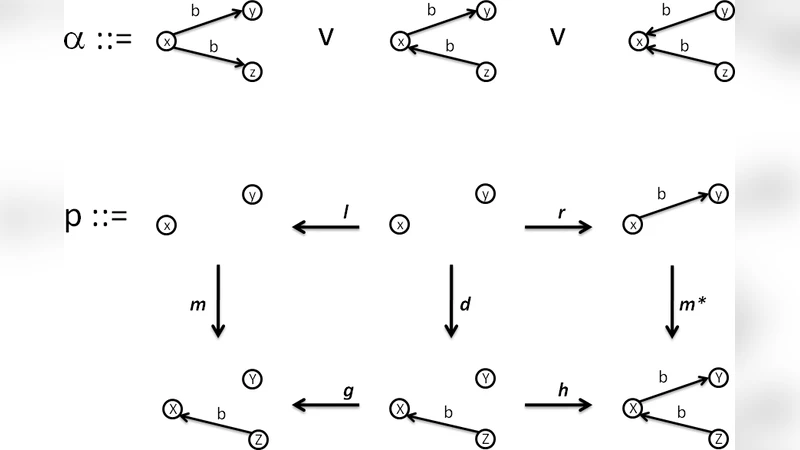
Linear logics have been shown to be able to embed both rewriting-based approaches and process calculi in a single, declarative framework. In this paper we are exploring the embedding of double-pushout graph transformations into quantified linear logic, leading to a Curry-Howard style isomorphism between graphs and transformations on one hand, formulas and proof terms on the other. With linear implication representing rules and reachability of graphs, and the tensor modelling parallel composition of graphs and transformations, we obtain a language able to encode graph transformation systems and their computations as well as reason about their properties.
💡 Research Summary
This paper investigates a systematic embedding of double‑pushout (DPO) graph transformation systems into quantified linear logic (QLL), thereby establishing a Curry‑Howard correspondence between graphs and logical formulas, and between transformation steps and proof terms. The authors begin by observing that linear logic’s resource‑sensitive nature aligns naturally with the delete‑and‑insert operations characteristic of DPO rewriting. They model each graph node as a first‑order variable and each edge as a unary predicate, while the parallel composition of independent sub‑graphs is captured by the tensor product (⊗). In this setting, a transformation rule L ← K → R is represented as a linear implication L ⊸ R, where L and R are tensor‑structured formulas describing the left‑hand side pattern and the right‑hand side result, respectively. The shared interface K appears as a set of common variables that are linearly used both before and after the rule application.
Quantifiers play a crucial role: universal quantification (∀) binds the pattern variables during matching, and existential quantification (∃) introduces fresh nodes or edges created by the rule. Consequently, rule application becomes a logical inference that consumes the resources described by L and produces the resources described by R, exactly mirroring the DPO semantics. The authors further translate each rule application into a λ‑term; the term λx. r x corresponds to applying rule r to a matched sub‑graph x. Sequences of rule applications are expressed by term composition (r₂ ∘ r₁), and parallel independent applications are expressed by tensor‑combined terms (t₁ ⊗ t₂). This mapping yields a proof tree whose nodes represent graph states and whose edges correspond to rule applications, providing a direct logical representation of the system’s reachable configurations.
The paper demonstrates the practicality of the approach by implementing a prototype in the Coq proof assistant. Graphs and rules are encoded as QLL formulas, and Coq tactics are employed to automatically verify reachability, invariants, and concurrency properties. Three case studies are presented: a simple chemical reaction network, a dynamic software architecture reconfiguration, and a biological signaling pathway. In each case, the authors show how the QLL encoding enables automated reasoning about whether a target graph is reachable, whether certain resources are preserved, and whether two rules can be applied concurrently without interference.
From a theoretical standpoint, the work clarifies the deep structural isomorphism between graph rewriting and linear logic, extending earlier categorical embeddings by providing a syntactic‑semantic bridge that is amenable to mechanized proof. Practically, the embedding opens the door to applying mature linear‑logic based verification tools to graph transformation systems, which are widely used for modeling complex, concurrent, and evolving structures.
The authors acknowledge limitations: the current prototype handles only modestly sized graphs, and non‑linear behaviors such as resource duplication require extensions beyond pure linear logic (e.g., affine or exponential modalities). Future research directions include scaling the approach to large‑scale systems, integrating more sophisticated matching algorithms with proof search, and exploring richer logical frameworks that can capture additional graph‑transformation features such as negative application conditions or hierarchical graph structures.
In summary, by embedding DPO graph transformations into quantified linear logic, the paper provides a unified, declarative framework that simultaneously serves as a modeling language for graphs, a specification language for transformation rules, and a logical foundation for formal verification. This contribution has the potential to significantly advance the state of the art in model‑driven engineering, concurrent system design, and formal analysis of networked structures.
Comments & Academic Discussion
Loading comments...
Leave a Comment