Session Types at the Mirror
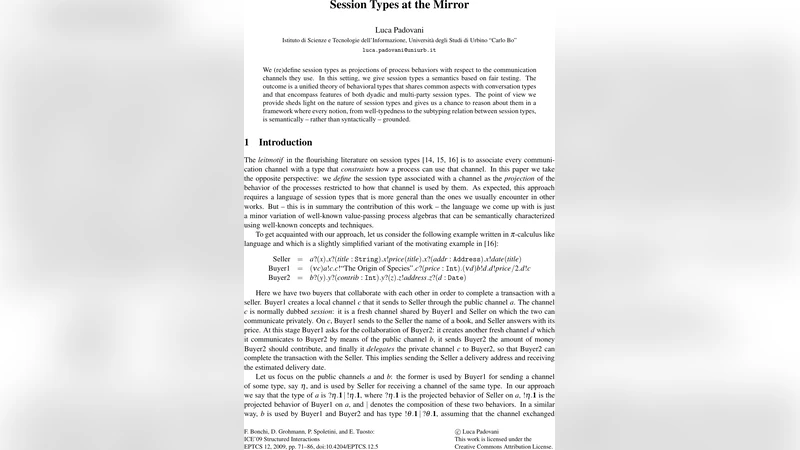
We (re)define session types as projections of process behaviors with respect to the communication channels they use. In this setting, we give session types a semantics based on fair testing. The outcome is a unified theory of behavioral types that shares common aspects with conversation types and that encompass features of both dyadic and multi-party session types. The point of view we provide sheds light on the nature of session types and gives us a chance to reason about them in a framework where every notion, from well-typedness to the subtyping relation between session types, is semantically -rather than syntactically- grounded.
💡 Research Summary
The paper presents a fundamentally new perspective on session types by defining them as projections of process behaviours with respect to the communication channels they use. Rather than relying on syntactic typing rules and linear type systems, the authors construct a semantics grounded in fair testing. This approach yields a unified theory that simultaneously accommodates dyadic (two‑party) and multiparty session protocols, while also clarifying the relationship between session types and conversation types.
Core Idea – Channel‑wise Projection
Given a process P and a channel c, the authors extract exactly those input and output actions that involve c, preserving their ordering, choice, and repetition structure. The extracted behaviour is then represented as a session type S_c. By performing this projection for every channel, a process is decomposed into a family of independent channel‑specific types. This decomposition is lossless at the behavioural level: the original process can be reconstructed by composing the projected types, yet each type isolates the protocol that a single channel must obey.
Fair‑Testing Semantics
Fair testing, originally introduced in process algebra, evaluates a process against all fair test environments—those that do not indefinitely postpone enabled actions. A session type is said to pass a fair test if any process implementing the type can always eventually respond to the test’s requests under a fair scheduler. This semantics is stronger than ordinary observational equivalence because it rules out spurious safety guarantees that arise from unfair scheduling or deadlocked loops. Consequently, a type’s semantics is defined as the set of all processes that pass exactly the same fair tests.
Semantic Subtyping
Traditional subtyping for session types is syntactic: a type T₁ is a subtype of T₂ if its syntax (e.g., selection/branching structure) is contained in T₂’s syntax. In the present framework, subtyping is semantic: T₁ ≤ T₂ iff every process that implements T₁ also passes every fair test that T₂ passes. In other words, T₁ is less restrictive in terms of observable behaviour. This definition captures subtle behavioural differences that syntactic rules miss, and it aligns subtyping directly with the notion of safe protocol refinement.
Relation to Conversation Types
Conversation types model the flow of a dialogue among participants, emphasizing “who says what and when”. The channel‑wise projection naturally records exactly this information: each projected type describes the sequence of messages on a particular channel, implicitly encoding the speaker and listener roles. The authors construct translation functions between conversation types and their projected session types, showing that the two form a semantic bridge. This bridge allows techniques developed for conversation types (e.g., reasoning about global choreography) to be applied within the session‑type setting, and vice‑versa, thereby simplifying the handling of complex global protocols.
Unifying Dyadic and Multiparty Session Types
Historically, dyadic and multiparty session types have been treated as distinct formalisms, each with its own syntax and typing discipline. The projection approach eliminates this separation: a multiparty protocol is simply a collection of dyadic projections, one per channel. By composing these projections, the global behaviour emerges without requiring a separate global type language. This unification enables a single type‑checking algorithm to verify both two‑party and many‑party protocols, and it makes reasoning about channel interleavings and synchronisation a matter of analysing the corresponding projected types.
Technical Contributions
-
Formal Definition of Projection – The paper introduces a rigorous mapping ⟦·⟧₍c₎ from processes to channel‑specific session types, together with proofs of soundness (the projected type faithfully represents the channel’s behaviour) and completeness (any behaviour admissible by the type can be realised by some process).
-
Fair‑Testing Based Type Semantics – By interpreting a session type as the set of processes that pass the same fair tests, the authors obtain a behavioral semantics that is independent of any particular syntactic typing discipline.
-
Semantic Subtyping Relation – The subtyping relation is proved to be a pre‑order that is congruent with parallel composition and restriction, guaranteeing that well‑typedness is preserved under process composition.
-
Integration of Conversation Types – Translation functions
toConversationandfromConversationare defined, and the paper proves that they are inverses up to fair‑testing equivalence, establishing an isomorphism between the two formalisms. -
Unified Type‑Checking Procedure – An algorithm is presented that, given a process and a set of channel projections, decides whether the process conforms to the projected types. The algorithm relies on checking inclusion of fair‑testing equivalence classes, which can be approximated using standard bisimulation techniques.
-
Formal Proofs of Soundness, Completeness, and Full Abstraction – The authors demonstrate that (i) any well‑typed process respects its session types under fair testing (soundness), (ii) any behaviour admitted by a session type can be realised by a well‑typed process (completeness), and (iii) the semantics is fully abstract with respect to the fair‑testing equivalence (full abstraction).
Implications and Future Directions
By grounding session types in a semantic framework, the paper resolves several longstanding issues: the ad‑hoc nature of syntactic subtyping, the difficulty of mixing dyadic and multiparty protocols, and the fragility of safety guarantees under unfair scheduling. The approach opens the door to semantic type inference, where a compiler could automatically derive the most permissive session type for a given process by analysing its fair‑testing behaviour. Moreover, the bridge to conversation types suggests that global choreography verification tools could be repurposed for session‑type‑based languages, potentially simplifying the development of correct distributed systems.
In summary, the work re‑imagines session types as channel‑centric behavioural projections equipped with a robust fair‑testing semantics. This yields a unified, semantically grounded theory that subsumes dyadic and multiparty session types, aligns subtyping with observable behaviour, and connects seamlessly to conversation types. The result is a more expressive, mathematically elegant foundation for type‑safe communication in concurrent and distributed programming.
Comments & Academic Discussion
Loading comments...
Leave a Comment