Note on Max Lin-2 above Average
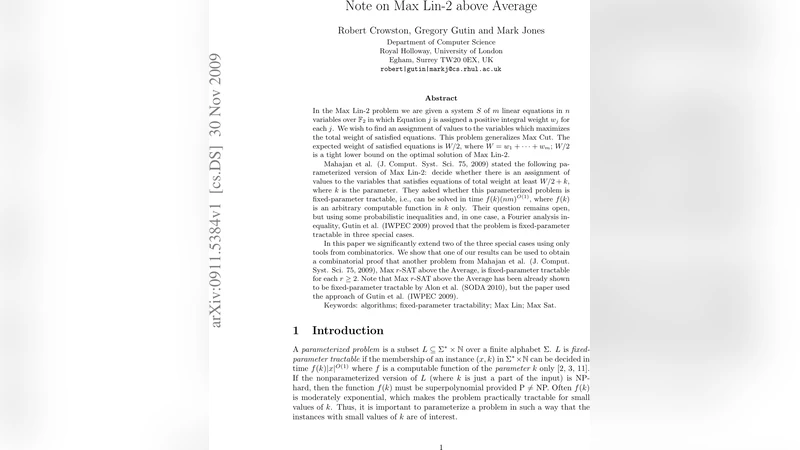
In the Max Lin-2 problem we are given a system $S$ of $m$ linear equations in $n$ variables over $\mathbb{F}_2$ in which Equation $j$ is assigned a positive integral weight $w_j$ for each $j$. We wish to find an assignment of values to the variables which maximizes the total weight of satisfied equations. This problem generalizes Max Cut. The expected weight of satisfied equations is $W/2$, where $W=w_1+… +w_m$; $W/2$ is a tight lower bound on the optimal solution of Max Lin-2. Mahajan et al. (J. Comput. Syst. Sci. 75, 2009) stated the following parameterized version of Max Lin-2: decide whether there is an assignment of values to the variables that satisfies equations of total weight at least $W/2+k$, where $k$ is the parameter. They asked whether this parameterized problem is fixed-parameter tractable, i.e., can be solved in time $f(k)(nm)^{O(1)}$, where $f(k)$ is an arbitrary computable function in $k$ only. Their question remains open, but using some probabilistic inequalities and, in one case, a Fourier analysis inequality, Gutin et al. (IWPEC 2009) proved that the problem is fixed-parameter tractable in three special cases. In this paper we significantly extend two of the three special cases using only tools from combinatorics. We show that one of our results can be used to obtain a combinatorial proof that another problem from Mahajan et al. (J. Comput. Syst. Sci. 75, 2009), Max $r$-SAT above the Average, is fixed-parameter tractable for each $r\ge 2.$ Note that Max $r$-SAT above the Average has been already shown to be fixed-parameter tractable by Alon et al. (SODA 2010), but the paper used the approach of Gutin et al. (IWPEC 2009).
💡 Research Summary
The paper addresses the “above‑average” version of the Max Lin‑2 problem, where a system S of m linear equations over (\mathbb{F}_2) with positive integer weights (w_1,\dots,w_m) is given, and the goal is to find an assignment that satisfies equations of total weight at least (W/2+k) (with (W=\sum_j w_j)). The baseline (W/2) is the expected weight of a random assignment and a tight lower bound on the optimum. Mahajan et al. (2009) posed the parameterized decision version with parameter k and asked whether it is fixed‑parameter tractable (FPT), i.e., solvable in time (f(k)\cdot (nm)^{O(1)}). While Gutin et al. (2009) showed FPT for three restricted cases using probabilistic inequalities and, in one case, a Fourier‑analysis bound, the general status remained open.
The contribution of this work is two‑fold. First, it extends two of the three special cases—(i) when each variable appears in a bounded number of equations, and (ii) when all equation weights lie in a bounded interval—using only elementary combinatorial tools. The authors develop a kernelization procedure based on a bipartite incidence graph between variables and equations. For case (i) they prove that any variable occurring in more than (2k) equations can be fixed (to 0 or 1) without losing more than (k) weight, by applying a simple counting argument derived from Markov’s inequality. Repeatedly fixing such high‑degree variables reduces the instance to a kernel with at most (O(k^2)) variables and equations. For case (ii) they show that if all weights are between 1 and a constant c and the total weight satisfies (W\le 2c k), then a random assignment already achieves the required excess (k); this follows from a Chernoff‑type bound on the deviation of the satisfied weight from its expectation. Consequently, after a polynomial‑time preprocessing step the remaining instance is guaranteed to be small, and an exhaustive search (or dynamic programming) over the kernel yields a solution in time (f(k)). Hence the decision problem is FPT for both extended families.
The second major contribution is a clean combinatorial reduction from Max r‑SAT above Average to Max Lin‑2 above Average. Each r‑clause can be expressed as a linear equation over (\mathbb{F}_2) with weight 1, and each variable appears in at most r equations. Therefore the transformed Max Lin‑2 instance satisfies the bounded‑degree condition (i) with degree r, and the weight‑balance condition (ii) with c = 1. Applying the kernelization described above yields a kernel of size (O(k^2)) for any fixed r ≥ 2, and the problem can be solved in FPT time. This provides a purely combinatorial proof of the FPT status of Max r‑SAT above Average, complementing the earlier Fourier‑analysis based proof by Alon et al. (2010) and the probabilistic approach of Gutin et al.
Beyond the technical results, the paper highlights several advantages of the combinatorial approach: the kernel size is explicit and quadratic in k, the algorithm is conceptually simple and easy to implement, and the same framework simultaneously handles two seemingly different problems. The authors also discuss potential extensions to more general Max Lin‑2 instances and to other “above‑average” parameterizations, suggesting that the techniques may be useful for a broader class of constraint satisfaction problems.
In summary, the authors present a kernelization‑based FPT algorithm for two broadened subclasses of Max Lin‑2 above Average, and they leverage this result to give a new combinatorial FPT proof for Max r‑SAT above Average (all r ≥ 2). This advances the understanding of parameterized complexity for weighted Boolean CSPs and opens avenues for further research on fixed‑parameter tractability of average‑excess optimization problems.
Comments & Academic Discussion
Loading comments...
Leave a Comment