Metrizable TAP, HTAP and STAP groups
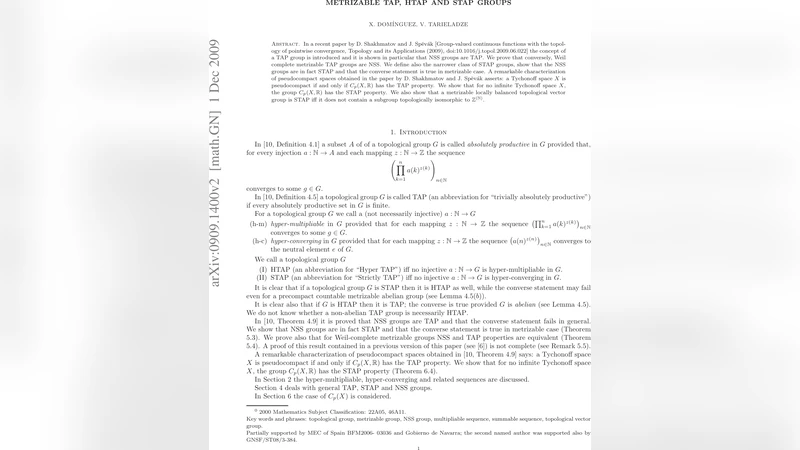
In a recent paper by D. Shakhmatov and J. Sp\v{e}v'ak [Group-valued continuous functions with the topology of pointwise convergence, Topology and its Applications (2009), doi:10.1016/j.topol.2009.06.022] the concept of a ${\rm TAP}$ group is introduced and it is shown in particular that ${\rm NSS}$ groups are ${\rm TAP}$. We prove that conversely, Weil complete metrizable ${\rm TAP}$ groups are ${\rm NSS}$. We define also the narrower class of ${\rm STAP}$ groups, show that the ${\rm NSS}$ groups are in fact ${\rm STAP}$ and that the converse statement is true in metrizable case. A remarkable characterization of pseudocompact spaces obtained in the paper by D. Shakhmatov and J. Sp\v{e}v'ak asserts: a Tychonoff space $X$ is pseudocompact if and only if $C_p(X,\mathbb R)$ has the ${\rm TAP}$ property. We show that for no infinite Tychonoff space $X$, the group $C_p(X,\mathbb R)$ has the ${\rm STAP}$ property. We also show that a metrizable locally balanced topological vector group is ${\rm STAP}$ iff it does not contain a subgroup topologically isomorphic to $\mathbb Z^{(\mathbb N)}$.
💡 Research Summary
The paper investigates three recently introduced topological properties of groups—TAP (Topology of pointwise convergence), HTAP (a weaker variant), and STAP (Strong TAP)—and clarifies their relationship with the classical NSS (No Small Subgroups) condition. After recalling the definitions, the authors prove that a TAP group which is both Weil‑complete and metrizable must be NSS. This result complements the known fact that every NSS group automatically satisfies TAP, thereby establishing an equivalence under the stated completeness and metrizability hypotheses.
Next, the authors define the stricter class STAP, requiring that any sequence converging to the identity eventually becomes constantly the identity. They show that all NSS groups are STAP, and, crucially, that in the metrizable setting the converse holds: a metrizable STAP group is necessarily NSS. The proof exploits the metric structure to turn the “eventual constancy” condition into a prohibition of non‑trivial small subgroups.
The paper then turns to function spaces. Building on a result of Shakhmatov and Spěvák, it is known that for a Tychonoff space X the group Cₚ(X,ℝ) (real‑valued continuous functions with the pointwise topology) has TAP precisely when X is pseudocompact. The authors strengthen this by showing that for any infinite Tychonoff space X, Cₚ(X,ℝ) cannot have STAP. The key observation is that Cₚ(X,ℝ) always contains a subgroup topologically isomorphic to the countable direct sum ℤ^{(ℕ)}; this subgroup fails STAP because it admits a sequence of non‑zero elements tending to zero without eventually becoming zero. Consequently, the whole function group inherits the failure of STAP.
Finally, the authors address topological vector groups. They prove that a metrizable locally balanced topological vector group is STAP if and only if it does not contain a subgroup topologically isomorphic to ℤ^{(ℕ)}. The “locally balanced” condition guarantees that scalar multiplication behaves uniformly in neighborhoods of the identity, allowing the authors to translate the absence of ℤ^{(ℕ)} into the STAP property.
Overall, the paper provides a clear hierarchy:
- NSS ⇒ TAP ⇒ HTAP, with TAP ⇔ NSS under Weil completeness + metrizability;
- NSS ⇔ STAP under metrizability;
- Cₚ(X,ℝ) has TAP ⇔ X is pseudocompact, but never STAP when X is infinite;
- For metrizable locally balanced vector groups, STAP is equivalent to the non‑existence of a ℤ^{(ℕ)} subgroup.
These results deepen the understanding of how small‑subgroup phenomena, completeness, and metrizability interact in topological groups, and they give concrete criteria for checking the STAP property in important classes such as function groups and topological vector spaces.
Comments & Academic Discussion
Loading comments...
Leave a Comment