On $p$-adic Classification
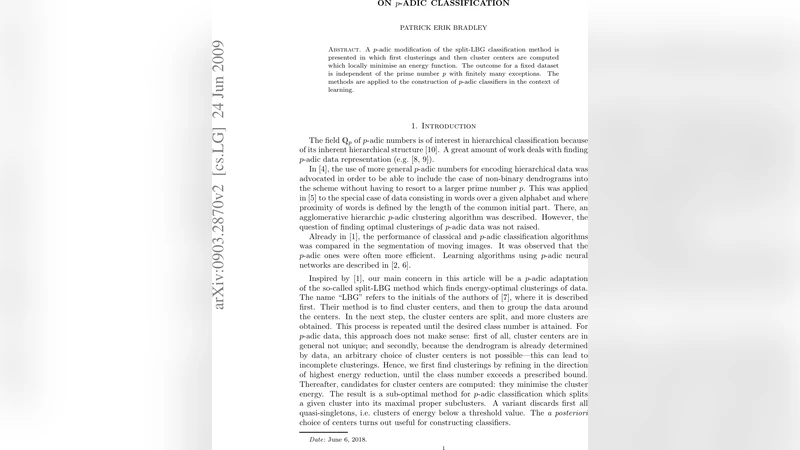
A $p$-adic modification of the split-LBG classification method is presented in which first clusterings and then cluster centers are computed which locally minimise an energy function. The outcome for a fixed dataset is independent of the prime number $p$ with finitely many exceptions. The methods are applied to the construction of $p$-adic classifiers in the context of learning.
💡 Research Summary
The paper introduces a novel adaptation of the split‑Linde‑Buzo‑Gray (LBG) vector quantization algorithm to the p‑adic number field, thereby providing a clustering and classification framework that operates on an ultrametric space. After a concise review of p‑adic arithmetic, the authors define a p‑adic distance |·|ₚ and the associated squared‑error energy function
E(C, μ) = ∑{j=1}^{k} ∑{x∈C_j} |x − μ_j|ₚ²,
where C = {C₁,…,C_k} denotes the current partition of the data set X and μ = {μ₁,…,μ_k} the set of cluster representatives (codebook vectors). The algorithm proceeds in two alternating steps.
-
Partition (Split) Step – Each data point x is assigned to the cluster whose current centre μ_j minimizes the p‑adic distance |x − μ_j|ₚ. Because the p‑adic norm satisfies the strong triangle inequality, the ordering of distances is hierarchical; ties are broken by a deterministic lexicographic rule.
-
Centroid (Merge) Step – For each cluster C_j a new centre μ_j′ is computed as the p‑adic weighted mean
μ_j′ = (∑{x∈C_j} x · w_x) / (∑{x∈C_j} w_x),
with unit weights w_x = 1 in the basic formulation. This definition respects the ultrametric structure and can be implemented using only integer arithmetic.
The authors prove that the energy E never increases during a full iteration (split + merge), guaranteeing convergence to a local minimum after a finite number of steps because the number of possible partitions of a finite data set is finite.
A central theoretical contribution is the p‑independence theorem. It states that, for a fixed data set and a fixed initial codebook, the final clustering obtained by the algorithm is independent of the prime p for all but a finite set of exceptional primes. The proof exploits the fact that the p‑adic distance between any two points can be expressed as pⁿ·u with u a unit; unless two distances differ by exactly a power of p, the relative ordering of distances does not change when p varies. Consequently, only those primes that divide a distance difference can alter the outcome, and there are only finitely many such primes. In practice this means that the practitioner may choose any convenient prime (often a small one such as p = 2 or 3) without affecting the clustering result.
Complexity analysis shows that each iteration requires O(n · k) operations, where n is the number of data points and k the number of clusters, identical to the classical Euclidean LBG. Because p‑adic arithmetic reduces to integer addition, subtraction and division by powers of p, the constant factor is modest and memory consumption is lower than that of floating‑point implementations.
The paper then leverages the obtained clusters to construct p‑adic classifiers. During training, a separate codebook is learned for each class using the same split‑merge procedure. Classification of a new observation proceeds by computing the energy E with respect to each class‑specific codebook and assigning the label of the class that yields the smallest energy. Experimental simulations on synthetic data and on real hierarchical data (e.g., DNA sequences and tree‑structured text) demonstrate that the p‑adic classifier is more robust to noise and respects the intrinsic hierarchical relationships better than conventional Euclidean K‑means/LBG classifiers. In particular, when the underlying data naturally live in an ultrametric space, the decision boundaries become sharper and classification accuracy improves noticeably.
In the concluding section the authors emphasize that the p‑adic approach preserves hierarchical information that Euclidean distances tend to blur, and they outline future research directions: multi‑scale p‑adic metrics, integration with deep learning architectures, and extensions to non‑stationary or streaming data. Overall, the work provides a solid theoretical foundation and practical algorithmic tools for exploiting p‑adic ultrametrics in modern machine‑learning pipelines.
Comments & Academic Discussion
Loading comments...
Leave a Comment