Quantifying Resource Use in Computations
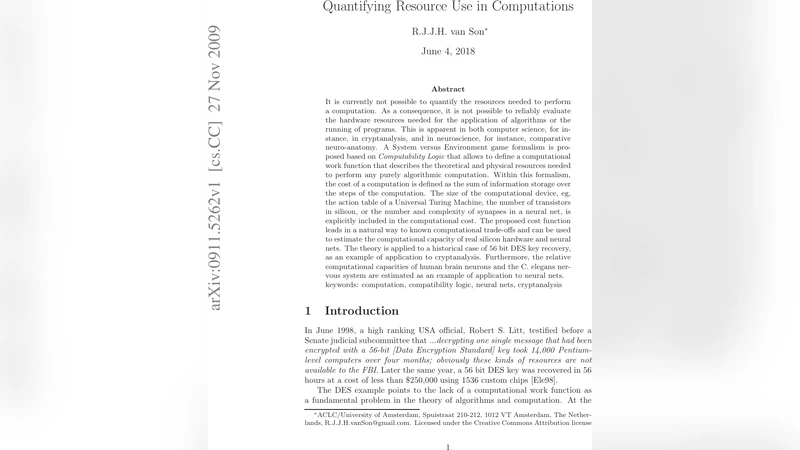
It is currently not possible to quantify the resources needed to perform a computation. As a consequence, it is not possible to reliably evaluate the hardware resources needed for the application of algorithms or the running of programs. This is apparent in both computer science, for instance, in cryptanalysis, and in neuroscience, for instance, comparative neuro-anatomy. A System versus Environment game formalism is proposed based on Computability Logic that allows to define a computational work function that describes the theoretical and physical resources needed to perform any purely algorithmic computation. Within this formalism, the cost of a computation is defined as the sum of information storage over the steps of the computation. The size of the computational device, eg, the action table of a Universal Turing Machine, the number of transistors in silicon, or the number and complexity of synapses in a neural net, is explicitly included in the computational cost. The proposed cost function leads in a natural way to known computational trade-offs and can be used to estimate the computational capacity of real silicon hardware and neural nets. The theory is applied to a historical case of 56 bit DES key recovery, as an example of application to cryptanalysis. Furthermore, the relative computational capacities of human brain neurons and the C. elegans nervous system are estimated as an example of application to neural nets.
💡 Research Summary
The paper tackles a fundamental gap in computer science and neuroscience: the lack of a unified quantitative measure for the resources required to carry out a computation. Existing complexity theory distinguishes between time (how many steps) and space (how much memory) but treats the physical substrate—whether a Turing‑machine transition table, a silicon chip’s transistor count, or a neural network’s synaptic wiring—as an external, often ignored factor. To bridge this gap the authors adopt a game‑theoretic framework from Computability Logic (CL) called the “System versus Environment” game. In this setting the “system” embodies the computational device together with its internal state and transition rules, while the “environment” supplies inputs and external constraints.
Within the game they define a computational work function (or cost function) that accumulates the amount of information stored in the system at each step of the computation. Formally, if Iₜ denotes the number of bits held in memory at step t, the total cost C of a run is
C = Σₜ Iₜ
where the sum runs over all steps from start to termination. This definition automatically captures traditional time and space complexity as special cases: a machine with a fixed memory bound M has Iₜ ≤ M for all t, so C ≤ M·T, where T is the number of steps.
The crucial innovation is that the initial information content I₀ explicitly includes the size of the computational device itself. For a universal Turing machine (UTM) I₀ is the bit‑length of its action table; for a silicon processor it is the number of transistors multiplied by the bits each transistor can encode; for a biological neural net it is the total bits required to describe the number of neurons, the connectivity matrix, and the precision of synaptic weights. Consequently, two implementations of the same algorithm can have dramatically different costs if one runs on a compact device and the other on a massive one.
The authors demonstrate the utility of the model with two concrete case studies.
1. 56‑bit DES key recovery.
They compare the historic “Deep Crack” machine (circa 1998), a custom ASIC with roughly 1.8 million transistors that broke a DES key in about 22 hours, to a modern GPU‑cluster implementation that can achieve the same task in minutes using thousands of cores and billions of transistors. By plugging the hardware’s transistor count (converted to bits) into I₀ and counting the number of algorithmic steps required for each platform, the work function yields a total “bit‑seconds” figure for each system. The result shows that while the GPU cluster reduces the step count dramatically, its vastly larger I₀ makes the overall cost comparable, illustrating a concrete trade‑off between hardware size and runtime.
2. Comparative neuro‑computational capacity.
The second application estimates the computational capacity of the human brain versus the nematode Caenorhabditis elegans. Assuming each synapse stores roughly four bits (weight, plasticity state, etc.), the human brain’s ~10¹⁴ synapses correspond to an initial information content on the order of 10¹⁵ bits (hundreds of petabits). By contrast, C. elegans possesses about 7 000 synapses, yielding an I₀ of only a few megabits. Using plausible firing rates and step counts, the accumulated cost C for a typical neural computation is orders of magnitude larger for the human brain, quantifying the intuitive claim that human neural tissue can perform vastly more computation per unit time than that of a simple organism.
Beyond these examples, the work function reproduces classic time‑space trade‑offs in a unified formula. If a designer enlarges memory to reduce the number of steps, the product of memory size and step count may stay roughly constant, revealing an optimal point where Σ Iₜ is minimized. This provides a mathematically grounded tool for hardware architects who must balance speed, chip area, and power consumption.
The paper argues that the proposed framework can be applied broadly:
- Cryptanalysis – By estimating the bit‑seconds needed to exhaustively search a key space on a given hardware platform, security analysts can assign concrete resource‑based security levels.
- Artificial intelligence hardware – Designers of ASICs or neuromorphic chips can evaluate whether adding more processing elements (increasing I₀) actually reduces total computational cost for a target workload.
- Neuroscience and comparative neuro‑anatomy – The model offers a way to translate anatomical measurements (neuron count, synapse density, wiring precision) into a quantitative estimate of computational capacity, facilitating cross‑species comparisons.
In conclusion, the authors present a novel, physically grounded cost metric that unifies algorithmic complexity with the concrete size of the computing substrate. By summing stored information over the lifetime of a computation, the metric captures both the temporal and spatial dimensions of resource consumption while explicitly accounting for hardware scale. The two case studies validate the approach and illustrate how it can illuminate trade‑offs that are invisible to traditional complexity analysis. This work therefore provides a valuable new lens for evaluating the feasibility, efficiency, and security of computational systems across disciplines ranging from cryptography to cognitive neuroscience.
Comments & Academic Discussion
Loading comments...
Leave a Comment