A note on Quadratic and Hermitian Groups
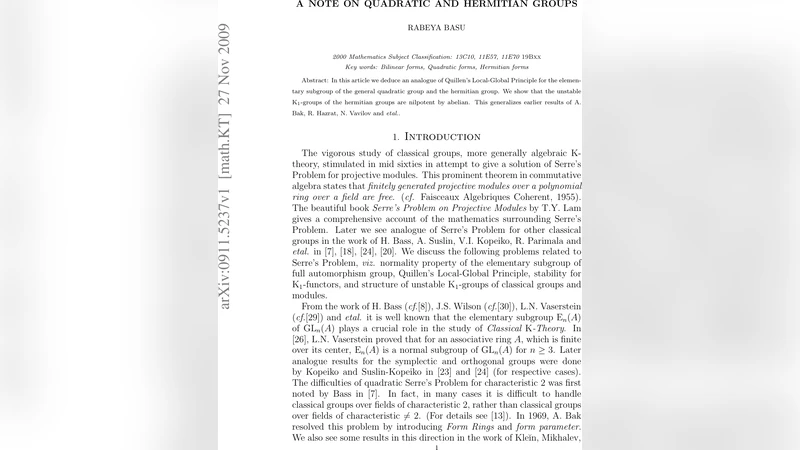
In this article we deduce an analogue of Quillen’s Local-Global Principle for the elementary subgroup of the general quadratic group and the hermitian group. We show that the unstable K_1-groups of the hermitian groups are nilpotent by abelian. This generalizes earlier results of A. Bak, R. Hazrat, N. Vavilov and etal..
💡 Research Summary
The paper “A note on Quadratic and Hermitian Groups” investigates two families of classical groups defined over a form ring ((R,\Lambda)): the general quadratic group (GQ_n(R,\Lambda)) and the hermitian group (GH_n(R,\Lambda)). The authors focus on the elementary subgroups (EQ_n(R,\Lambda)) and (EH_n(R,\Lambda)), which are generated by elementary transvections of the form (e_{ij}(a)) (with (a\in R)) and the “form” transvections (e_i(b)) (with (b\in\Lambda)). Their main goal is to extend Quillen’s Local‑Global Principle (LGP), originally proved for the general linear group (GL_n(R)), to these more intricate groups, and to analyze the structure of the corresponding unstable (K_1)-groups.
Section 1 – Preliminaries and Notation
The authors begin by recalling the notion of a form ring ((R,\Lambda)), where (R) is an associative ring with involution () and (\Lambda) is a form parameter (a right ideal satisfying certain compatibility conditions with ()). They define the quadratic form (q) and the hermitian form (h) associated with (\Lambda), and explain how the groups (GQ_n(R,\Lambda)) and (GH_n(R,\Lambda)) consist of matrices preserving these forms. The elementary generators are introduced precisely, and the basic commutator relations among them are listed; these relations are crucial for later normality arguments.
Section 2 – Transfer Maps and Localisation
A central technical tool is the construction of transfer (or “norm”) maps (\tau_f : GQ_n(R,\Lambda) \to GQ_n(S,\Lambda_S)) (and similarly for hermitian groups) induced by ring homomorphisms (f:R\to S). The paper proves that for any maximal ideal (\mathfrak m) of (R), the localisation map (R\to R_{\mathfrak m}) yields a surjective transfer on elementary subgroups. This surjectivity is essential for establishing a “local‑to‑global” passage: any relation that holds after localisation at every maximal ideal can be lifted to a global relation in the original group.
Section 3 – Quillen’s Local‑Global Principle for Quadratic and Hermitian Groups
The authors formulate the analogue of Quillen’s LGP: if an element (g\in GQ_n(R,\Lambda)) (or (GH_n(R,\Lambda))) becomes elementary after localisation at every maximal ideal, then (g) itself lies in the elementary subgroup. The proof proceeds in two stages. First, using the commutator formulas from Section 1, they show that elementary generators act transitively on unimodular rows, which yields a normality property for the elementary subgroup inside the full group. Second, they construct a finite “transfer chain” of localisation maps and apply a patching argument reminiscent of Quillen’s original proof for (GL_n). The result holds for all (n\ge 3), thereby covering the smallest rank where the groups are non‑trivial.
Section 4 – Structure of Unstable (K_1) for Hermitian Groups
The unstable (K_1)-group is defined as the quotient
\
Comments & Academic Discussion
Loading comments...
Leave a Comment