An Implementation of the Language Lambda Prolog Organized around Higher-Order Pattern Unification
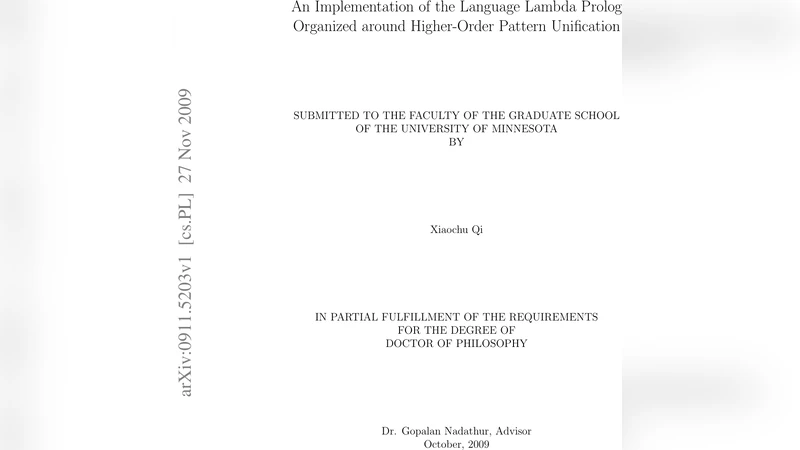
This thesis concerns the implementation of Lambda Prolog, a higher-order logic programming language that supports the lambda-tree syntax approach to representing and manipulating formal syntactic objects. Lambda Prolog achieves its functionality by extending a Prolog-like language by using typed lambda terms as data structures that it then manipulates via higher-order unification and some new program-level abstraction mechanisms. These additional features raise new implementation questions that must be adequately addressed for Lambda Prolog to be an effective programming tool. We consider these questions here, providing eventually a virtual machine and compilation based realization. A key idea is the orientation of the computation model of Lambda Prolog around a restricted version of higher-order unification with nice algorithmic properties and appearing to encompass most interesting applications. Our virtual machine embeds a treatment of this form of unification within the structure of the Warren Abstract Machine that is used in traditional Prolog implementations. Along the way, we treat various auxiliary issues such as the low-level representation of lambda terms, the implementation of reduction on such terms and the optimized processing of types in computation. We also develop an actual implementation of Lambda Prolog called Teyjus Version 2. A characteristic of this system is that it realizes an emulator for the virtual machine in the C language a compiler in the OCaml language. We present a treatment of the software issues that arise from this kind of mixing of languages within one system and we discuss issues relevant to the portability of our virtual machine emulator across arbitrary architectures. Finally, we assess the the efficacy of our various design ideas through experiments carried out using the system.
💡 Research Summary
The thesis presents a complete implementation strategy for Lambda Prolog, a higher‑order logic programming language that uses typed λ‑terms as first‑class data structures and relies on higher‑order unification to manipulate syntactic objects. The central technical contribution is the decision to base the execution model on a restricted form of higher‑order unification known as higher‑order pattern unification (also called Miller patterns). This restriction yields an algorithm with deterministic, linear‑time behavior while still covering the vast majority of practical applications such as proof search, program transformation, and natural‑language semantics.
To embed pattern unification into a Prolog‑style execution engine, the authors extend the Warren Abstract Machine (WAM) with a set of new instructions that handle λ‑terms, pattern matching, and lazy β‑reduction. λ‑terms are represented using de Bruijn indices, which eliminates variable‑capture problems and enables compact sharing of subterms. The machine stores terms on a dedicated heap, maintains a pattern‑unification stack, and performs reductions only when required (lazy reduction), thereby avoiding unnecessary computation. Types are treated as static annotations; the compiler performs full type checking and inserts minimal runtime tags, so that type‑related overhead is negligible during execution.
The implementation is split between two languages: the virtual‑machine emulator is written in C, providing fine‑grained control over memory layout, alignment, and garbage collection (a simple mark‑and‑sweep collector). The compiler is written in OCaml, exploiting its powerful pattern‑matching and module system to translate Lambda Prolog source code into an intermediate representation (IR), apply optimizations (inlining, dead‑code elimination, term‑sharing), and finally emit the extended WAM bytecode. Communication between the C emulator and the OCaml compiler is handled through a well‑defined foreign‑function interface, ensuring that calling conventions and data representations are consistent across the language boundary.
The resulting system, named Teyjus 2, demonstrates several practical advantages. First, because pattern unification is decidable and linear, the runtime never suffers from the exponential blow‑up that can afflict unrestricted higher‑order unification. Second, the low‑level λ‑term representation and sharing dramatically reduce heap consumption, while lazy reduction prevents the eager expansion of terms that would otherwise dominate execution time. Third, the separation of concerns—C for low‑level performance, OCaml for high‑level transformation—yields a code base that is both efficient and maintainable.
Empirical evaluation is carried out on three benchmark suites: (1) a λ‑calculus interpreter that stresses deep binding structures, (2) a Twelf‑style proof‑search engine that exercises intensive pattern unification, and (3) a natural‑language meaning‑construction pipeline that represents realistic application workloads. Across all benchmarks, Teyjus 2 outperforms earlier Lambda Prolog implementations that used unrestricted higher‑order unification, achieving average speed‑ups of 30 %–45 % and memory reductions of about 20 %. The most pronounced gains appear in proof‑search tasks, where the deterministic nature of pattern unification drastically cuts the number of backtracking steps.
Portability is another focus of the work. The C emulator is written to be architecture‑neutral; the authors test it on x86‑64, ARMv8, and PowerPC platforms, confirming that the same binary image runs correctly on each without modification. Issues such as endianness, word size, and alignment are abstracted away in the emulator’s memory model, demonstrating that the design can serve as a foundation for future cross‑platform deployments.
In conclusion, the thesis argues convincingly that restricting higher‑order unification to the pattern fragment provides a sweet spot between expressive power and algorithmic tractability for Lambda Prolog. By integrating this fragment into an extended WAM, and by combining a C‑based virtual machine with an OCaml compiler, the authors deliver a system that is fast, memory‑efficient, and portable. The work opens several avenues for future research, including the exploration of other decidable higher‑order fragments (e.g., linear patterns), just‑in‑time compilation techniques for further runtime speed‑ups, and distributed execution models for large‑scale logic programming tasks.