A compartmental model of the cAMP/PKA/MAPK pathway in Bio-PEPA
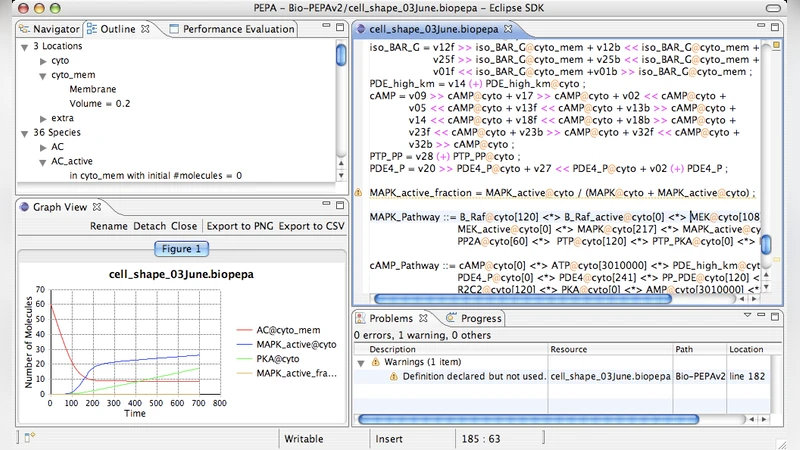
The vast majority of biochemical systems involve the exchange of information between different compartments, either in the form of transportation or via the intervention of membrane proteins which are able to transmit stimuli between bordering compartments. The correct quantitative handling of compartments is, therefore, extremely important when modelling real biochemical systems. The Bio-PEPA process algebra is equipped with the capability of explicitly defining quantitative information such as compartment volumes and membrane surface areas. Furthermore, the recent development of the Bio-PEPA Eclipse Plug-in allows us to perform a correct stochastic simulation of multi-compartmental models. Here we present a Bio-PEPA compartmental model of the cAMP/PKA/MAPK pathway. We analyse the system using the Bio-PEPA Eclipse Plug-in and we show the correctness of our model by comparison with an existing ODE model. Furthermore, we perform computational experiments in order to investigate certain properties of the pathway. Specifically, we focus on the system response to the inhibition and strengthening of feedback loops and to the variation in the activity of key pathway reactions and we observe how these modifications affect the behaviour of the pathway. These experiments are useful to understand the control and regulatory mechanisms of the system.
💡 Research Summary
The paper presents a comprehensive compartmental model of the cAMP/PKA/MAPK signaling cascade using the Bio‑PEPA process algebra, and demonstrates how the recent Bio‑PEPA Eclipse Plug‑in can be employed to perform accurate stochastic simulations of multi‑compartment biochemical systems. The authors begin by highlighting the importance of correctly handling compartments in cellular models, noting that many biological processes involve transport across membranes or signaling mediated by membrane proteins. Traditional ODE‑based models often treat the cell as a well‑mixed volume, ignoring the distinct volumes of extracellular space, cytosol, and nucleus, as well as the surface areas of membranes that influence transport rates.
To address this limitation, the authors construct a Bio‑PEPA model that explicitly defines three compartments: extracellular, cytoplasmic, and nuclear. For each compartment they specify the molecular species (cAMP, PKA, MAPK, and associated kinases/phosphatases) and the biochemical reactions that occur within or across compartments. The model includes the generation of cAMP by adenylate cyclase, its degradation by phosphodiesterase, activation of PKA by cAMP, the sequential phosphorylation events of the MAPK cascade (MEK, ERK), and feedback loops where downstream MAPK activity can modulate upstream components. Crucially, transport reactions are modeled as separate Bio‑PEPA actions that depend on compartment volumes and membrane surface areas, allowing the simulation to capture concentration changes that arise from dilution or accumulation in different spaces.
Parameter values (rate constants, initial concentrations) are taken from a well‑established deterministic ODE model of the same pathway, while compartment volumes and membrane areas are derived from typical mammalian cell measurements. The model is encoded in the Bio‑PEPA language and loaded into the Eclipse Plug‑in, which uses Gillespie’s stochastic simulation algorithm to generate time‑course trajectories. The authors compare the stochastic mean trajectories with the deterministic ODE solution and find excellent agreement for key observables such as cAMP concentration, active PKA levels, and doubly phosphorylated MAPK (ppERK). This validation confirms that Bio‑PEPA can faithfully reproduce the average behavior of the system while also providing insight into stochastic fluctuations that are invisible to deterministic approaches.
Having validated the model, the authors conduct a series of computational experiments to probe the regulatory architecture of the pathway. First, they manipulate the strength of the negative feedback loop in which MAPK activity inhibits upstream PKA activation. Weakening or removing this feedback leads to a prolonged cAMP surge and hyper‑activation of both PKA and MAPK, illustrating the loop’s role in dampening signal overshoot. Strengthening the feedback, on the other hand, accelerates signal termination and reduces the peak amplitude of downstream MAPK activation. Second, they perform sensitivity analyses by varying the catalytic efficiencies of key enzymes. Doubling the activity of adenylate cyclase produces a non‑linear amplification of the entire cascade, whereas increasing phosphodiesterase activity sharply reduces cAMP levels and consequently attenuates PKA and MAPK activation. These manipulations demonstrate how the pathway can be tuned by altering specific enzymatic steps, a finding relevant for drug targeting.
Finally, the authors explore how changes in compartment geometry affect signaling dynamics. Increasing compartment volume dilutes molecular concentrations, slowing the rise of cAMP and downstream responses, while enlarging membrane surface area enhances transport rates, leading to faster signal propagation. This geometric sensitivity analysis underscores the necessity of explicit compartment modeling when translating in‑vitro kinetic data to in‑vivo cellular contexts.
In conclusion, the study showcases Bio‑PEPA as a powerful formalism for constructing and analyzing multi‑compartment biochemical networks. By integrating quantitative compartment information with stochastic simulation, the authors provide a more realistic representation of the cAMP/PKA/MAPK pathway than traditional ODE models. Their systematic exploration of feedback modulation, enzyme activity variation, and compartment geometry yields valuable insights into the control mechanisms governing signal fidelity and robustness. The work paves the way for future extensions that incorporate additional organelles (e.g., endoplasmic reticulum, mitochondria) and spatial diffusion, ultimately enabling whole‑cell signaling models that can inform both basic biology and therapeutic design.
Comments & Academic Discussion
Loading comments...
Leave a Comment