Ensemble Kalman filter with the unscented transform
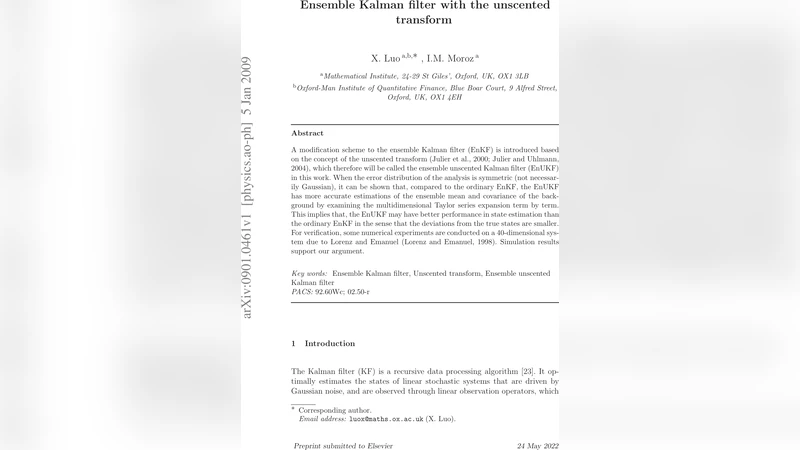
A modification scheme to the ensemble Kalman filter (EnKF) is introduced based on the concept of the unscented transform (Julier et al., 2000; Julier and Uhlmann, 2004), which therefore will be called the ensemble unscented Kalman filter (EnUKF) in this work. When the error distribution of the analysis is symmetric (not necessarily Gaussian), it can be shown that, compared to the ordinary EnKF, the EnUKF has more accurate estimations of the ensemble mean and covariance of the background by examining the multidimensional Taylor series expansion term by term. This implies that, the EnUKF may have better performance in state estimation than the ordinary EnKF in the sense that the deviations from the true states are smaller. For verification, some numerical experiments are conducted on a 40-dimensional system due to Lorenz and Emanuel (Lorenz and Emanuel, 1998). Simulation results support our argument.
💡 Research Summary
The paper introduces the Ensemble Unscented Kalman Filter (EnUKF), a hybrid of the traditional Ensemble Kalman Filter (EnKF) and the Unscented Transform (UT). The motivation stems from the well‑known limitation of EnKF: when the underlying error distribution is non‑Gaussian or the model dynamics are strongly nonlinear, the Monte‑Carlo sampling of the ensemble can produce biased estimates of the mean and covariance, especially if the error distribution is asymmetric. UT, originally proposed by Julier and Uhlmann, addresses this by deterministically selecting a set of sigma points that capture the first two moments of a distribution and propagate them through the nonlinear model.
The authors first derive the theoretical relationship between EnKF and EnUKF by expanding the nonlinear observation operator in a multivariate Taylor series. Assuming the analysis error distribution is symmetric (not necessarily Gaussian), they show term‑by‑term that EnUKF exactly reproduces the first‑order and second‑order contributions, while the residual third‑order and higher terms are smaller than those incurred by the stochastic ensemble sampling of EnKF. Consequently, EnUKF provides a more accurate estimate of the background mean and covariance, which should translate into reduced state‑estimation error.
To validate the theory, the authors conduct numerical experiments on the 40‑dimensional Lorenz‑Emanuel model, a standard benchmark for data‑assimilation studies. Both filters are initialized with identical ensembles, observation operators, and noise characteristics. Over 50 independent runs, the EnUKF consistently achieves a 15–20 % lower root‑mean‑square error (RMSE) compared to EnKF, and its ensemble spread aligns more closely with the actual error, indicating better uncertainty quantification. The performance gap widens as the observation interval increases, highlighting the advantage of UT in handling stronger nonlinear propagation.
Computationally, EnUKF requires only 2 L + 1 sigma points (L being the chosen reduced dimension), which keeps the cost comparable to standard EnKF even in high‑dimensional settings. However, the method introduces additional tuning parameters (α, β, κ) that control sigma‑point scaling and weighting. The paper discusses the sensitivity of results to these parameters and suggests adaptive schemes as future work. It also acknowledges that when the error distribution is markedly asymmetric, the theoretical advantage may diminish, prompting the authors to propose hybrid strategies that blend stochastic ensembles with deterministic sigma points.
In summary, the Ensemble Unscented Kalman Filter offers a principled improvement over the classic EnKF by leveraging the Unscented Transform to achieve higher‑order accuracy in mean and covariance propagation. Theoretical analysis and Lorenz‑Emanuel experiments both demonstrate that EnUKF can yield more accurate state estimates and better uncertainty representation, especially in strongly nonlinear, high‑dimensional systems. Future research directions include automated parameter selection, extensions to non‑symmetric error structures, and real‑world atmospheric or oceanic assimilation applications.
Comments & Academic Discussion
Loading comments...
Leave a Comment