Le monde arabe face aux defis de leau : enjeux et conflits
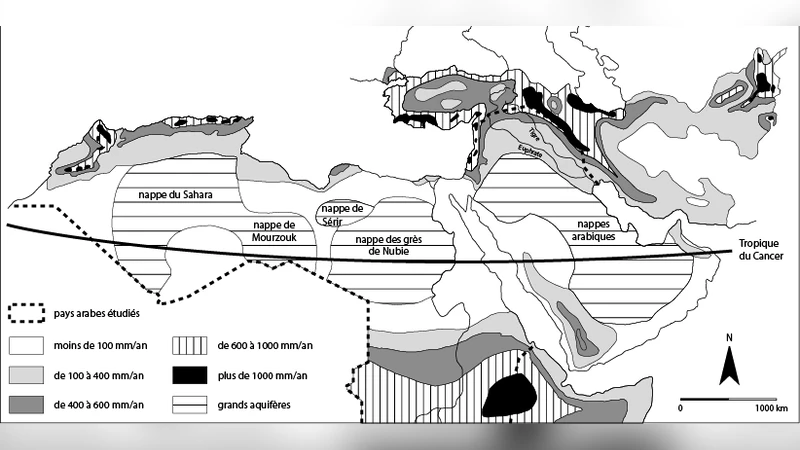
In the past years, water has become a global concern. This essential and irreplaceable resource is unevenly distributed between Continents. North Africa and Middle East Arabic countries appear to be the most menaced area. From a starting point : 4.3% of the world population has access to only 0.67% of the resources for sustainable soft water. After decades of voluntarism, self-help, and of technical and development keen interest, times of worries have started. Since the 50’s, all the efforts, in the Arabic World, have tended towards the mobilization of increasing volumes. The expected advantages of irrigated agriculture and production of electricity have been lauded, as well as the extension of distribution networks in cities and country side districts. Today’s big construction works contribute to legitimize present acting teams: projects such as the Assouan high dam in Egypt, in its time the largest in the world and the Syrian dam of Tabqa, the Moroccan slogan for a million irrigated hectares. Under the triple shock of drought, pollution, and the tremendous growth of needs engendered by population increase and urban growth, the natural resource which we thought would be available for ever has become a scarce economical good. The terms change fundamentally: scarcity, shortage, pollution, confrontation are the key words of a new problematic time. Past certainties fade away. We all have to ask ourselves the right questions and draw conclusions. It might be better in this field not to adopt too sharp attitudes and not to criticize systematically what used to be a short time ago the way to progress.
💡 Research Summary
The paper provides a comprehensive examination of the water crisis confronting the Arab world, highlighting the interplay of demographic pressure, climate variability, and historical water‑management policies. It begins by quantifying the stark global imbalance: 4.3 % of the world’s population controls only 0.67 % of renewable freshwater resources. This disparity is especially acute in North Africa and the Middle East, where arid climates, limited precipitation, and rapid desertification constrain natural water availability.
Since the 1950s, Arab states have pursued a “big‑dam” strategy to overcome scarcity. The Aswan High Dam in Egypt, once the world’s largest, the Tabqa Dam in Syria, and Morocco’s “one‑million‑hectare” irrigation ambition are cited as emblematic projects. Initially, these infrastructures delivered tangible benefits: expanded irrigated acreage, increased agricultural yields, and new hydro‑electric capacity. However, the paper argues that the long‑term consequences expose fundamental flaws. Dams trap sediments, degrade downstream ecosystems, and suffer from reduced generation efficiency as reservoirs age. Large‑scale irrigation accelerates soil salinization and over‑exploits aquifers, undermining the very productivity it was meant to secure.
Concurrently, the Arab region has experienced explosive population growth (averaging 2–3 % per year) and rapid urbanization. Water demand has shifted from a predominantly agricultural focus (≈70 % of total withdrawals) toward industrial and domestic uses (≈30 %). Existing water‑management frameworks, still oriented around massive irrigation schemes, fail to accommodate this structural shift, leading to mismatches between supply and demand.
Pollution compounds the scarcity problem. Unregulated industrial effluents and untreated municipal wastewater degrade surface‑water quality, limiting reuse options and raising treatment costs. The degradation of water quality transforms a once‑abundant resource into an expensive economic good, intensifying competition among users.
The paper further emphasizes that water has transitioned from a “soft” natural resource to a strategic economic and political asset. Scarcity fuels potential interstate and intra‑regional conflicts, threatens food security, and amplifies social inequities as water prices rise. Consequently, the authors call for a paradigm shift away from reliance on large‑scale infrastructure toward an integrated, sustainable water‑management approach.
Key recommendations include: (1) adopting advanced irrigation technologies such as drip and precision‑watering systems to boost water‑use efficiency; (2) modernizing wastewater treatment facilities and promoting the reuse of reclaimed water for agriculture and industry; (3) implementing demand‑management policies—pricing reforms, public awareness campaigns, and regulatory standards—to encourage conservation; (4) establishing robust trans‑boundary water‑governance mechanisms to mitigate conflict and enable cooperative resource sharing; and (5) embedding water security within national development strategies, recognizing its dual role as a vital life‑supporting element and a strategic commodity.
In sum, the paper argues that the Arab world’s water crisis cannot be solved by expanding supply alone. A multifaceted strategy that combines technological innovation, efficient demand management, pollution control, and regional cooperation is essential for achieving long‑term water security and sustainable development.
Comments & Academic Discussion
Loading comments...
Leave a Comment