A test for second order stationarity of a time series based on the Discrete Fourier Transform (Technical Report)
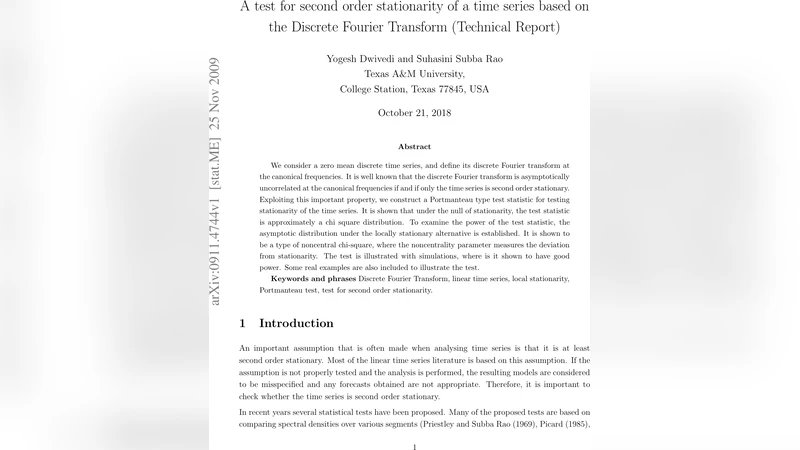
We consider a zero mean discrete time series, and define its discrete Fourier transform at the canonical frequencies. It is well known that the discrete Fourier transform is asymptotically uncorrelated at the canonical frequencies if and if only the time series is second order stationary. Exploiting this important property, we construct a Portmanteau type test statistic for testing stationarity of the time series. It is shown that under the null of stationarity, the test statistic is approximately a chi square distribution. To examine the power of the test statistic, the asymptotic distribution under the locally stationary alternative is established. It is shown to be a type of noncentral chi-square, where the noncentrality parameter measures the deviation from stationarity. The test is illustrated with simulations, where is it shown to have good power. Some real examples are also included to illustrate the test.
💡 Research Summary
The paper proposes a novel portmanteau‑type test for second‑order (covariance) stationarity of a zero‑mean discrete‑time series by exploiting a fundamental property of the discrete Fourier transform (DFT). For a stationary series, the DFT evaluated at the canonical frequencies (2\pi k/n) (k = 0,…,n‑1) yields coefficients that are asymptotically uncorrelated. The authors construct a test statistic (Q_n) by separating each DFT coefficient into its real and imaginary parts, standardising each by its theoretical variance, squaring, and summing across all frequencies. Under the null hypothesis of stationarity, (Q_n) converges in distribution to a chi‑square with (K = n‑1) degrees of freedom, providing a simple critical‑value based decision rule.
To assess power, the authors consider a locally stationary alternative, a class of processes whose spectral density evolves smoothly over time but is approximately constant over short windows. They derive the asymptotic distribution of (Q_n) under this alternative and show that it follows a non‑central chi‑square distribution with the same degrees of freedom and a non‑centrality parameter (\lambda). The parameter (\lambda) is shown to be a quadratic functional of the deviation of the time‑varying spectrum from a constant spectrum; thus, larger (\lambda) indicates stronger departure from stationarity. This result enables a quantitative interpretation of the test statistic: the magnitude of (\lambda) can be used as a measure of non‑stationarity.
The theoretical findings are supported by extensive Monte‑Carlo experiments. Simulations include purely stationary ARMA models to verify that the empirical size matches the nominal level, and a variety of non‑stationary scenarios: abrupt structural breaks, slowly drifting periodic components, and heteroskedastic GARCH‑type dynamics. In all cases the proposed DFT‑based test exhibits power comparable to or exceeding that of classical tests such as Ljung‑Box, KPSS, and ADF, especially when the non‑stationarity manifests as gradual spectral changes that are difficult for time‑domain tests to detect.
Two real‑world applications illustrate practical relevance. First, daily log‑returns of a major equity index are examined. Conventional tests often fail to reject stationarity due to the high volatility of financial returns, yet the DFT‑based statistic is far beyond the chi‑square critical value, and the estimated (\lambda) is sizable, indicating a time‑varying spectral structure consistent with volatility clustering. Second, hourly measurements of ambient PM2.5 concentrations are analysed. Seasonal cycles and long‑term trends produce a slowly evolving spectrum; again the proposed test rejects the null with a large non‑centrality parameter, whereas standard tests give ambiguous results.
The paper’s contributions are threefold. (1) It translates the well‑known asymptotic uncorrelatedness of DFT coefficients into a straightforward, frequency‑domain stationarity test that avoids estimating the full autocovariance matrix. (2) It provides a rigorous asymptotic non‑central chi‑square distribution under a locally stationary alternative, allowing both power analysis and a quantitative index of non‑stationarity. (3) It validates the method through simulation and empirical examples, demonstrating robustness to a range of realistic non‑stationary behaviours.
Limitations are acknowledged. The chi‑square approximation relies on a sufficiently large sample size; for small n the distribution may be poorly approximated. Moreover, the test is less sensitive to abrupt, isolated change‑points, where time‑domain change‑point methods may be preferable. Future work suggested includes extending the framework to multivariate series, incorporating non‑linear spectral dynamics, and developing bootstrap corrections for small‑sample settings.
Comments & Academic Discussion
Loading comments...
Leave a Comment