Advances in Calibration and Imaging Techniques in Radio Interferometry
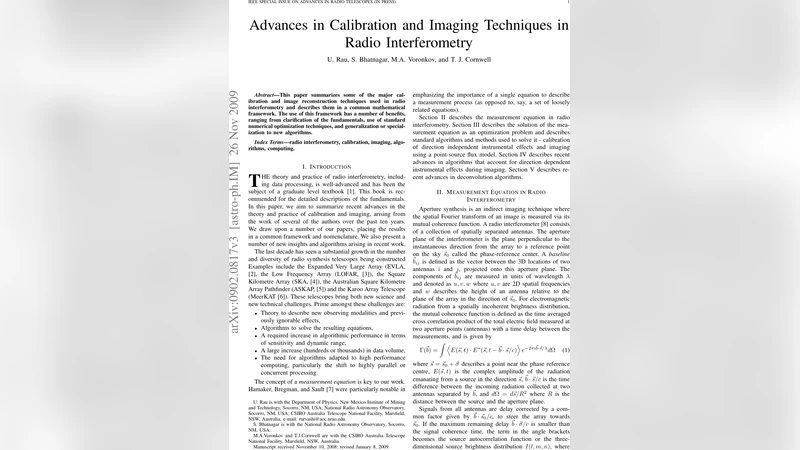
This paper summarizes some of the major calibration and image reconstruction techniques used in radio interferometry and describes them in a common mathematical framework. The use of this framework has a number of benefits, ranging from clarification of the fundamentals, use of standard numerical optimization techniques, and generalization or specialization to new algorithms.
💡 Research Summary
The paper presents a unified mathematical framework that brings together the major calibration and image‑reconstruction techniques used in radio interferometry, showing how they can be viewed as instances of a single non‑linear optimization problem. It begins by describing the measurement equation, which relates the true sky brightness distribution to the observed visibilities through a series of complex Jones matrices that encode both direction‑independent effects (DIE) such as antenna gains and direction‑dependent effects (DDE) arising from the atmosphere, ionosphere, and primary‑beam variations.
In the calibration section, the authors first review traditional direction‑independent calibration methods, including antenna‑based gain solving and self‑calibration, which iteratively refine antenna gains using an initial sky model. They then discuss the limitations of these approaches when strong DDE are present, leading to residual artefacts that cannot be removed by DIE‑only solutions. To address this, the paper details modern DDE‑aware strategies such as A‑projection, AW‑projection, and global non‑linear least‑squares solvers that incorporate DDE directly into the forward model. These methods either apply convolution kernels in the Fourier domain before imaging or solve for DDE parameters jointly with antenna gains, thereby achieving higher fidelity in the calibrated data.
The imaging portion of the work surveys the evolution from the classic CLEAN algorithm, which assumes a sparse point‑source model and removes the brightest residual iteratively, to more sophisticated variants like multi‑scale CLEAN, maximum entropy methods (MEM), and compressed‑sensing‑based reconstructions. The latter employ L1‑norm sparsity penalties and total‑variation regularization to recover both compact and extended emission even at low signal‑to‑noise ratios. By expressing all these techniques as the minimization of a cost function consisting of a data‑fidelity term plus one or more regularization terms, the authors demonstrate that a wide range of solvers—ADMM (Alternating Direction Method of Multipliers), FISTA (Fast Iterative Shrinkage‑Thresholding Algorithm), and variational Bayesian approaches—can be applied in a modular fashion.
A key insight of the paper is that calibration and imaging are not separate pipelines but two facets of the same inverse problem. This realization enables the reuse of algorithmic components, simplifies the development of hybrid methods (for example, integrating deep‑learning priors with traditional regularizers), and provides a clear pathway for extending existing algorithms to new regimes such as wide‑field, wide‑band, and ultra‑large‑array observations. The authors illustrate the practical benefits of the framework with case studies on simulated SKA‑like datasets, showing reductions in computational cost and improvements in dynamic range compared with legacy pipelines.
Finally, the paper outlines future research directions, including more accurate physical modeling of propagation effects, joint multi‑frequency and multi‑epoch calibration, and the incorporation of machine‑learning‑derived priors into the unified optimization. By positioning calibration and imaging within a common mathematical language, the work offers a powerful foundation for the next generation of radio interferometric data processing, promising both higher scientific accuracy and the scalability required for upcoming facilities such as the Square Kilometre Array.
Comments & Academic Discussion
Loading comments...
Leave a Comment