Gain/loss asymmetry in time series of individual stock prices and its relationship to the leverage effect

Reading time: 6 minute
...

📝 Original Info

  • Title: Gain/loss asymmetry in time series of individual stock prices and its relationship to the leverage effect
  • ArXiv ID: 0911.4679
  • Date: 2009-11-25
  • Authors: Researchers from original ArXiv paper

📝 Abstract

Previous research has shown that for stock indices, the most likely time until a return of a particular size has been observed is longer for gains than for losses. We establish that this so-called gain/loss asymmetry is present also for individual stocks and show that the phenomenon is closely linked to the well-known leverage effect -- in the EGARCH model and a modified retarded volatility model, the same parameter that governs the magnitude of the leverage effect also governs the gain/loss asymmetry.

💡 Deep Analysis

Deep Dive into Gain/loss asymmetry in time series of individual stock prices and its relationship to the leverage effect.

Previous research has shown that for stock indices, the most likely time until a return of a particular size has been observed is longer for gains than for losses. We establish that this so-called gain/loss asymmetry is present also for individual stocks and show that the phenomenon is closely linked to the well-known leverage effect – in the EGARCH model and a modified retarded volatility model, the same parameter that governs the magnitude of the leverage effect also governs the gain/loss asymmetry.

📄 Full Content

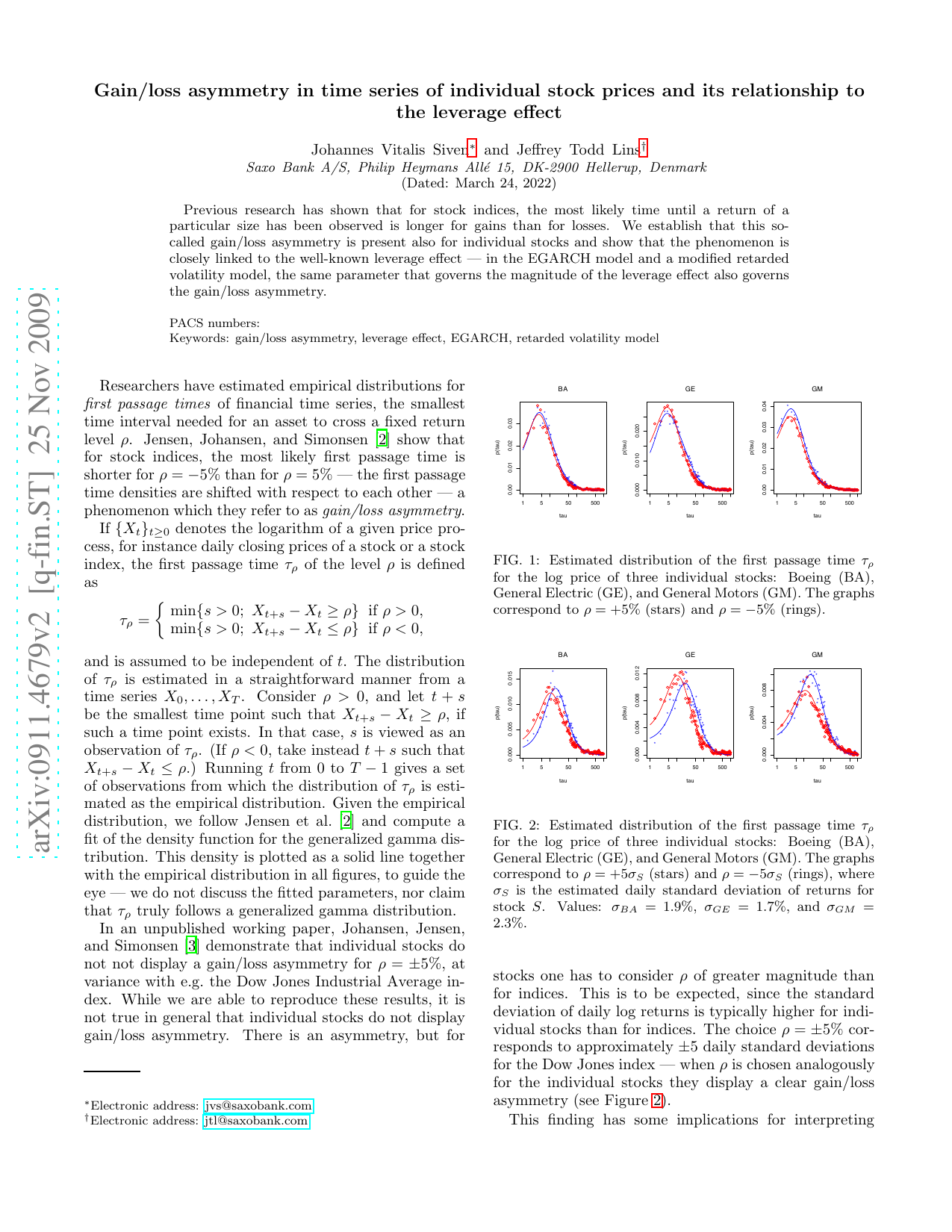
arXiv:0911.4679v2 [q-fin.ST] 25 Nov 2009 Gain/loss asymmetry in time series of individual stock prices and its relationship to the leverage effect Johannes Vitalis Siven∗and Jeffrey Todd Lins† Saxo Bank A/S, Philip Heymans All´e 15, DK-2900 Hellerup, Denmark (Dated: March 24, 2022) Previous research has shown that for stock indices, the most likely time until a return of a particular size has been observed is longer for gains than for losses. We establish that this so- called gain/loss asymmetry is present also for individual stocks and show that the phenomenon is closely linked to the well-known leverage effect — in the EGARCH model and a modified retarded volatility model, the same parameter that governs the magnitude of the leverage effect also governs the gain/loss asymmetry. PACS numbers: Keywords: gain/loss asymmetry, leverage effect, EGARCH, retarded volatility model Researchers have estimated empirical distributions for first passage times of financial time series, the smallest time interval needed for an asset to cross a fixed return level ρ. Jensen, Johansen, and Simonsen [2] show that for stock indices, the most likely first passage time is shorter for ρ = −5% than for ρ = 5% — the first passage time densities are shifted with respect to each other — a phenomenon which they refer to as gain/loss asymmetry. If {Xt}t≥0 denotes the logarithm of a given price pro- cess, for instance daily closing prices of a stock or a stock index, the first passage time τρ of the level ρ is defined as τρ =  min{s > 0; Xt+s −Xt ≥ρ} if ρ > 0, min{s > 0; Xt+s −Xt ≤ρ} if ρ < 0, and is assumed to be independent of t. The distribution of τρ is estimated in a straightforward manner from a time series X0, . . . , XT . Consider ρ > 0, and let t + s be the smallest time point such that Xt+s −Xt ≥ρ, if such a time point exists. In that case, s is viewed as an observation of τρ. (If ρ < 0, take instead t + s such that Xt+s −Xt ≤ρ.) Running t from 0 to T −1 gives a set of observations from which the distribution of τρ is esti- mated as the empirical distribution. Given the empirical distribution, we follow Jensen et al. [2] and compute a fit of the density function for the generalized gamma dis- tribution. This density is plotted as a solid line together with the empirical distribution in all figures, to guide the eye — we do not discuss the fitted parameters, nor claim that τρ truly follows a generalized gamma distribution. In an unpublished working paper, Johansen, Jensen, and Simonsen [3] demonstrate that individual stocks do not not display a gain/loss asymmetry for ρ = ±5%, at variance with e.g. the Dow Jones Industrial Average in- dex. While we are able to reproduce these results, it is not true in general that individual stocks do not display gain/loss asymmetry. There is an asymmetry, but for ∗Electronic address: jvs@saxobank.com †Electronic address: jtl@saxobank.com 1 5 50 500 0.00 0.01 0.02 0.03 BA tau p(tau) * * * ** * * ** * *** ************************************************************************** 1 5 50 500 0.000 0.010 0.020 GE tau p(tau) * * ** * * ** ** * ** *********** ***** **** ************************************************************ 1 5 50 500 0.00 0.01 0.02 0.03 0.04 GM tau p(tau) * * **** * ** ** *** ******* ******************************************************************** FIG. 1: Estimated distribution of the first passage time τρ for the log price of three individual stocks: Boeing (BA), General Electric (GE), and General Motors (GM). The graphs correspond to ρ = +5% (stars) and ρ = −5% (rings). 1 5 50 500 0.000 0.005 0.010 0.015 BA tau p(tau) * * * * * * * * * * * * ** * ***** ** * * * * ** * ******** ** ********* * ***************************************************** 1 5 50 500 0.000 0.004 0.008 0.012 GE tau p(tau) * * * * * * * * * * **** ** ** ** ** * ** * **** * * *** ***** ** ** ***** * *** * ** ******************************************* 1 5 50 500 0.000 0.004 0.008 GM tau p(tau) * * ** * * * * * * * * ** * ** * * ** *** ** * * ****** ******** ***** ******* ******** **************************************************** FIG. 2: Estimated distribution of the first passage time τρ for the log price of three individual stocks: Boeing (BA), General Electric (GE), and General Motors (GM). The graphs correspond to ρ = +5σS (stars) and ρ = −5σS (rings), where σS is the estimated daily standard deviation of returns for stock S. Values: σBA = 1.9%, σGE = 1.7%, and σGM = 2.3%. stocks one has to consider ρ of greater magnitude than for indices. This is to be expected, since the standard deviation of daily log returns is typically higher for indi- vidual stocks than for indices. The choice ρ = ±5% cor- responds to approximately ±5 daily standard deviations for the Dow Jones index — when ρ is chosen analogously for the individual stocks they display a clear gain/loss asymmetry (see Figure 2). This finding has some implications for interpreting 2 other results in the literature. Donangelo, Jensen, Si- monsen, and Snep

…(Full text truncated)…

📸 Image Gallery

cover.png page_2.webp page_3.webp

Reference

This content is AI-processed based on ArXiv data.

Start searching

Enter keywords to search articles

↑↓
ESC
⌘K Shortcut