G3 : GENESIS software envrionment update
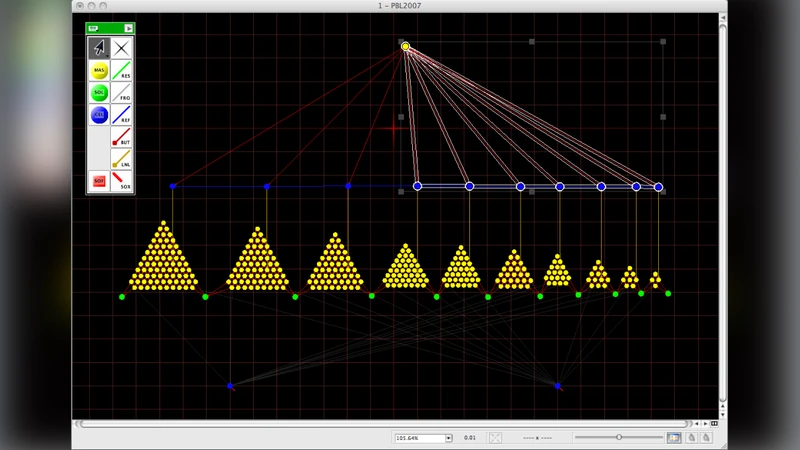
GENESIS3 is the new version of the GENESIS software environment for musical creation by means of mass-interaction physics network modeling. It was designed, and developed from scratch, in hindsight of more than 10 years working on and using the previous version. We take the opportunity of this birth to provide in this article (1) an analysis of the peculiarities in GENESIS, aiming at highlighting its core ?software paradigm?; and (2) an update on the features of the new version as compared to the last.
💡 Research Summary
The paper presents GENESIS3, the latest incarnation of the GENESIS software environment for music creation through mass‑interaction physics network modeling. Building on more than a decade of experience with its predecessor, GENESIS3 is not merely an incremental update but a ground‑up redesign that preserves the core “mass‑interaction network” paradigm while addressing the technical limitations of the earlier version. The authors first outline the distinctive software paradigm: a network of masses, springs, dampers, and other physical elements is assembled graphically; the network itself becomes the input and output of a real‑time physics engine, eliminating the traditional separation between parameter control and audio rendering. This paradigm enforces two design principles: data structures and computation reside in the same layer, and modularity enables reuse of individual physical blocks across different projects.
The paper then details five major advances introduced in GENESIS3. (1) A multi‑core‑aware real‑time simulation engine automatically partitions the network’s computational load across available CPU cores, allowing thousands of interacting masses to be processed without frame‑rate drops. (2) A revamped visual programming interface provides drag‑and‑drop node placement, a rich preset library, and context‑sensitive hints, dramatically lowering the entry barrier for newcomers. (3) An extensible scripting layer, with native Python and Lua bindings, lets users embed custom algorithms directly into the network or load user‑written DSP modules compiled in C++. (4) Standardized data‑exchange formats—including OSC, MIDI, and JSON‑based metadata—facilitate seamless interoperability with digital audio workstations, live‑performance rigs, and educational tools. (5) Integrated collaboration and version‑control features enable cloud‑based project sharing and Git‑style change tracking.
To illustrate the practical impact, the authors describe two case studies. In a live‑performance scenario, a complex string‑instrument model receives real‑time sensor data from a performer’s gestures; the physics engine translates these gestures into natural‑sounding timbral variations, demonstrating the system’s low latency and expressive potential. In an educational context, students manipulate spring constants and masses in a simple resonator network, hearing immediate auditory feedback that reinforces abstract physics concepts.
The discussion concludes that GENESIS3 opens new avenues for research and artistic practice. Its multi‑core simulation and scriptable architecture empower composers, sound designers, and researchers to prototype sophisticated physical models, evaluate them audibly in real time, and iterate rapidly. The authors outline a future roadmap that includes GPU‑accelerated simulation, deeper cloud collaboration tools, and machine‑learning‑driven parameter optimization. Overall, GENESIS3 is positioned as a versatile platform for interactive sound design, instrument prototyping, performance art, and interdisciplinary education, extending the unique mass‑interaction paradigm into modern computing environments.
Comments & Academic Discussion
Loading comments...
Leave a Comment