A tight upper bound on the (2,1)-total labeling number of outerplanar graphs
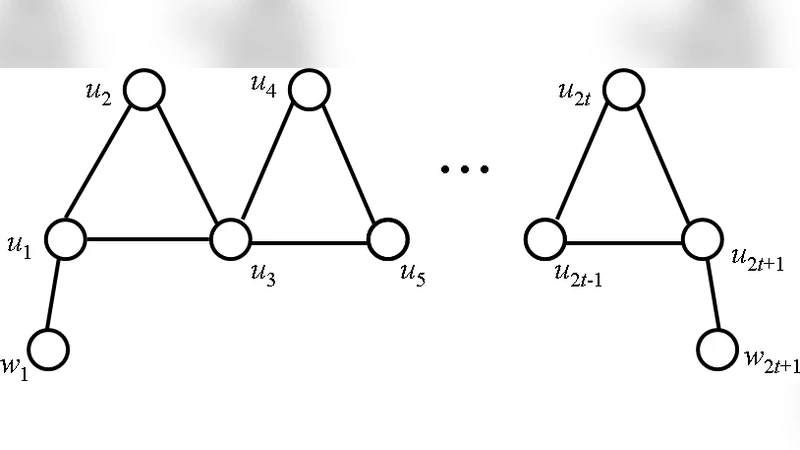
A $(2,1)$-total labeling of a graph $G$ is an assignment $f$ from the vertex set $V(G)$ and the edge set $E(G)$ to the set ${0,1,…,k}$ of nonnegative integers such that $|f(x)-f(y)|\ge 2$ if $x$ is a vertex and $y$ is an edge incident to $x$, and $|f(x)-f(y)|\ge 1$ if $x$ and $y$ are a pair of adjacent vertices or a pair of adjacent edges, for all $x$ and $y$ in $V(G)\cup E(G)$. The $(2,1)$-total labeling number $\lambda^T_2(G)$ of a graph $G$ is defined as the minimum $k$ among all possible assignments. In [D. Chen and W. Wang. (2,1)-Total labelling of outerplanar graphs. Discr. Appl. Math. 155, 2585–2593 (2007)], Chen and Wang conjectured that all outerplanar graphs $G$ satisfy $\lambda^T_2(G) \leq \Delta(G)+2$, where $\Delta(G)$ is the maximum degree of $G$, while they also showed that it is true for $G$ with $\Delta(G)\geq 5$. In this paper, we solve their conjecture completely, by proving that $\lambda^T_2(G) \leq \Delta(G)+2$ even in the case of $\Delta(G)\leq 4 $.
💡 Research Summary
The paper addresses the (2,1)-total labeling problem, a variant of graph labeling where both vertices and edges receive integer labels from {0,…,k}. The labeling must satisfy two distance constraints: any vertex and an incident edge must differ by at least 2, while any two adjacent vertices or any two adjacent edges must differ by at least 1. The smallest integer k for which such a labeling exists is called the (2,1)-total labeling number λ⁽ᵀ⁾₂(G).
In 2007, Chen and Wang proved that for outerplanar graphs (graphs that can be drawn in the plane without crossings such that all vertices lie on the outer face) the inequality λ⁽ᵀ⁾₂(G) ≤ Δ(G)+2 holds whenever the maximum degree Δ(G) is at least 5. They conjectured that the same bound should be true for all outerplanar graphs, regardless of Δ, but the case Δ ≤ 4 remained open.
The present work resolves the conjecture completely. The authors develop a constructive, inductive proof that works for every outerplanar graph, including those with Δ = 2, 3, or 4. Their methodology can be summarized in four main components:
-
Preliminaries and Structural Observations – The authors recall the definition of (2,1)-total labeling, introduce notation, and emphasize two crucial structural facts about outerplanar graphs: (i) they are 2‑connected or can be decomposed into 2‑connected blocks, and (ii) each block contains at least one “outer path” (a path whose vertices all lie on the outer face).
-
Base Cases for Small Maximum Degree – Explicit labelings are presented for the smallest outerplanar graphs: paths, cycles, and small grids with Δ = 2, 3, or 4. These constructions use the full label set {0,…,Δ+2} and demonstrate that the constraints can be satisfied with a margin of at least two unused labels, which later serves as the “slack” needed for inductive extensions.
-
Inductive Reduction by Vertex Removal – For a generic outerplanar graph G, the authors locate a vertex v of degree 1 or 2 (such a vertex always exists in an outerplanar graph). Removing v yields a smaller outerplanar graph G′ with the same maximum degree. By the induction hypothesis, G′ admits a (2,1)-total labeling using labels up to Δ+2. The authors then show how to re‑insert v and its incident edges without violating any distance constraints. The key observation is that, because the labeling uses Δ+2 as the top label, at least two label values remain free in the neighborhood of v, guaranteeing a feasible placement for v’s label and for the incident edge labels.
-
Detailed Case Analysis for Δ = 4 – The most delicate part of the proof concerns graphs with maximum degree four. Here the authors distinguish two structural configurations that can cause potential conflicts: (a) the presence of two disjoint outer paths that share a common interior region, and (b) the existence of an interior triangle (a 3‑cycle) attached to the outer face. For each configuration they devise a systematic “relabeling” scheme. The scheme fixes the extreme labels 0 and Δ+2 on selected vertices to act as anchors, then cyclically shifts the intermediate labels along the paths or around the triangle. This process eliminates any violation of the “difference at least 2” rule between a vertex and its incident edges while preserving the “difference at least 1” rule among adjacent vertices or edges. The authors provide exhaustive sub‑cases, demonstrating that in every possible arrangement a feasible labeling can be constructed.
Because the inductive step works for any vertex of degree 1 or 2, and the base cases cover all graphs with Δ ≤ 4, the proof establishes that every outerplanar graph G satisfies λ⁽ᵀ⁾₂(G) ≤ Δ(G)+2. Moreover, the constructive nature of the proof yields a polynomial‑time algorithm that, given an outerplanar graph, produces an explicit (2,1)-total labeling meeting the bound.
The significance of the result is twofold. First, it confirms the long‑standing conjecture of Chen and Wang, showing that the bound Δ+2 is tight for the entire class of outerplanar graphs. Second, the techniques—particularly the careful handling of the Δ = 4 case—provide a template for tackling similar labeling problems on broader graph families, such as planar graphs or graphs with higher girth. The paper thus closes an important gap in the theory of graph labelings and opens avenues for future research on (p,q)-total labelings in more complex topological settings.
Comments & Academic Discussion
Loading comments...
Leave a Comment