Bigraphical models for protein and membrane interactions
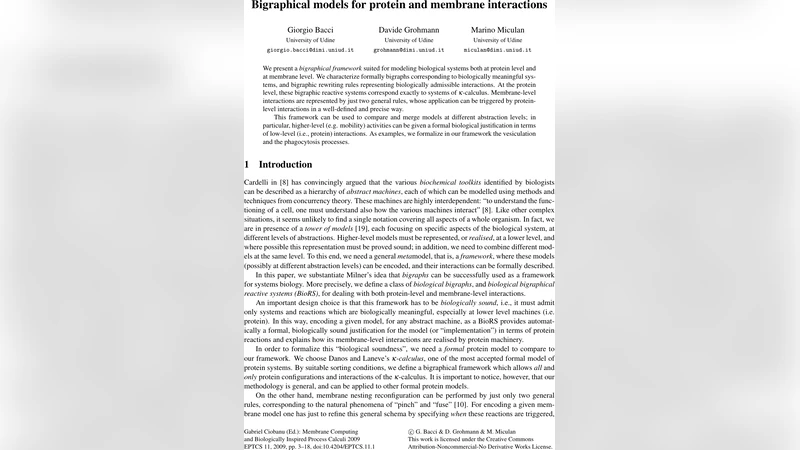
We present a bigraphical framework suited for modeling biological systems both at protein level and at membrane level. We characterize formally bigraphs corresponding to biologically meaningful systems, and bigraphic rewriting rules representing biologically admissible interactions. At the protein level, these bigraphic reactive systems correspond exactly to systems of kappa-calculus. Membrane-level interactions are represented by just two general rules, whose application can be triggered by protein-level interactions in a well-de"ined and precise way. This framework can be used to compare and merge models at different abstraction levels; in particular, higher-level (e.g. mobility) activities can be given a formal biological justification in terms of low-level (i.e., protein) interactions. As examples, we formalize in our framework the vesiculation and the phagocytosis processes.
💡 Research Summary
The paper introduces a novel application of Milner’s bigraphical formalism to the modeling of biological systems that operate simultaneously at the protein and membrane levels. A bigraph consists of two orthogonal structures: a link graph that captures the connectivity of agents (e.g., protein–protein bindings) and a place graph that encodes nesting or spatial containment (e.g., membranes, vesicles). By imposing two biologically motivated constraints—link‑connectivity and hierarchical consistency—the authors define a subclass of “biological bigraphs” that faithfully represent feasible cellular configurations.
At the protein level, the authors demonstrate a precise correspondence between bigraphical reactive systems (BRS) and the κ‑calculus, a well‑established graph‑rewriting calculus for protein interactions. They map each κ‑rule (binding, unbinding, state change) to a bigraph rewriting rule, using graph isomorphism for pattern matching and preserving the semantics of κ‑calculi. Formal proofs of completeness (every κ‑reaction can be simulated by a bigraph rewrite) and soundness (every bigraph rewrite corresponds to a valid κ‑reaction) are provided, establishing that the bigraph framework does not lose any expressive power of the κ‑calculus while gaining the ability to represent spatial nesting.
The membrane level is modeled with only two generic bigraph rewriting rules: membrane fusion and membrane fission. These rules capture topological transformations such as the merging of adjacent membrane domains or the splitting of a membrane into two distinct compartments. Crucially, the application of these membrane rules is conditioned on the presence of specific protein configurations; a protein complex that binds to a membrane can trigger a fission event, for example. This conditional triggering yields a multi‑layer rewriting system in which low‑level (protein) events drive high‑level (membrane) dynamics, thereby providing a formal causal link between molecular interactions and large‑scale cellular morphology changes.
The authors formalize three key theorems: (1) homomorphism preservation ensures that isomorphic bigraphs remain isomorphic after any rewrite, (2) the equivalence theorem guarantees that κ‑calculus and bigraph rewriting are interchangeable, and (3) a trigger‑correctness theorem proves that membrane rules fire only when the required protein‑membrane patterns are present, preventing biologically implausible state transitions. These results collectively guarantee that the model remains both mathematically rigorous and biologically faithful.
Two biologically relevant case studies illustrate the practical utility of the framework. In vesiculation, a set of adaptor proteins recruits clathrin to a membrane patch, creating a localized curvature. The bigraph model first applies protein‑level κ‑rules to bind adaptor and clathrin, then triggers the membrane fission rule, yielding a new vesicle as a nested place‑graph node. In phagocytosis, surface receptors bind an external particle, initiating a sequence of protein‑level bindings that cause the plasma membrane to wrap around the particle (membrane fusion), followed by a fission event that internalizes the particle as a phagosome. Subsequent interactions with lysosomal proteins are again captured by κ‑rules, completing the degradation pathway. Both examples demonstrate how a cascade of low‑level molecular events can be systematically lifted to high‑level morphological transformations within a single formalism.
The significance of this work lies in its unification of two previously separate modeling traditions: the fine‑grained, rule‑based κ‑calculus for protein networks and the spatially aware bigraph approach for compartmental dynamics. By doing so, it opens the door to multi‑scale analysis, model merging, and formal verification of complex cellular processes. The authors suggest future extensions such as stochastic bigraphs for quantitative timing, hierarchical bigraphs for tissue‑level modeling, and tool integration with existing κ‑simulators to enable seamless workflow adoption. In summary, the paper delivers a robust, mathematically grounded framework that bridges molecular interaction networks and membrane topology, offering a powerful new lens for systems and synthetic biology research.
Comments & Academic Discussion
Loading comments...
Leave a Comment