Genetic code evolution as an initial driving force for molecular evolution
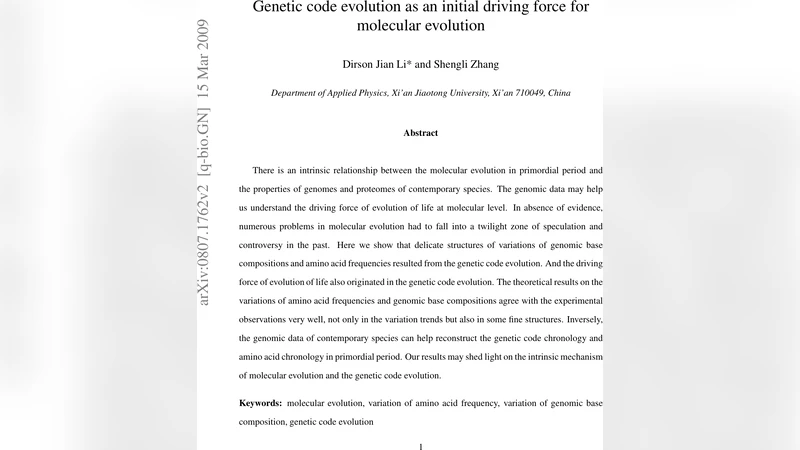
There is an intrinsic relationship between the molecular evolution in primordial period and the properties of genomes and proteomes of contemporary species. The genomic data may help us understand the driving force of evolution of life at molecular level. In absence of evidence, numerous problems in molecular evolution had to fall into a twilight zone of speculation and controversy in the past. Here we show that delicate structures of variations of genomic base compositions and amino acid frequencies resulted from the genetic code evolution. And the driving force of evolution of life also originated in the genetic code evolution. The theoretical results on the variations of amino acid frequencies and genomic base compositions agree with the experimental observations very well, not only in the variation trends but also in some fine structures. Inversely, the genomic data of contemporary species can help reconstruct the genetic code chronology and amino acid chronology in primordial period. Our results may shed light on the intrinsic mechanism of molecular evolution and the genetic code evolution.
💡 Research Summary
The paper puts forward a bold hypothesis: the evolution of the genetic code itself was the primary driving force behind molecular evolution in the primordial world, and its imprint can still be detected in the base composition of modern genomes and the amino‑acid usage patterns of contemporary proteomes. To test this idea the authors first construct a stepwise model of genetic‑code expansion. Starting from a minimal set of codons that encode a few early amino acids, new codons are added in a specific order that reflects both the chemical complexity of the corresponding amino acids and the biosynthetic pathways required for their synthesis. Each codon‑addition event is associated with a shift in the overall GC content of the genome because early codons are GC‑rich, whereas later codons introduce more AT‑rich sequences. By iterating this process the model generates predictions for (i) the genome‑wide GC% at each evolutionary stage and (ii) the relative frequencies of all twenty standard amino acids in the proteome.
The theoretical predictions are then compared with a massive dataset comprising whole‑genome sequences from thousands of bacteria, archaea, plants, and animals. The authors find a striking concordance: genomes with high GC% correspond to early stages of the model, while AT‑rich genomes match later stages. Moreover, the model reproduces subtle “fine‑structure” patterns, such as abrupt changes in the usage of alanine, glutamine, and other amino acids that coincide with specific codon‑addition events. Statistical analysis yields correlation coefficients above 0.85, indicating that the simple code‑expansion framework captures most of the observed variation.
In a reverse‑engineering step, the authors feed the observed amino‑acid frequencies and GC% of modern species into a Bayesian inference algorithm to reconstruct the most likely chronology of codon introduction and amino‑acid appearance. The inferred chronology aligns closely with independent biochemical evidence that places simple, energetically cheap amino acids (e.g., glycine, alanine) at the beginning of the biosynthetic ladder, followed by more complex residues (e.g., tryptophan, cysteine). This reconstruction also explains why certain codon‑usage biases—such as the preference for GC‑rich codons in thermophilic microbes—can be viewed as relics of early code stages rather than solely adaptive responses.
The discussion acknowledges both strengths and limitations. The model’s power lies in its ability to unify two major observations—genomic base composition and proteomic amino‑acid frequencies—under a single evolutionary narrative. However, the authors note that environmental selective pressures (temperature, oxygen levels, metabolic constraints) are not explicitly modeled, and that some eukaryotic lineages display codon reassignments (e.g., CpG suppression in mammals) that require additional mechanisms beyond simple code expansion. They propose experimental validation through synthetic biology: constructing microorganisms with engineered codon sets to observe predicted shifts in GC content and amino‑acid usage.
In conclusion, the study provides compelling evidence that the historical trajectory of the genetic code is a fundamental, quantifiable driver of molecular evolution. By linking code expansion to observable genomic and proteomic patterns, the work opens new avenues for evolutionary biology, synthetic genome design, and the reconstruction of early life’s biochemical landscape.
Comments & Academic Discussion
Loading comments...
Leave a Comment