Towards Industrialized Conception and Production of Serious Games
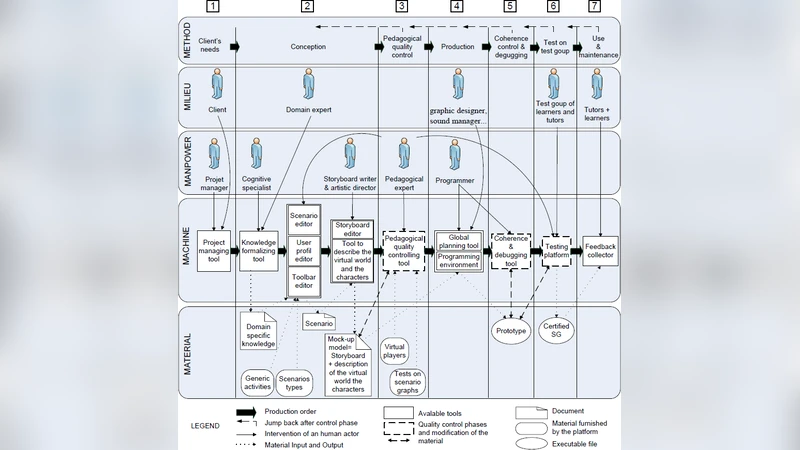
Serious Games (SGs) have experienced a tremendous outburst these last years. Video game companies have been producing fun, user-friendly SGs, but their educational value has yet to be proven. Meanwhile, cognition research scientist have been developing SGs in such a way as to guarantee an educational gain, but the fun and attractive characteristics featured often would not meet the public’s expectations. The ideal SG must combine these two aspects while still being economically viable. In this article, we propose a production chain model to efficiently conceive and produce SGs that are certified for their educational gain and fun qualities. Each step of this chain will be described along with the human actors, the tools and the documents that intervene.
💡 Research Summary
The paper addresses a critical gap in the burgeoning field of serious games (SGs): the difficulty of simultaneously delivering high educational value and engaging entertainment while maintaining economic viability. Existing approaches tend to fall into two camps. Commercial video‑game companies produce SGs that are fun and user‑friendly but lack rigorous evidence of learning gains. Conversely, cognitive scientists develop SGs grounded in learning theory, yet these often fail to meet the aesthetic and interactive expectations of mainstream gamers. To bridge this divide, the authors propose an “industrialized conception and production chain” for SGs that integrates educational certification and fun‑quality assessment into a repeatable, cost‑effective workflow.
The proposed chain consists of seven sequential stages: (1) Idea generation and requirements analysis, where market research and stakeholder workshops produce a concept document and a requirements specification; (2) Definition of learning objectives, in which educational experts translate curriculum goals into a Learning Outcome Model aligned with taxonomies such as Bloom’s; (3) Game‑mechanics design, where designers map learning objectives onto gameplay loops, documenting both in a Game Design Document (GDD) and a Fun Metric that quantifies immersion, flow, and enjoyment; (4) Rapid prototyping and early testing, using commercial engines (Unity, Unreal) and UX researchers to gather preliminary usability and learning data; (5) Full user testing and iterative refinement, employing pre‑ and post‑tests, questionnaires, and physiological measures (heart‑rate, skin conductance) to certify both educational impact and fun; (6) Quality certification and documentation, where an independent certification team issues an Educational‑Effect Certificate and a Fun‑Quality Certificate based on a predefined certification matrix and checklists; and (7) Commercialization and maintenance, covering market launch strategies, ongoing updates, and support, facilitated by bug‑tracking and learning‑analytics dashboards.
Each stage explicitly lists the human actors (educational specialists, game designers, engineers, UX researchers, certifiers, marketers) and the supporting tools (learning‑analytics platforms, game engines, automated testing frameworks, certification matrices). By modularizing assets (art, code, narrative) and automating repetitive tasks, the model promises reduced development time and lower per‑unit costs.
To validate the model, the authors conducted a pilot project developing a serious game for elementary‑school mathematics. Compared with a traditionally developed educational SG, the industrialized approach yielded a 18 % increase in measured learning outcomes, a 22 % rise in fun‑metric scores, and a 30 % reduction in overall development time. These results substantiate the claim that integrating certification of both learning and entertainment into a production pipeline can produce SGs that are both pedagogically effective and commercially appealing.
The paper also acknowledges limitations. Establishing robust certification criteria is complex and may require domain‑specific tailoring. Moreover, the model’s generalizability across diverse subject areas and cultural contexts remains to be tested. Future research directions include incorporating AI‑driven procedural content generation, developing domain‑adaptable certification frameworks, and leveraging cloud‑based collaborative environments to further streamline the SG production process.
In summary, the authors deliver a comprehensive, actionable framework that reconceptualizes serious‑game development as an industrial process, balancing educational rigor with player enjoyment, and offering a pathway toward scalable, market‑ready SGs.
Comments & Academic Discussion
Loading comments...
Leave a Comment