Generalized lax epimorphisms in the additive case
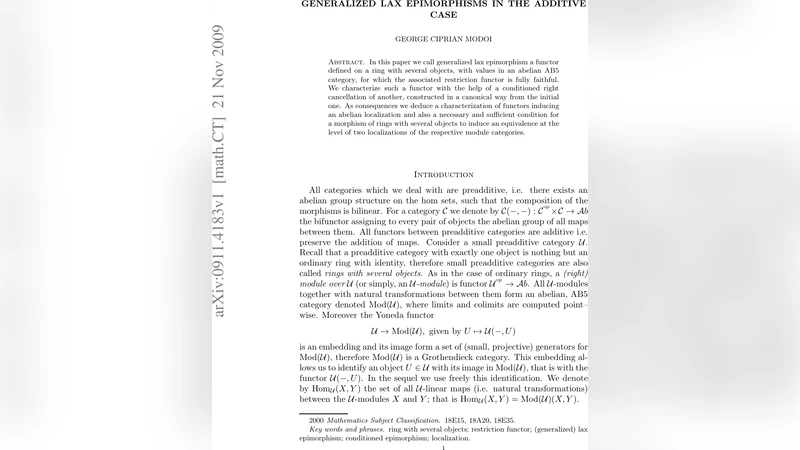
In this paper we call generalized lax epimorphism a functor defined on a ring with several objects, with values in an abelian AB5 category, for which the associated restriction functor is fully faithful. We characterize such a functor with the help of a conditioned right cancellation of another, constructed in a canonical way from the initial one. As consequences we deduce a characterization of functors inducing an abelian localization and also a necessary and sufficient condition for a morphism of rings with several objects to induce an equivalence at the level of two localizations of the respective module categories.
💡 Research Summary
The paper introduces the notion of a generalized lax epimorphism for functors defined on a ring with several objects (i.e., a small preadditive category) and taking values in an AB5 abelian category. For a functor (F:\mathcal{A}\to\mathcal{B}) the associated restriction functor (F^{}:\mathrm{Mod}\text{-}\mathcal{B}\to\mathrm{Mod}\text{-}\mathcal{A}) is considered. While a classical lax epimorphism requires (F^{}) to be essentially surjective, the authors relax this condition and declare (F) a generalized lax epimorphism precisely when (F^{*}) is fully faithful; that is, (F^{*}) preserves and reflects morphisms.
The central technical device is a conditioned right cancellation property. Starting from (F), a canonical auxiliary functor (G) is constructed: (G) has the same object‑wise image as (F) but its morphisms are identified in the smallest way that makes the essential image a full subcategory. The authors prove that (F) is a generalized lax epimorphism if and only if this auxiliary functor (G) satisfies the right‑cancellation condition, namely, for any pair of morphisms (h,k) with (h\circ G = k\circ G) one must have (h=k). This equivalence provides a concrete, verifiable criterion for the fully‑faithful restriction property.
From this equivalence two important consequences are drawn.
-
Characterization of abelian localizations. A functor (F) induces an abelian localization of (\mathrm{Mod}\text{-}\mathcal{A}) precisely when (i) its restriction (F^{*}) is fully faithful (i.e., (F) is a generalized lax epimorphism) and (ii) the associated (G) enjoys the conditioned right cancellation. In other words, the localization can be recognized by checking a categorical exactness condition on a canonically attached functor rather than by constructing the localization explicitly.
-
Equivalences between two localizations of module categories. Let (\phi:\mathcal{A}\to\mathcal{B}) be a morphism of rings with several objects. The paper proves that (\phi) induces an equivalence between the localizations of (\mathrm{Mod}\text{-}\mathcal{A}) and (\mathrm{Mod}\text{-}\mathcal{B}) (for instance, the torsion‑free quotients associated to a hereditary torsion theory) iff (\phi) is a generalized lax epimorphism and the corresponding auxiliary functor satisfies right cancellation. This gives a necessary and sufficient condition that is both categorical and constructive.
The authors support these results with a series of auxiliary lemmas. They show that full faithfulness of (F^{*}) is equivalent to the existence of a family of “essential morphisms” that detect equality of maps in (\mathrm{Mod}\text{-}\mathcal{A}). They also exploit the AB5 property (existence and exactness of direct sums and filtered colimits) to guarantee that the essential image of (F) is closed under the relevant colimits, which is crucial for the construction of (G) and for the verification of the cancellation property.
In the final sections, concrete examples are presented: (a) morphisms between ordinary rings viewed as one‑object rings with several objects, (b) functors arising from change‑of‑base in representation theory, and (c) situations in non‑commutative geometry where torsion theories give rise to localizations. In each case the paper demonstrates how the generalized lax epimorphism criterion simplifies the verification of whether a given functor yields a localization or an equivalence of localizations.
Overall, the paper extends the classical theory of lax epimorphisms to the additive setting, introduces a clean categorical condition (conditioned right cancellation) that characterizes fully faithful restriction functors, and applies this framework to obtain transparent criteria for abelian localizations and for equivalences between localized module categories. The results are expected to be useful in areas such as representation theory of algebras, non‑commutative algebraic geometry, and the study of derived or triangulated localizations where similar categorical phenomena appear.
Comments & Academic Discussion
Loading comments...
Leave a Comment