Symplectic Categories
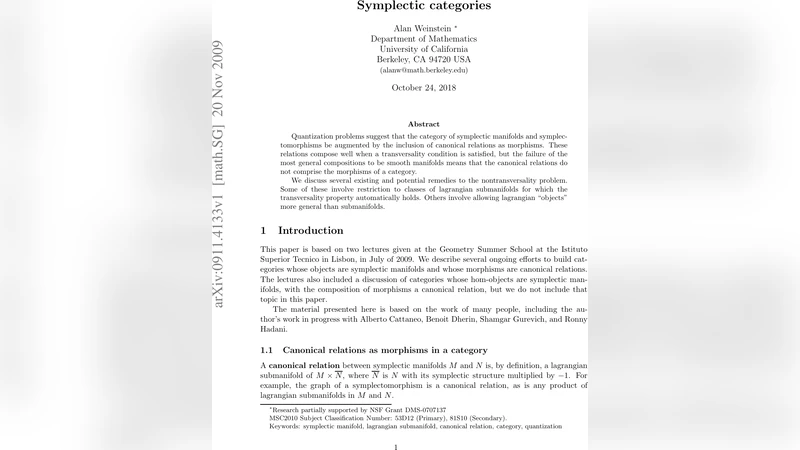
Quantization problems suggest that the category of symplectic manifolds and symplectomorphisms be augmented by the inclusion of canonical relations as morphisms. These relations compose well when a transversality condition is satisfied, but the failure of the most general compositions to be smooth manifolds means that the canonical relations do not comprise the morphisms of a category. We discuss several existing and potential remedies to the nontransversality problem. Some of these involve restriction to classes of lagrangian submanifolds for which the transversality property automatically holds. Others involve allowing lagrangian “objects” more general than submanifolds.
💡 Research Summary
The paper addresses a fundamental obstacle in extending the category of symplectic manifolds beyond symplectomorphisms to include canonical relations as morphisms—a move motivated by problems in geometric quantization. A canonical relation between two symplectic manifolds (M, ω) and (N, η) is a Lagrangian submanifold L ⊂ M⁻ × N, where M⁻ denotes M equipped with the opposite symplectic form. Such relations naturally encode state‑space transformations that are not functions, making them attractive candidates for morphisms in a “symplectic category.”
The central technical issue is composition. Given L₁ ⊂ M⁻ × N and L₂ ⊂ N⁻ × P, their composition is defined as
L₁ ∘ L₂ = π_{MP}(L₁ ×_N L₂),
where L₁ ×N L₂ is the fiber product over N and π{MP} projects to M × P. For the result to be a smooth Lagrangian submanifold (hence a legitimate morphism), the fiber product must be a smooth manifold of the expected dimension. This smoothness is guaranteed precisely when L₁ and L₂ intersect transversely in N. If transversality fails, the fiber product can acquire singularities, and the composition ceases to be defined within the original class of objects, breaking the closure and associativity required for a category.
The authors survey several strategies to overcome this “non‑transversality” problem:
-
Restrict to classes where transversality is automatic.
- Graphs of symplectomorphisms are always transverse, yielding a subcategory equivalent to the classical one.
- “Clean” Lagrangians, i.e., those whose intersections are themselves smooth manifolds of the correct dimension, also guarantee well‑behaved composition.
- Introducing auxiliary data (weights, micro‑local structures) can sometimes “regularize” a non‑transverse intersection, effectively perturbing the situation into a transverse one.
-
Enlarge the notion of objects and morphisms.
- Replace manifolds by Lagrangian stacks or derived symplectic spaces. In this higher‑geometric setting, a non‑transverse fiber product is interpreted as a derived intersection, which remains a well‑defined object in the derived category.
- Adopt a 2‑category or ∞‑category perspective: canonical relations become 1‑morphisms, while homotopies between different ways of composing them become 2‑morphisms. The associativity law then holds up to coherent homotopy rather than strictly.
-
Relax transversality up to homotopy.
- One may accept that L₁ and L₂ are not transverse but are homotopic through a family of Lagrangians that become transverse. The composition is then defined only up to homotopy equivalence. This approach aligns with the “pruned” or “Cauchy–Riemann” techniques used in Floer theory and allows one to keep track of obstruction classes.
-
Algebraic or categorical alternatives.
- Treat canonical relations as multi‑valued morphisms, leading to a multicategory structure where composition is a set‑valued operation.
- Shift the underlying geometric framework (e.g., to Poisson or Dirac structures) where the composition law can be reformulated without requiring strict transversality.
Each approach has trade‑offs. Restricting to transverse classes preserves the simplicity of ordinary categories but excludes many physically relevant transformations. Enlarging the object class yields a mathematically robust theory (derived symplectic geometry, stacks) but introduces substantial technical overhead and moves the discussion into the realm of higher category theory. Homotopy‑relaxed compositions are flexible and compatible with modern Floer‑theoretic techniques, yet they sacrifice strict associativity and demand careful bookkeeping of higher homotopies. Algebraic alternatives avoid geometric singularities at the cost of departing from the intuitive picture of Lagrangian submanifolds.
The authors conclude that no single remedy solves the problem universally; instead, a pragmatic combination of restrictions, higher‑geometric extensions, and homotopical relaxations is advisable, depending on the intended application—whether it be deformation quantization, topological field theory, or symplectic topology. This nuanced stance provides a roadmap for researchers seeking a categorical framework that faithfully captures the richness of canonical relations while remaining mathematically coherent.
Comments & Academic Discussion
Loading comments...
Leave a Comment