Statistical physics of cerebral embolization leading to stroke
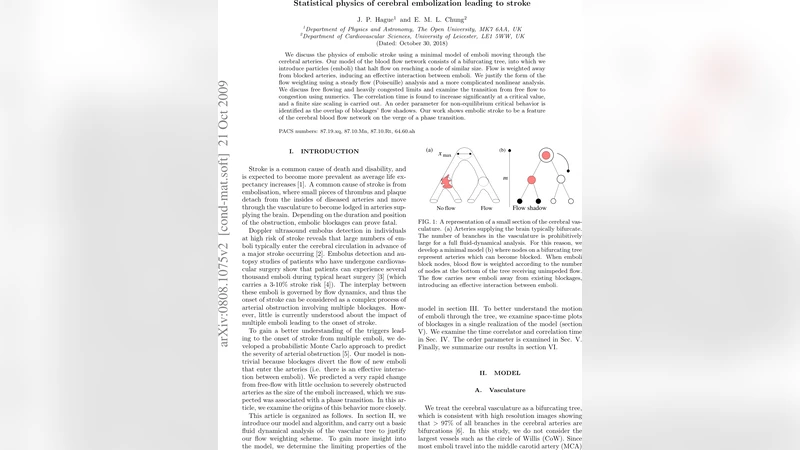
We discuss the physics of embolic stroke using a minimal model of emboli moving through the cerebral arteries. Our model of the blood flow network consists of a bifurcating tree, into which we introduce particles (emboli) that halt flow on reaching a node of similar size. Flow is weighted away from blocked arteries, inducing an effective interaction between emboli. We justify the form of the flow weighting using a steady flow (Poiseuille) analysis and a more complicated nonlinear analysis. We discuss free flowing and heavily congested limits and examine the transition from free flow to congestion using numerics. The correlation time is found to increase significantly at a critical value, and a finite size scaling is carried out. An order parameter for non-equilibrium critical behavior is identified as the overlap of blockages’ flow shadows. Our work shows embolic stroke to be a feature of the cerebral blood flow network on the verge of a phase transition.
💡 Research Summary
The authors present a minimalist yet physically grounded model to explore how emboli traveling through the cerebral arterial tree can precipitate an acute ischemic stroke. The vascular network is represented as a binary branching tree in which each successive level has a smaller vessel diameter, mimicking the tapering of real cerebral arteries. Emboli are introduced at a prescribed rate and possess a characteristic size; when an embolus encounters a node whose diameter is comparable to its own, it occludes that node completely, thereby cutting off flow to all downstream branches. This occlusion creates a “flow shadow” – a region of the network that no longer carries blood.
To capture the redistribution of blood after a blockage, the authors weight the flow away from occluded branches. They first derive the weighting function from a linear Poiseuille analysis, showing that pressure drops scale with the inverse fourth power of vessel radius. Recognizing that real cerebral flow is nonlinear, they also perform a more sophisticated nonlinear analysis, confirming that the same qualitative weighting emerges. Consequently, each embolus not only blocks a single node but also indirectly influences the trajectories of subsequent emboli by altering the pressure field throughout the tree.
The dynamics are explored across two limiting regimes. In the “free‑flow” regime, emboli are sparse, blockages are isolated, and the overall hydraulic resistance of the tree changes only modestly. In the “congested” regime, the emboli production rate exceeds a critical threshold; blockages begin to overlap, their flow shadows intersect, and the system exhibits a dramatic slowdown in relaxation – the correlation time grows sharply. To quantify this transition, the authors introduce an order parameter Ψ defined as the fraction of the network occupied by overlapping flow shadows. Near the critical point Ψ jumps from zero to a finite value, mirroring the behavior of an order parameter in equilibrium phase transitions.
Finite‑size scaling analysis is performed by varying the depth of the binary tree, allowing the extraction of critical exponents that characterize the non‑equilibrium transition. The scaling collapse of Ψ and the divergence of the correlation time provide strong evidence that the embolic stroke phenomenon can be viewed as a network‑level phase transition poised at the edge of criticality.
The study’s key insight is that the cerebral arterial network, by virtue of its branching geometry and the physics of low‑Reynolds‑number flow, is intrinsically close to a percolation‑like threshold. Small changes in embolus generation (e.g., due to atrial fibrillation or plaque rupture) can tip the system from a regime of isolated, clinically silent occlusions to one where overlapping blockages produce a rapid, system‑wide loss of perfusion – the hallmark of an embolic stroke. Although the model abstracts away many anatomical complexities (vascular tortuosity, pulsatile flow, active autoregulation), it establishes a clear, quantitative framework linking embolus dynamics to emergent, critical behavior in the cerebrovascular network. This framework could inform risk‑assessment tools, guide therapeutic strategies aimed at reducing embolus burden, and inspire further interdisciplinary work at the interface of statistical physics and neurovascular medicine.
Comments & Academic Discussion
Loading comments...
Leave a Comment