Internal Kleisli categories
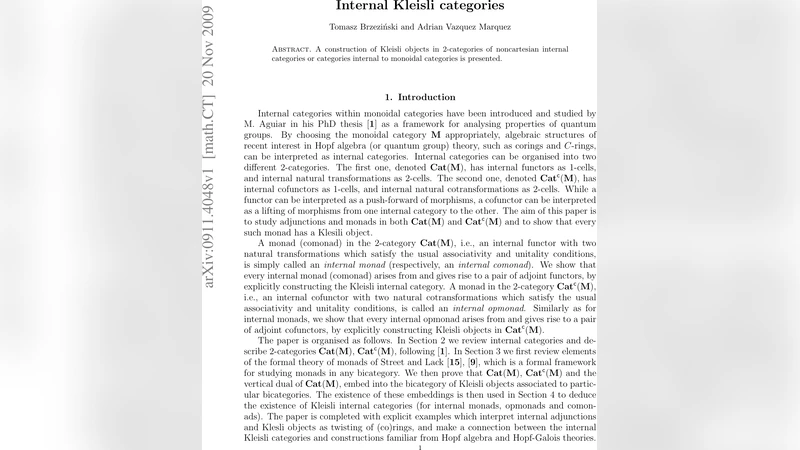
A construction of Kleisli objects in 2-categories of noncartesian internal categories or categories internal to monoidal categories is presented.
💡 Research Summary
The paper “Internal Kleisli Categories” addresses a fundamental limitation in the classical theory of Kleisli objects: the standard construction assumes that the underlying monoidal category is cartesian (typically Set or Cat). Many contemporary mathematical and computational contexts, however, involve monoidal structures that are not cartesian—such as tensor products of vector spaces, probabilistic monads, or quantum‑mechanical Hilbert spaces. Moreover, one often works with categories that are themselves internal to a monoidal category, i.e., objects, morphisms, source, target, composition, and identities are all given as morphisms in a base monoidal category 𝔙. The author’s goal is to develop a unified framework that produces Kleisli objects for monads living in these more general 2‑categories of internal categories.
The paper proceeds in four main stages.
-
Background and Motivation
The author reviews the classical Kleisli construction for a monad (T, μ, η) on a cartesian monoidal category and explains why the cartesian property is crucial in the usual proofs (e.g., the existence of pullbacks, the ability to form product projections, and the naturality of the unit). He then motivates the need for a non‑cartesian analogue by citing examples from linear algebra (tensor product of vector spaces), probability theory (convolution monads), and quantum information (tensor product of Hilbert spaces). In each case, the ambient monoidal category lacks cartesian products, and internal categories—categories whose data live inside 𝔙—provide a natural setting for modeling structures such as linear categories, stochastic processes, or quantum channels. -
Internal Categories and Internal Monads
The paper defines a 𝔙‑internal category C as a sextuple (C₀, C₁, s, t, m, e) where C₀ (objects) and C₁ (arrows) are objects of 𝔙, and the source, target, composition, and identity maps are morphisms in 𝔙 satisfying the usual associativity and unit axioms expressed internally. A 𝔙‑internal functor is a pair of 𝔙‑morphisms preserving this structure, and a 𝔙‑internal natural transformation is a 2‑cell in the resulting 2‑category IntCat(𝔙). An internal monad (T, μ, η) on C consists of an internal endofunctor T: C → C together with internal 2‑cells μ: TT ⇒ T and η: Id ⇒ T satisfying the standard monad equations, now interpreted as equalities of 2‑cells in IntCat(𝔙). -
Construction of the Internal Kleisli Object
The core contribution is a systematic recipe for building a Kleisli object Kl(T) inside the 2‑category IntCat(𝔙) (or its non‑cartesian variant IntCatₙ(𝔙)). The construction mirrors the classical one but replaces external set‑theoretic constructions with internal ones:- Objects: The objects of Kl(T) are exactly those of C.
- Morphisms: A morphism X → Y in Kl(T) is an equivalence class of internal arrows f: X → T Y in C, where two arrows are identified if there exists an internal 2‑cell making the appropriate diagram commute. These are called T‑algebraic arrows.
- Composition: Given f: X → T Y and g: Y → T Z, their composite is defined by the internal diagram
X ─f→ T Y ─T g→ T T Z ─μ_Z→ T Z,
where μ_Z is the component of the multiplication 2‑cell. The associativity of this composition follows from the associativity of μ and the coherence of the internal monoidal structure. - Identities: The identity on X is η_X: X → T X, the unit component of the monad, regarded as a T‑algebraic arrow.
In the non‑cartesian setting, the tensor product ⊗ of 𝔙 does not provide a symmetry, so the author introduces an internal braiding σ: X ⊗ Y → Y ⊗ X that exists only at the level of 2‑cells. This σ is required to satisfy the usual hexagon identities relative to μ and η, ensuring that the composition defined above is well‑behaved even without a global symmetry. The paper proves that with these additional coherence conditions, Kl(T) is indeed a well‑defined internal category.
The main theorems are:
- Theorem 3.7 (Cartesian case): For any internal monad (T, μ, η) on a 𝔙‑internal category C, the constructed Kl(T) is a Kleisli object in IntCat(𝔙). Moreover, for every internal T‑algebra (i.e., an internal functor F: C → D equipped with a compatible action), there exists a unique internal functor (\bar{F}: Kl(T) → D) making the usual universal diagram commute.
- Theorem 4.2 (Non‑cartesian case): The same universal property holds in IntCatₙ(𝔙) provided that a suitable internal braiding σ exists and satisfies the coherence equations listed in Section 4.1.
The proofs are carried out by explicit diagrammatic calculations in the internal language of 𝔙, making heavy use of the string‑diagram calculus for monoidal categories. The author shows that the universal property of Kl(T) can be expressed as an adjunction between the forgetful 2‑functor from T‑algebras to internal functors and the free‑Kleisli construction.
-
Examples and Applications
The paper concludes with three illustrative families of examples:-
Linear categories: Take 𝔙 = (Vectₖ, ⊗, k) where ⊗ is the usual tensor product of vector spaces. An internal category is a linear category (objects are vector spaces, hom‑spaces are vector spaces, composition is bilinear). A monad T may be the “free associative algebra” monad, sending a vector space V to the tensor algebra T(V) = ⊕ₙ V^{⊗ n}. The internal Kleisli category Kl(T) then encodes linear maps into tensor algebras, providing a categorical framework for universal enveloping algebras and for modeling linear effects in functional programming languages.
-
Probabilistic monads: Let 𝔙 be the category of measurable spaces equipped with the convolution monoidal structure (product of probability measures). Internal categories model stochastic processes, and a monad T can be the “distribution” monad assigning to each space X the space of probability measures on X. Kl(T) captures stochastic kernels as morphisms, and the construction recovers the classical Kleisli category of the Giry monad, but now internal to the measurable‑space setting, allowing for a more refined treatment of conditioning and disintegration.
-
Quantum channels: Choose 𝔙 as the category of finite‑dimensional Hilbert spaces with the tensor product. Internal categories correspond to categories of quantum operations (completely positive maps). A monad T may be the “environment‑extension” monad that tensors a system with a fixed ancillary space. The resulting Kl(T) gives a categorical description of quantum channels that have been extended by an environment, a construction useful in quantum programming language semantics and in the study of dilations.
These examples demonstrate that the internal Kleisli construction is not merely a theoretical curiosity but a versatile tool that unifies disparate domains under a common categorical umbrella.
-
-
Future Directions
The author outlines several promising research avenues: extending the theory to internal distributive laws and double monads, investigating the dual notion of internal co‑Kleisli categories (for comonads), and applying the framework to effect systems in functional programming languages, especially those that combine linear, probabilistic, and quantum effects. The paper also suggests exploring connections with higher‑dimensional category theory, such as (∞,2)‑categories of internal categories, where the internal Kleisli construction might admit a homotopical refinement.
In summary, the paper succeeds in generalising the Kleisli construction from the familiar cartesian setting to the far broader context of internal categories in arbitrary monoidal (including non‑cartesian) bases. By carefully internalising the monad axioms, introducing an appropriate braiding when needed, and proving the universal property in the 2‑categorical language, the author provides a robust and widely applicable framework. This work opens the door to systematic treatment of monadic effects in linear algebra, probability, quantum theory, and beyond, and it lays a solid foundation for further categorical investigations of internal structures.
Comments & Academic Discussion
Loading comments...
Leave a Comment