Identifying the Obscured Black-Hole Growth Phase of Distant Massive Galaxies
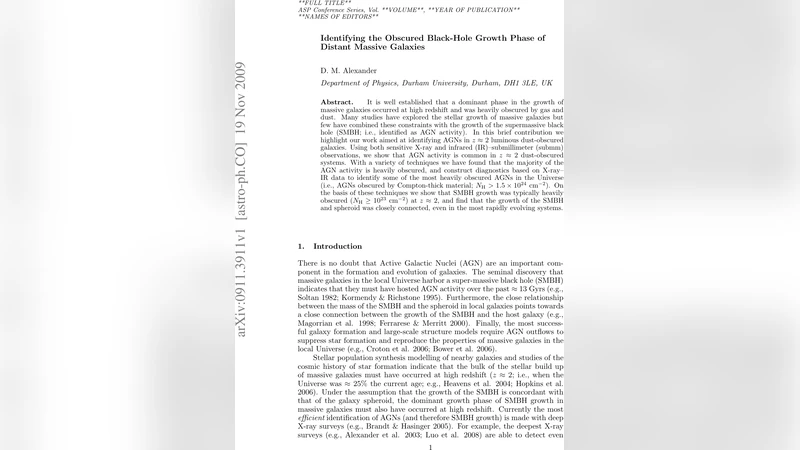
It is well established that a dominant phase in the growth of massive galaxies occurred at high redshift and was heavily obscured by gas and dust. Many studies have explored the stellar growth of massive galaxies but few have combined these constraints with the growth of the supermassive black hole (SMBH; i.e., identified as AGN activity). In this brief contribution we highlight our work aimed at identifying AGNs in z2 luminous dust-obscured galaxies. Using both sensitive X-ray and infrared (IR)-submillimeter (submm) observations, we show that AGN activity is common in z2 dust-obscured systems. With a variety of techniques we have found that the majority of the AGN activity is heavily obscured, and construct diagnostics based on X-ray-IR data to identify some of the most heavily obscured AGNs in the Universe (i.e., AGNs obscured by Compton-thick material; N_H>1.5x10^24 cm^-2). On the basis of these techniques we show that SMBH growth was typically heavily obscured (N_H>10^23 cm^-2) at z~2, and find that the growth of the SMBH and spheroid was closely connected, even in the most rapidly evolving systems.
💡 Research Summary
The paper addresses a critical gap in our understanding of massive galaxy evolution at the epoch of peak cosmic activity (redshift ≈ 2), a period known to be heavily shrouded by gas and dust. While numerous studies have quantified stellar mass assembly during this era, relatively few have simultaneously traced the growth of the central supermassive black holes (SMBHs) that manifest as active galactic nuclei (AGN). To bridge this gap, the authors combine deep X‑ray observations with extensive infrared–submillimeter (IR‑submm) data to identify AGN within a sample of luminous, dust‑obscured galaxies (often referred to as “dust‑obscured galaxies” or DOGs) at z ≈ 2.
The methodology proceeds in several stages. First, the authors select a parent sample based on extreme mid‑IR to optical flux ratios, ensuring that the objects are heavily dust‑enshrouded and thus invisible or faint in optical surveys. Next, they exploit the penetrating power of hard X‑ray photons (2–10 keV) obtained from Chandra and XMM‑Newton deep fields to search for high‑energy signatures of accretion. By measuring the X‑ray hardness ratio (the relative strength of hard versus soft X‑ray bands) they estimate the line‑of‑sight column density (N_H) for each source. A high hardness ratio indicates substantial absorption, with N_H > 10^23 cm⁻² signifying heavily obscured AGN and N_H > 1.5 × 10^24 cm⁻² defining the Compton‑thick regime.
In parallel, the authors construct full IR‑submm spectral energy distributions (SEDs) using data from Spitzer, Herschel, and ALMA. By fitting these SEDs with a combination of star‑formation‑heated dust templates and an AGN torus component, they isolate the AGN contribution to the total IR luminosity (L_IR). Mid‑IR colour diagnostics (e.g., the 8 µm/4.5 µm ratio) further help to separate AGN‑dominated sources from pure star‑forming galaxies.
The key innovation of the study is a composite X‑ray–IR diagnostic that flags the most heavily buried AGN. The authors demonstrate that sources with a low X‑ray‑to‑IR luminosity ratio (L_X/L_IR) relative to the expectation for unobscured AGN are excellent Compton‑thick candidates. This approach captures objects that would be missed by X‑ray surveys alone because their X‑ray flux is suppressed below detection thresholds.
Applying these techniques, the authors find that more than half of the dust‑obscured galaxy sample exhibits detectable X‑ray emission, and the majority of those detections correspond to column densities exceeding 10^23 cm⁻². Approximately 10 % of the sample meets the stringent criteria for Compton‑thick obscuration. For sources lacking individual X‑ray detections, stacking analyses reveal an average N_H still in the heavily obscured regime, confirming that the non‑detections are not simply low‑luminosity AGN but are instead deeply buried.
These results have profound implications. First, they suggest that SMBH growth at z ≈ 2 is predominantly obscured, implying that census studies based solely on X‑ray or optical signatures severely underestimate the true accretion budget at this epoch. Second, the tight correlation between the inferred SMBH accretion rates (from the AGN component of the IR SED) and the host galaxy star‑formation rates indicates a close co‑evolution of black holes and their spheroids, even in the most rapidly evolving, dust‑rich systems. The authors argue that this co‑evolution is likely driven by large‑scale gas inflows, possibly triggered by major mergers, which simultaneously fuel star formation and black‑hole accretion while also providing the dense obscuring medium.
Finally, the paper highlights the future potential of the presented diagnostic framework. With upcoming facilities such as JWST, Athena, and the next generation of sub‑mm interferometers, the combined X‑ray–IR approach can be refined to identify the hidden AGN population across a broader redshift range and to quantify their contribution to the cosmic X‑ray background. In sum, the study provides compelling evidence that the most vigorous phase of SMBH growth in massive galaxies is hidden behind thick veils of gas and dust, and that this obscured growth is intimately linked to the assembly of the host galaxy’s stellar mass.
Comments & Academic Discussion
Loading comments...
Leave a Comment