Improved Approximation for the Number of Hamiltonian Cycles in Dense Digraphs
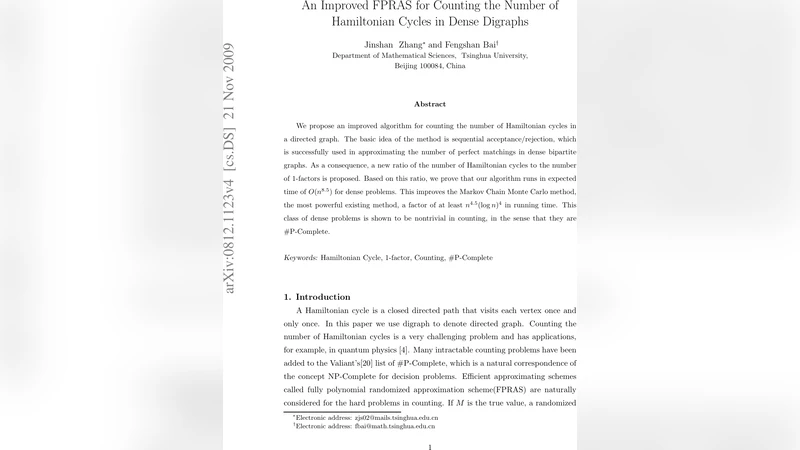
We propose an improved algorithm for counting the number of Hamiltonian cycles in a directed graph. The basic idea of the method is sequential acceptance/rejection, which is successfully used in approximating the number of perfect matchings in dense bipartite graphs. As a consequence, a new bound on the number of Hamiltonian cycles in a directed graph is proved, by using the ratio of the number of 1-factors. Based on this bound, we prove that our algorithm runs in expected time of $O(n^{8.5})$ for dense problems. This improves the Markov chain method, the most powerful existing method, a factor of at least $n^{4.5}(\log n)^{4}$ in running time. This class of dense problems is shown to be nontrivial in counting, in the sense that it is $#$P-Complete.
💡 Research Summary
The paper presents a novel algorithm for approximating the number of Hamiltonian cycles in dense directed graphs, achieving a substantial improvement over the best previously known methods. The authors adapt the sequential acceptance‑rejection technique—originally successful for counting perfect matchings in dense bipartite graphs—to the setting of directed Hamiltonian cycles. Their approach hinges on a new relationship between the number of 1‑factors (directed 1‑regular subgraphs covering all vertices) and the number of Hamiltonian cycles.
First, the authors establish a tight bound that links the two quantities. For a dense digraph (G) with minimum in‑ and out‑degree at least (\alpha n) (where (\alpha) is a constant), they prove
\
Comments & Academic Discussion
Loading comments...
Leave a Comment