Quantum information processing at the cellular level. Euclidean approach
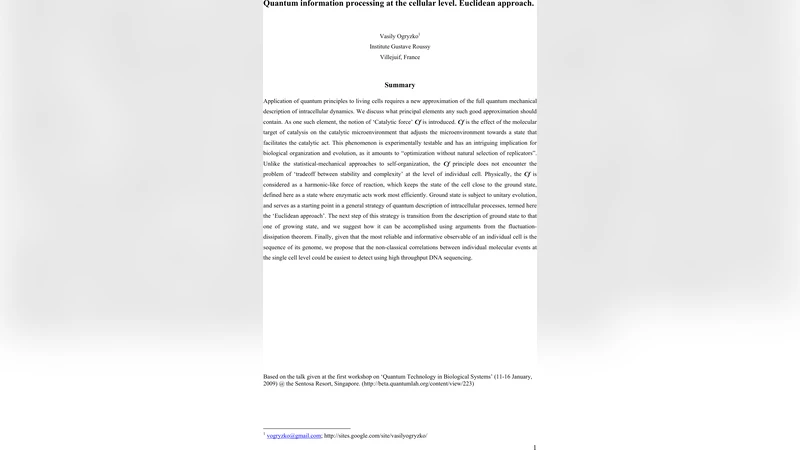
Application of quantum principles to living cells requires a new approximation of the full quantum mechanical description of intracellular dynamics. We discuss what principal elements any such good approximation should contain. As one such element, the notion of “Catalytic force” Cf is introduced. Cf is the effect of the molecular target of catalysis on the catalytic microenvironment that adjusts the microenvironment towards a state that facilitates the catalytic act. This phenomenon is experimentally testable and has an intriguing implication for biological organization and evolution, as it amounts to “optimization without natural selection of replicators”. Unlike the statistical-mechanical approaches to self-organization, the Cf principle does not encounter the problem of “tradeoff between stability and complexity” at the level of individual cell. Physically, the Cf is considered as a harmonic-like force of reaction, which keeps the state of the cell close to the ground state, defined here as a state where enzymatic acts work most efficiently. Ground state is subject to unitary evolution, and serves as a starting point in a general strategy of quantum description of intracellular processes, termed here “Euclidean approach”. The next step of this strategy is transition from the description of ground state to that one of growing state, and we suggest how it can be accomplished using arguments from the fluctuation-dissipation theorem. Finally, given that the most reliable and informative observable of an individual cell is the sequence of its genome, we propose that the non-classical correlations between individual molecular events at the single cell level could be easiest to detect using high throughput DNA sequencing.
💡 Research Summary
The paper proposes a novel framework for describing intracellular dynamics using quantum mechanical concepts, arguing that classical and statistical‑mechanical models are insufficient to capture the full complexity of living cells. Central to the authors’ proposal is the introduction of a “catalytic force” (Cf), a reciprocal interaction whereby the molecular target of a catalytic reaction influences its surrounding microenvironment, nudging it toward a configuration that maximizes catalytic efficiency. Unlike conventional forces that act unidirectionally from enzyme to substrate, Cf is modeled as a harmonic‑like restoring force (analogous to F = –k·x) that keeps the system near a “ground state” – defined as the cellular configuration in which enzymatic processes operate at minimal free energy and maximal coherence.
The ground state is treated as a quantum reference point that evolves unitarily under the Schrödinger equation. The authors term the overall strategy the “Euclidean approach,” because the cellular wavefunction is envisioned as a point in a high‑dimensional Euclidean space whose dynamics are governed by unitary operators. To describe how a cell departs from this optimal ground state during growth, differentiation, or environmental perturbation, the paper invokes the fluctuation‑dissipation theorem (FDT). According to the FDT, microscopic quantum fluctuations (e.g., tunneling events, vibrational mode shifts, transient entanglement) generate a dissipative response that is precisely counterbalanced by the catalytic force, thereby guiding the cell along a low‑energy trajectory toward a new quasi‑steady state. This mechanism constitutes a form of “optimization without natural selection,” where the system self‑organizes toward efficiency without requiring population‑level evolutionary pressure.
A key strength of the work is its concrete experimental proposal. The authors suggest that the most accessible, high‑information observable of a single cell is its genomic sequence. By performing high‑throughput, single‑cell DNA sequencing over time, one can detect non‑classical correlations manifested as anomalous mutation patterns, transcriptional noise, or epigenetic marks that deviate from purely stochastic expectations. Such “quantum signatures” would reflect the underlying Cf‑mediated coordination of molecular events. The paper outlines statistical pipelines for extracting these signatures, emphasizing the need for temporal resolution and large sample sizes to distinguish genuine quantum‑induced correlations from conventional biochemical noise.
In summary, the manuscript offers a coherent theoretical construct that integrates quantum harmonic forces, unitary ground‑state evolution, and fluctuation‑dissipation dynamics to explain intracellular organization. It challenges the prevailing view that biological complexity inevitably entails a trade‑off between stability and adaptability, proposing instead that a quantum‑driven catalytic force can maintain cells near an optimal ground state while still permitting growth and adaptation. If experimentally validated through single‑cell sequencing or other high‑resolution techniques, this framework could reshape our understanding of cellular self‑organization, bridging quantum physics and molecular biology in a way that may open new avenues for synthetic biology, quantum‑based therapeutics, and the study of evolution beyond classical Darwinian mechanisms.
Comments & Academic Discussion
Loading comments...
Leave a Comment