Hopf cyclic cohomology in braided monoidal categories
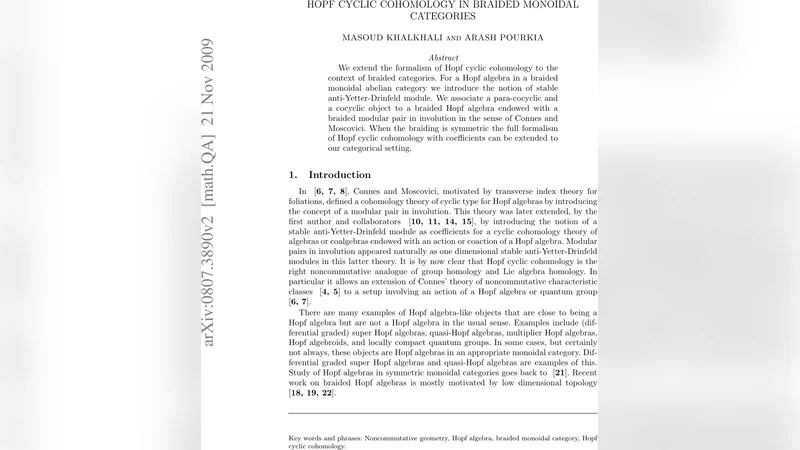
We extend the formalism of Hopf cyclic cohomology to the context of braided categories. For a Hopf algebra in a braided monoidal abelian category we introduce the notion of stable anti-Yetter-Drinfeld module. We associate a para-cocyclic and a cocyclic object to a braided Hopf algebra endowed with a braided modular pair in involution in the sense of Connes and Moscovici. When the braiding is symmetric the full formalism of Hopf cyclic cohomology with coefficients can be extended to our categorical setting.
💡 Research Summary
The paper extends the framework of Hopf cyclic cohomology, originally developed by Connes and Moscovici for Hopf algebras in the symmetric monoidal category of vector spaces, to the much broader setting of braided monoidal abelian categories. After recalling the basic notions of a braided monoidal category (\mathcal{C}) and the definition of a Hopf algebra (H) internal to (\mathcal{C}), the authors introduce a new class of coefficients: stable anti‑Yetter‑Drinfeld (SAYD) modules. A SAYD module is simultaneously an (H)‑module and an (H)‑comodule, but the usual compatibility conditions are twisted by the braiding (\beta). In addition, a “stability” requirement forces the braiding to act trivially on the module–comodule structure, guaranteeing that the cyclic operators will not be distorted by the non‑trivial interchange of tensor factors.
The second key ingredient is a braided modular pair in involution ((\delta,\sigma)). Here (\delta:H\to\mathbf{1}) is a character and (\sigma:\mathbf{1}\to H) a group‑like element satisfying (\delta\circ\sigma=\mathrm{id}) together with braiding‑adjusted compatibility relations with the Hopf structure. This pair generalizes the classical modular pair used in Connes‑Moscovici theory, adapting it to the presence of a non‑symmetric braiding.
With these data ((H,M,\delta,\sigma)) the authors construct a para‑cocyclic object \
Comments & Academic Discussion
Loading comments...
Leave a Comment